
From concept to product
From prototyping to production, our production sites can handle all your manufacturing projects.
Home / All / Injection Molding / What are the most common applications of overmolding in industrial product design?
What are the most common applications of overmolding in industrial product design?
The short answer
Overmolding is used for soft-touch grips on tools and appliances, sealed connectors and integrated gaskets, vibration-damping mounts, encapsulated electronics and dual-durometer parts. It replaces a glued or snap-fitted assembly with one bonded component, typically cutting assembly cost by around 30 percent and holding soft layers from 0.8 to 3 mm.
Six application families and what each one replaces
Overmolding is best understood as a substitution: it removes a separate part or a separate assembly step and replaces it with a layer that is moulded directly onto a substrate. That framing explains why the process appears in such different products. A soft grip replaces a stick-on pad or a separately moulded handle; a sealed connector replaces a discrete gasket; a vibration mount replaces a rubber isolator and its fasteners; an encapsulated board replaces a potted housing; and a dual-durometer part replaces two mouldings that would otherwise be joined by adhesive or ultrasonic welding. In each case the function is the same — a rigid structure with a soft or sealing layer that cannot come off — and the saving comes from deleting an operation rather than from the material.
The economics follow the same pattern. Every overmolded part removes between one and three secondary operations, so the case strengthens as the assembly it replaces becomes more complex and as volume rises. Below roughly 10,000 parts a year, a two-shot tool is hard to justify and a pick-and-place overmold, where a pre-moulded substrate is loaded into the second tool, is often the cheaper route. Above that band, a single two-shot cycle produces the finished part with no handling between shots, which is where the unit cost advantage becomes decisive.

Soft-touch grips and ergonomic handles
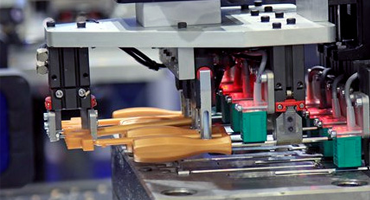
Grips are the most common overmolding application and the one most people have handled without knowing it. Power tools, hand tools, kitchen knives and utensils, toothbrushes, razors, sports equipment, luggage handles and personal-care devices all use a rigid substrate — usually ABS, polycarbonate, nylon or PP — with a TPE layer moulded over the grip area. The substrate carries the load and the threads; the elastomer supplies friction, comfort, impact absorption and, in many cases, insulation. Grip layers typically run 1.5 to 3 mm thick in a Shore A 40 to 60 grade, which is the band that reads as soft to the hand.
Three design figures make grips predictable. The soft layer should sit between 1.5 and 3.0 mm so it is thick enough to deflect but not so thick that it sinks or feels mushy. The transition from the coated grip to the bare substrate should be a moulded step rather than a feathered edge, because a grip that tapers to nothing peels from that point. And colour is usually specified one shade darker than the substrate, a convention borrowed from consumer electronics because the overmold hides wear and fingerprints better than a lighter colour does. Where two colours or two hardnesses are wanted, the same tool can run a multi-shot cycle and produce a two-tone grip without any post-mould decoration.
Sealed connectors, gaskets and strain relief
The second family uses the overmold as a seal rather than a surface. A connector body moulded in PA66 or PBT can be overmoulded with a TPE or TPV boot that both seals the cable entry and provides strain relief, which removes the separate grommet, the cable tie and the assembly step that a conventional connector needs. The same principle produces integrated gaskets in enclosures: a rigid housing is moulded first, then a TPE sealing bead is overmoulded along the joint line, so the seal is part of the housing and cannot be lost, mis-seated or left out on the line. Where the seal has to hold an ingress-protection rating, the overmold is what carries it, which is why bond integrity in this family is a functional requirement rather than a cosmetic one.
Strain relief is the quieter half of this family and the one with the clearest cost story. An overmoulded boot distributes bending over a defined length instead of concentrating it at the connector, which raises the number of flex cycles a cable survives and removes the manual steps of fitting a boot and a tie. Because the boot is moulded, its shape can be tuned to the bend radius the cable actually needs, and it can be made in the same shot as the sealing bead, so a single tool delivers both functions.

Vibration and noise damping
Damping applications use the overmold as a compliant interface between a vibrating source and a structure. A metal bracket with an overmoulded rubber mount isolates a pump or a motor from a panel; a gear with a soft overmoulded ring runs quieter than an all-plastic gear because the elastomer absorbs the contact noise that a rigid tooth pair would radiate. In industrial and automotive products the same idea appears as overmoulded bushings, grommets and bumpers. The design figures that matter here are the thickness and hardness of the compliant layer, since both set the natural frequency of the mount, and the bond strength, because a damped joint that delaminates becomes a rattle rather than an isolator.
Damping is also where the material choice narrows fastest. A thermoplastic elastomer overmold is comfortable in a temperature range up to about 90 degrees Celsius, so a mount near an engine, an oven or a sterilizer has to move to a silicone or a high-temperature vulcanizate. The service temperature, not the damping performance, usually decides which elastomer the part gets.
Encapsulated electronics and dual-durometer parts
Encapsulation uses the overmold as a protective shell over a functional insert. A sensor, a small circuit board, a terminal or a lighting element can be placed in the tool and overmoulded with a TPE or TPV layer that provides environmental protection, electrical insulation and a finished appearance in one step, replacing a potting operation that would otherwise need a mould, a cure and a de-flashing step. Where the shell must also be a colour or carry a logo, the same shot delivers it, because a pigment can be run with the overmold grade.
Dual-durometer parts are the other half of this family and often the most valuable. A part that needs a rigid structural core and a flexible functional feature — a bottle cap with rigid threads and a flexible sealing liner, a hinged closure with a rigid body and a flexible living hinge, a medical connector with a rigid luer fitting and a soft tube — can be produced as one component instead of two joined pieces. The value is not only the material saving but the removal of a joint, and a joint is where a two-piece design leaks, cracks or comes apart. Where a metal insert is needed as well, as with a threaded fitting, the sequence is insert moulding first and overmolding second, so the part carries both a metal interface and a soft surface from a single supply chain.

Where overmolding is the wrong answer
Four situations argue against overmolding. Very low volumes are the first: below about 10,000 parts a year a two-shot tool is difficult to amortise, and a pick-and-place route or a conventional assembly is often cheaper, even though the bonded part is better. An incompatible material pair is the second, because the process cannot create a chemical bond where the polymers will not interact, and a design that needs an overmold on POM or HDPE will carry a mechanical-only joint whether the designer intended one or not. Parts that need metal hardware with high pull-out strength belong to insert molding rather than to overmolding, because embedding a metal insert and bonding a soft layer are different problems with different tooling. And parts whose soft layer is purely decorative but which are produced in small batches are usually better served by a pad, a coating or a two-piece design, because the tool cost buys nothing the user can feel.
Three limits are worth stating on any overmolding brief. Soft elastomer layers hold looser dimensional tolerances than the rigid substrate — roughly plus or minus 0.05 mm on the soft layer against plus or minus 0.02 mm on the rigid part — so any precision mating surface should be on the substrate or finished after moulding. Overmold colour and texture should be specified as a grade and a finish rather than as a visual match, because colour drift between batches is normal and a match to a painted sample is a moving target. And a part that will be sterilized or chemically cleaned needs its bond validated after that exposure, not only as moulded, since heat, humidity and cleaning agents all attack the interface. Where these three are respected, overmolding is one of the most reliable ways to combine two materials in one part; where they are ignored, the part fails at the joint rather than in the material.
See injection molding for the process family that includes overmolding and insert molding, plastic injection molding for the service that runs them, and aluminium die casting when the substrate side of a multi-material part is a casting rather than a moulding.
Scope and sources. The application and industry list — cockpit control grips, avionics connector seals, cabin equipment overmolds and UAV components in aerospace, battery connector seals, sensor housings, interior soft-touch controls and under-hood gaskets in automotive, liquid cooling connector seals, server rack vibration isolators and cable management grommets in AI devices, surgical instrument grips, wearable device seals and diagnostic cartridge gaskets in medical devices, gripper pads, cable grommets, vacuum cups, dust boots and vibration isolation mounts in robotics, and power tool grips, toothbrush handles, kitchen utensil soft-touch and personal care devices in consumer products — together with the design guidelines of an LSR soft layer down to 0.3 mm and a TPE or TPU layer at 0.5 mm and above, a rigid substrate wall of at least 0.8 mm, internal fillets of R 0.5 mm or more, a 0.1 to 0.2 mm flash groove at overmold edges, insert positioning to plus or minus 0.05 mm, vent depth of 0.01 to 0.02 mm, a standard tolerance of plus or minus 0.02 mm on a rigid substrate and plus or minus 0.05 mm on a soft elastomer layer, prototype tooling delivering T1 samples in 7 to 10 days, production tooling in 15 to 20 days and support from single pieces to over 500,000 units come from an overmolding capabilities and DFM reference. The pairing table of ABS, PC and PC-ABS with SEBS-based TPE, PP with TPV, PA66 and PA6 with TPU and POM with a modified TPE requiring mechanical interlock, the overmold wall of 1.0 mm minimum and 1.5 to 3 mm ideal, the substrate surface texture that enhances interlock, the fillet radius of R 0.5 mm or more, the colour convention of an overmold one shade darker than the substrate, a Shore A 30 to 90 range with 60 to 70 giving the optimal tactile feel, and the application list from power tool handles to medical endoscope sheaths and sports equipment grips come from an overmolding process and materials note. The maximum part envelope of 250 by 350 by 120 mm, the wall thickness range of 0.5 to 4 mm, a dimensional tolerance of plus or minus 0.02 mm on critical features, minimum radii of 0.2 mm, production lead time of 15 to 45 business days and the substrate and overmold material lists come from an overmolding services capability reference. The distinction between insert molding and overmolding, the overmold thickness of 0.8 to 1.5 mm, the process parameters of a PC or ABS substrate at a 280 to 310 degrees Celsius melt and 60 to 90 degrees Celsius mold against an overmold TPE melt of 180 to 230 degrees Celsius, the peel strengths of 15 to 30 newtons per millimetre for ABS to SEBS TPE and PC to polyester TPE, cycle times of 30 to 80 seconds, positional accuracy of plus or minus 0.05 mm and process control targeting Cpk of 1.33 to 1.67 come from an insert molding versus overmolding comparison. The application-by-industry guidance, the soft-grip screwdriver handle example over a rigid PP core, the note that silicone over a thermoplastic needs a primer or mechanical features, and the temperature ceiling of about 90 degrees Celsius for a thermoplastic elastomer overmold come from a overmolding guide. These are planning ranges, not quotations; confirm every figure with your molder before committing to tooling.
Are you looking for a reliable manufacturer of down home textile products?
We can quickly provide customers with market analysis, technical support and customized services.From concept to product
From prototyping to production, our production sites can handle all your manufacturing projects.
subscription