
From concept to product
From prototyping to production, our production sites can handle all your manufacturing projects.
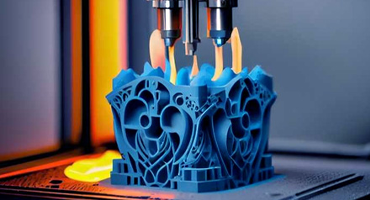
Why is 3D printing used?
The short answer
3D printing is used because it turns a design into a physical part in hours without tooling, so iteration is cheap and the geometry is unconstrained. It pays off under a few hundred parts, for designs still moving and for shapes machining cannot reach; above that, moulding or machining wins.
Six reasons a part gets printed, and the figure behind each
Nobody prints a part because printing is interesting. A project is printed because one of six pressures is present, and each pressure carries a number that can be checked before anything is committed. Read the chart below as a set of tests rather than as a list of benefits: if none of the third column applies to the part in front of you, the reason to print is probably not there yet.

| Reason to print | What it buys | The figure that decides |
|---|---|---|
| Iteration speed | A design change costs nothing | First part in 2 to 24 hours |
| No tooling | No mould and no minimum order | Break-even 300 to 2,000 units |
| Design freedom | Channels, lattices, one-piece bodies | Shapes a cutting tool cannot reach |
| One-off economics | Unit cost flat from 1 to 500 parts | Roughly the same price at any quantity |
| Customisation | Every part can be different | No per-variant tooling penalty |
| Supply continuity | Bridge stock and spare parts | Hours instead of weeks |
The first two rows are the ones a finance team can audit, and between them they account for most production decisions. The next four are the reasons a printed part often stays in service long after the prototype phase has ended.
Reason one: speed, which in practice means iteration
The number that matters is not how fast one part prints, it is how long a complete design loop takes. A printed part is available within 2 to 24 hours on a fused-deposition machine, and published bureau timings put resin printing at 1 to 3 days, SLS nylon at 2 to 3 days, industrial FDM at 2 to 4 days and metal powder-bed printing at 3 to 5 days. A change is an edited model and a new slice, so an iteration loop of one to five days is normal rather than exceptional.
Set that against the alternative for a moulded plastic part. Injection moulding tooling takes 2 to 4 weeks in aluminium and 4 to 8 weeks in hardened steel, and it costs roughly USD 1,500 to 4,000 for a simple single-cavity aluminium tool and USD 8,000 to 40,000 for a production-grade steel tool. Every design change after that costs USD 1,000 to 5,000 or more, because the change is cut into steel. Three revisions before a design settles turns a fortnight of thinking into two months of waiting, and it is that deferral — not the price of the plastic — that printing removes.

This is also the reason the technology is used inside production rather than only before it. Jigs, fixtures, soft jaws and end-of-arm tooling are printed because the line cannot wait six weeks for a machined fixture, and because the fixture is usually revised twice in its first month of use.
Reason two: there is no tool to pay for
Printing removes a fixed cost and keeps a higher variable cost; moulding does the opposite. The comparison collapses into one line: break-even quantity equals tooling cost divided by the difference between the printed and the moulded unit cost. With an USD 8,000 tool, a printed part at USD 4 and a moulded part at USD 0.50, the crossover sits near 2,300 units. A 120 by 80 by 40 mm enclosure quoted with a USD 12,000 tool, printed at USD 18 to 25 each against USD 2 to 4 moulded, crosses over at roughly 600 to 750 units. Simple parts cross at 300 to 500; complex parts with expensive multi-cavity tools cross at 1,500 to 2,000.

Three costs sit outside that arithmetic and usually decide real projects: the working capital tied up in a minimum order of 500 or more parts, the inventory risk if demand falls short, and the revenue deferred by a six to ten week tooling wait. Counting the deferred launch revenue moves the practical crossover to the right of the chart above, and it is the reason that bridge production — printing parts while the mould is being cut — is now a standard launch strategy rather than a compromise.
Reason three: geometry no cutting tool can reach
The third reason is not economic at all. A machined manifold with cross-drilled internal passages needs plugs and O-rings, and every joint is a potential leak; the same manifold printed as a single body has no joints. Conformal cooling channels that follow the curve of a mould insert, lattice blocks that remove mass without removing stiffness, and housings that replace four bolted parts with one are all shapes a cutter cannot reach, or cannot reach at a price worth paying.
The reason has a limit worth stating early: printing buys geometry, not precision. As-built metal surfaces land near Ra 8 to 15 micrometres, internal channels keep that roughness so flow resistance is higher than a honed bore, fine-pitch printed threads are unreliable, and a 6 mm H7 bore arrives undersized and has to be reamed. Design the printed part for the geometry gain, then machine the faces that carry a dimension.
Reasons four to six: one-offs, customisation and supply
Because the unit cost does not fall with volume, printing is a poor choice for a mass-produced part and an excellent one for everything else. One part and five hundred parts cost about the same each, so a variant, a spare or a one-off carries no tooling penalty. That is what turns printing into a service channel rather than only a prototype channel: spare parts for equipment whose tooling no longer exists, surgical guides and dental aligners that differ for every patient, and fixtures that exist in a handful of copies.
The supply-chain reason is the newest and the fastest growing. A printed part produced while the production tool is still being cut lets a product launch before the mould is finished, and a distributed print network lets a repair part be produced near the point of demand rather than shipped from a central warehouse. Airbus now produces more than 25,000 flight-critical printed parts a year across three aircraft platforms, with a published 43 percent weight reduction and lead-time cuts of up to 85 percent on those parts, and a state-funded shared-printer network in Michigan had processed more than 51,000 print jobs by mid-2025.
When printing is the wrong reason
- The material is not the production material. A part printed in nylon tells you how nylon behaves, not how the eventual moulded ABS or cast aluminium part will behave. For a test that has to predict production, machine the prototype from production stock instead.
- Tolerance is an order of magnitude away. Resin printing holds about plus or minus 0.05 to 0.15 mm, SLS about plus or minus 0.1 to 0.3 mm and FDM about plus or minus 0.2 to 0.5 mm, against plus or minus 0.01 to 0.05 mm for machining. Mating features and sealing faces are machined afterwards or redesigned.
- The surface has to be an appearance surface. Layer lines and as-built roughness are visible. A part judged by a customer needs sanding, vapour smoothing or a coat, and each of those is a cost the comparison above did not include.
- The load crosses the layers. Extruded parts carry only about 50 to 75 percent of their bulk strength across the layer boundary, so a printed bracket can be strong in the plane of the bed and weak through it.
- The unit cost never falls. Printing has no scale economy. At 10,000 units a moulded part may cost USD 0.30 while the printed equivalent still costs USD 3, and no amount of volume closes that gap.
- Traceability is the requirement. A printed part is not wrought stock and does not arrive with a mill certificate. Where a programme needs that paper, it is a requirement on the process, and it is confirmed per programme and per factory in writing before production.
What to send if printability decides the project
Send the CAD model as a STEP file if you have one, a toleranced drawing, the quantity and annual volume, the feature that matters most and the environment the part will see. Those five items settle the process before price is discussed: a bracket with a bending or impact load points to sintered nylon, the same geometry with an in-plane load and a tight budget points to filament printing, a fine-detail or appearance part points to resin, and a part that has to be metal points to powder-bed printing followed by machining. See FDM 3D printing for economical filament parts, SLS 3D printing for durable nylon components and SLA resin 3D printing for fine detail, then send a model for a free engineering review.
Scope and sources. Process mechanics and layer-height ranges were compiled in 2026 from a 3D printing process guide by Premsa Industries (FDM layers 0.1 to 0.3 mm, infill 15 to 40 percent) and from the seven-category ISO/ASTM 52900 comparison by AS Prototypes (metal powder bed 20 to 50 microns, vat photopolymerisation 25 to 100 microns, material extrusion 100 to 300 microns, SLA tolerance plus or minus 0.05 to 0.1 mm, SLS tolerance plus or minus 0.2 to 0.3 mm, DMLS tolerance plus or minus 0.1 to 0.2 mm, SLS PA12 at 45 to 50 MPa, FDM polycarbonate at 55 to 70 MPa, DMLS Ti6Al4V at 1,050 to 1,150 MPa, bureau lead times of 1 to 5 days). Surface, thread and bore limits come from a machining-side process explainer (as-printed metal Ra 8 to 15 microns, wall thickness below about 1 mm becomes a process variable, H7 bores require reaming). Cost and break-even figures come from a 2026 tooling and per-part cost guide (aluminium tool USD 1,500 to 4,000 in 2 to 4 weeks, steel tool USD 8,000 to 40,000 in 4 to 8 weeks, FDM part USD 1 to 10, moulded part USD 0.10 to 2.00, worked break-even of about 2,286 units) and from a small-batch comparison (enclosure tooling USD 12,000, printed USD 18 to 25, moulded USD 2 to 4, break-even 600 to 750 units, design change USD 1,000 to 5,000). The Airbus figure of more than 25,000 flight-critical printed parts a year with a 43 percent weight reduction and up to 85 percent lead-time reduction, and the Michigan shared-printer network figure of more than 51,000 print jobs by mid-2025, are reported in a 2025 additive manufacturing review. These are typical published ranges for general-purpose machines and parameter sets, not a specification for any particular build; orientation, material grade, geometry and post-processing all move them. Nothing on this page states or implies a certification held by any supplier.
Previous
What is SLA and SLS?
Are you looking for a reliable manufacturer of down home textile products?
We can quickly provide customers with market analysis, technical support and customized services.From concept to product
From prototyping to production, our production sites can handle all your manufacturing projects.
subscription