
From concept to product
From prototyping to production, our production sites can handle all your manufacturing projects.
What is SLA and SLS?
The short answer
SLA and SLS are the two leading resin-and-powder additive processes. SLA cures liquid photopolymer with ultraviolet light, one thin layer at a time, and holds the finest detail, down to 25 micron layers. SLS sinters nylon powder with a laser and needs no supports, so it produces the strongest, most near-isotropic plastic parts.
SLA: liquid resin cured by light
SLA stands for stereolithography, and it was the first additive process to be commercialised, in the 1980s. The mechanism is photopolymerisation: a build platform sits one layer below the surface of a vat of liquid resin, and an ultraviolet light source draws the cross-section of the part across that surface, hardening the resin only where the light touches it. The platform then drops by one layer height, fresh resin flows across, and the next cross-section is drawn on top of the last.
Two consequences follow directly. Because the part is built from a liquid and cured into one continuous solid, there is no seam between layers and no direction in which the material is weaker. And because the light source can be focused very finely, the process resolves features that no other method resolves: layers of 25 to 100 microns, features down to about 0.1 to 0.3 mm, and an as-built surface of Ra 1 to 5 micrometres, which is smoother than most machined finishes.

The cost of that precision is paid in three places. Supports are needed, because the part hangs from the platform and overhangs have nowhere else to stand, and removing them leaves contact marks that have to be sanded. Post-processing is mandatory, because uncured resin has to be washed off in solvent and the part then needs a final ultraviolet cure to reach its stated properties. And the material itself is brittle: a standard resin elongates only 4 to 6 percent before it breaks, which is why a resin part that looked perfect can crack the first time it is dropped.
SLS: nylon powder fused by a laser
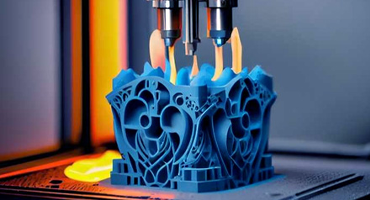
SLS stands for selective laser sintering. Instead of a vat of liquid, the machine holds a bed of fine nylon powder. A roller spreads a layer roughly 80 to 150 microns thick across the bed, a laser traces the cross-section of the part and fuses those powder particles together, the bed drops, and the roller spreads the next layer. Nothing is glued and nothing is cured in a liquid; the particles are sintered into a continuous solid.
The defining advantage is not the laser, it is the powder. The unfused powder around the part supports it, so the process needs no support structures at all. That single fact opens geometry the other processes cannot reach: internal channels, undercuts, living hinges, snap fits and interlocking assemblies printed in one piece, with nothing to cut away afterwards and no contact marks to sand. The bed is also why SLS is the only common additive process that nests many parts in a single build rather than printing them one at a time.
The material is usually nylon, either PA12 or PA11, and that is what gives SLS its reputation. PA12 prints at roughly 45 to 50 MPa tensile with 15 to 20 percent elongation and a heat deflection temperature in the 90 to 170 degrees Celsius range depending on the grade; PA11 trades some strength for elongation that runs to 200 percent, which is why it is chosen for parts that flex repeatedly rather than parts that carry a steady load. Glass-filled grades push tensile strength to 70 to 85 MPa at the cost of elongation, which falls to 2 to 5 percent.
The two side by side on the mechanics

| Point | SLA, stereolithography | SLS, selective laser sintering |
|---|---|---|
| What is fused | Liquid photopolymer resin | Nylon powder, PA12 or PA11 |
| Energy source | Ultraviolet light | Laser, carbon dioxide or fibre |
| Layer height | 25 to 100 microns | 80 to 150 microns |
| Supports | Required, and they leave marks | None, the surrounding powder holds the part |
| Post-processing | Solvent wash, ultraviolet cure, support removal | Depowdering and bead blasting |
| Surface as built | Smooth, Ra 1 to 5 micron | Matte, Ra 6 to 12 micron |
| Tensile strength | 50 to 65 MPa standard, 55 to 65 MPa tough grade | 45 to 50 MPa for PA12, 70 to 85 MPa glass filled |
| Failure mode | Brittle under impact, degrades in ultraviolet light | Slightly porous, matte texture |
| Typical use | Fine detail, dental and medical models, casting patterns | Functional nylon components, complex assemblies |
One row of that table is worth repeating because it catches buyers out: an SLS part is the stronger part, and it is not the smoother one. If the part has to be photographed or handled by a customer, SLA wins on appearance regardless of the strength argument. If the part has to flex, take an impact or carry a snap fit, SLS wins regardless of the appearance argument.
Why SLS nylon is the tougher plastic
Tensile strength alone does not predict which of these two parts survives a drop test, and the reason is elongation. A material that stretches 15 to 20 percent before it breaks absorbs energy that a material stretching 4 to 6 percent simply does not, so a nylon part deforms and recovers where a resin part cracks. The chart below makes the gap visible on one scale.

This is also why an SLS part is usually the right choice for anything that moves. Living hinges, snap fits, clips and press-fit features all rely on the material deforming without cracking, which is a property of nylon's elongation rather than of its strength. A resin part can be made to work in the same role with a tough or engineering resin grade, but the result is still a photopolymer under load, and it still changes outdoors.
What neither one does well
- Neither is a production process. Both make prototype and low-volume quantities. Above a few hundred identical parts the economics move to injection moulding, casting or machining, and a part validated for one of these processes is not validated for the process that makes the production units.
- Neither holds machining tolerances. SLA holds about plus or minus 0.05 to 0.15 mm and SLS about plus or minus 0.1 to 0.3 mm, against plus or minus 0.01 to 0.05 mm for machining. Sealing faces, bearing bores and threads are machined afterwards, or the feature is redesigned.
- SLA parts change in daylight. Photopolymers discolour and embrittle under prolonged ultraviolet exposure unless the resin is chosen for outdoor service or the part is coated.
- SLS parts are porous and matte. As-built nylon is not fluid-tight without sealing, and its Ra 6 to 12 micrometres texture is wrong for a visible cosmetic surface.
- Neither produces a certified material lot. A printed part is not wrought stock and does not arrive with a mill certificate. Where a programme needs that traceability, it is a requirement on the process and it is confirmed per programme and per factory in writing before production.
- Neither replaces the design rules. Minimum wall thickness is roughly 0.6 to 0.8 mm for SLA and 0.7 to 1.0 mm for SLS, thin unsupported features distort, and powder parts must be designed so that trapped powder can be emptied out.
How to choose, and what to send
Two questions settle it. Does the part have to look finished, hold fine detail or serve as a casting pattern? That is SLA. Does the part have to flex, take an impact or contain internal geometry that cannot be supported? That is SLS. If the answer is both, the usual route is to split the part: print the visual and detail features in resin, and the loaded or moving features in nylon, then assemble and check fit before any tooling is committed.
Send the model, the surface and feature requirement, the loads and the quantity, and the process recommendation comes back with an accuracy figure, a material and a finishing route attached to it. See SLA 3D printing for fine-detail resin parts, SLS 3D printing for durable nylon components and surface finishing for the post-processing that decides how either part finally looks.
Scope and sources. Mechanism, layer height and surface roughness descriptions were compiled in 2026 from the published capability tables of Modo Rapid (SLA layer 25 to 100 microns, tolerance plus or minus 0.05 to 0.15 mm, as-built Ra 1 to 5 microns, minimum wall 0.6 to 0.8 mm; SLS layer 80 to 150 microns, tolerance plus or minus 0.1 to 0.3 mm, as-built Ra 6 to 12 microns, minimum wall 0.8 to 1.0 mm) and from the SLA, SLS, FDM and SLM comparison published by Zorapid. Material properties come from a 3D printing materials comparison (SLA standard resin about 50 to 65 MPa and 4 to 6 percent elongation, tough resin about 55 to 65 MPa and 10 to 20 percent, PA12 SLS about 50 MPa, glass-filled nylon about 70 MPa) and from a study of loaded printed components that reports PA12 at 50 MPa with 20 percent elongation and PA11 at 45 MPa with elongation up to 200 percent. Machine and material cost context comes from a comparison of SLA and SLS in tooling. These are typical published ranges for general-purpose industrial machines; geometry, orientation, grade and post-processing all move them, and none of the figures is a specification for a particular build. Nothing on this page states or implies a certification held by any supplier.
Are you looking for a reliable manufacturer of down home textile products?
We can quickly provide customers with market analysis, technical support and customized services.From concept to product
From prototyping to production, our production sites can handle all your manufacturing projects.
subscription