Home / All / Technology Innovation / Custom CNC Machining for the Food and Beverage Industry: Stainless Steel Solutions
Custom CNC Machining for the Food and Beverage Industry: Stainless Steel Solutions
Aug 26,2026
Introduction: Why Stainless Steel CNC Machining Is the Backbone of Food and Beverage Equipment
Every bottle of juice, every slice of processed cheese, and every bag of frozen vegetables moves through equipment made of precision-machined parts. From filling nozzles that dispense exact volumes to pump impellers that move viscous sauces, these components operate under constant washdown, aggressive cleaning chemicals, and strict food-safety audits. The global food processing machinery market was valued at $64.81 billion in 2025 and is projected to reach $68.27 billion in 2026, growing at a compound annual growth rate (CAGR) of 5.3%, according to The Business Research Company. Broader estimates from Fortune Business Insights place food processing and handling equipment at $131.72 billion in 2026, expanding at 5.8% CAGR through 2034.
This growth is driven by processed-food demand, automation, and ever-tightening hygiene regulations. For manufacturers of food processing, beverage, and packaging equipment, that means one engineering question dominates: how do you source custom CNC parts that are precise, corrosion-resistant, and truly cleanable? The answer, in the vast majority of cases, is food-grade stainless steel machined to hygienic standards. In this guide, we explain the materials, surface finishes, design rules, and certifications behind food-grade CNC machining, and how SOMI Custom Parts applies them to every part we produce for the food and beverage industry.
$68.27B
Food processing machinery market, 2026 (TBRC)
5.3%
Market CAGR 2025–2026
Ra 0.4µm
Hygienic finish for high-hazard food-contact parts
3-A/EHEDG
Sanitary design frameworks governing equipment
What Is Food and Beverage CNC Machining?
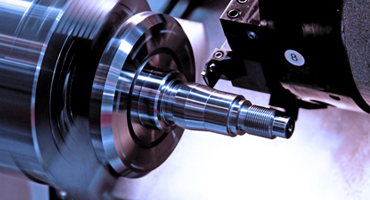
Food and beverage CNC machining is the manufacturing of precision components for food processing, beverage production, and packaging equipment using computer numerical control (CNC) milling, turning, drilling, and multi-axis machining. Unlike general industrial parts, these components are engineered for hygiene, cleanability, and corrosion resistance in environments that are cleaned repeatedly with chlorinated sanitizers, hot caustic solutions, and steam.
The discipline combines three core requirements. First, materials must be food-contact safe, typically 304 or 316L stainless steel, or FDA-compliant engineering plastics such as PEEK, POM (Delrin), and PTFE. Second, surfaces must be smooth enough to resist bacterial adhesion, with product-contact roughness targets of Ra 0.4–0.8 µm. Third, geometry must follow sanitary design rules, including large internal corner radii, self-draining slopes, and the total elimination of dead legs where food or cleaning fluid can pool.
CNC Milling
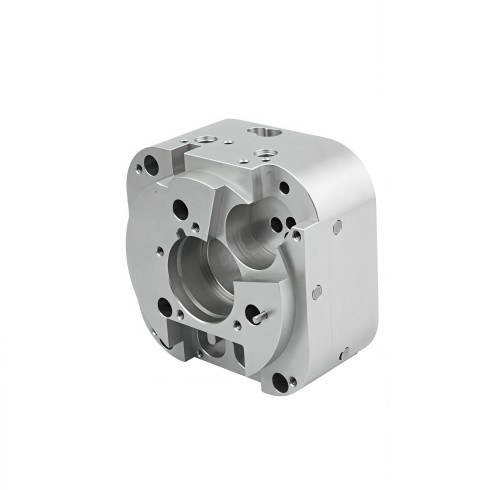
Multi-surface components such as valve bodies, manifolds, and housings with accurate dimensional control across complex geometries.
CNC Turning
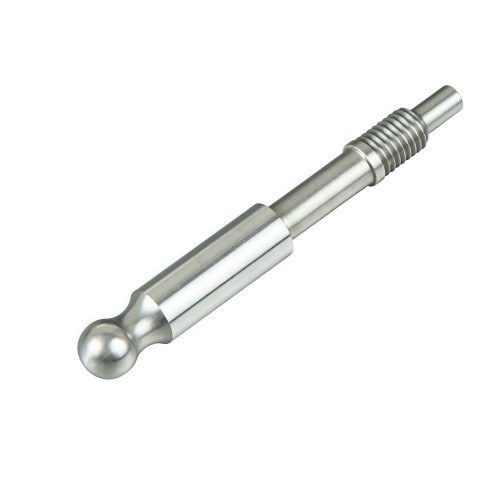
Shafts, sleeves, fittings, and cylindrical parts with consistent concentricity and smooth surface transitions.
5-Axis Machining
Single-setup machining of complex parts such as filling valves and mixing impellers, eliminating weld seams that create sanitary dead zones.
Swiss Machining
Ultra-precision small-diameter components, including dosing nozzles and spray heads where flow control is critical.
Stainless steel is the default material family for food-contact CNC parts because of its corrosion resistance, cleanability, and regulatory acceptance. But within the family, grade selection matters enormously. The two workhorses are AISI 304 (1.4301) and AISI 316L (1.4404). They look identical and are often confused, yet they behave very differently in chloride-rich food environments.
The key difference is molybdenum. 316L contains 2–3% molybdenum, which raises its Pitting Resistance Equivalent Number (PREN) from roughly 18–20 for 304 to about 25–27 for 316L. In a 3.5% NaCl solution, 304 typically shows pitting above 22°C (Critical Pitting Temperature), while 316L withstands 30–40°C. That premium matters wherever salt, brine, vinegar, acidic fruits, or chlorinated sanitizers are present. 316L also carries an "L" for low carbon (≤0.03% C), which prevents sensitization and intergranular corrosion in welded assemblies.
Property
304 (1.4301)
316L (1.4404)
Practical Meaning
Nominal composition
18% Cr / 8% Ni
16–18% Cr / 10–14% Ni / 2–3% Mo
Mo is the entire story
PREN (pitting resistance)
≈ 18–20
≈ 25–27
316L resists chloride pitting far better
CPT in 3.5% NaCl
≈ 22°C
≈ 30–40°C
316L handles warm brine and washdown
Relative material cost
1.0×
≈ 1.3–1.5×
316L bar stock runs 20–50% higher
Machinability index
100% baseline
≈ 70–80%
316L work-hardens faster; expect more tool wear
Typical cutting speed
70–110 m/min
60–90 m/min
Adjust feeds for 316L strain hardening
Best application
Dry, salt-free food zones; structural frames
Brine, acid, dairy, CIP/SIP, seafood
Match grade to service environment
Rule of thumb from real shop floor experience: if the part will contact chloride-bearing foods, sanitizers, or steam — specify 316L. If the service is dry, indoor, and salt-free, 304 delivers the same food-grade compliance at a lower cost. And never use free-machining 303 in wet or hygienic applications: its manganese sulfide inclusions leach sulfur and accelerate localized attack. The material cost premium of 316L (about 25–40% on the finished part) is routinely justified — NACE studies of seafood processing plants show 316L extending equipment life from roughly 5 years to 12 years compared with 304.
Hygiene Standards That Govern Food-Contact CNC Parts
Food-grade CNC parts are not judged by tolerances alone. They must satisfy a stack of regulatory and industry frameworks that define materials, surface finish, weld quality, drainability, and cleanability. Understanding these standards is essential for anyone sourcing custom parts for food and beverage equipment — the certification burden ultimately lands on the equipment manufacturer, and downstream on the machining partner.
Standard
Region / Scope
What It Governs
FDA 21 CFR Part 117.40
United States (FSMA)
Equipment must be adequately cleanable and prevent food contamination
FDA 21 CFR Part 177
United States
Food-contact polymers such as PEEK, POM, and PTFE
3-A Sanitary Standards
North America (dairy & beverage)
Prescriptive design criteria: Ra ≤ 0.8 µm product contact, self-draining, no dead legs
EHEDG
Europe / global export
Test-based cleanability certification (EL Class I, Aseptic Class I); 50+ design guidelines
ISO 14159
International
Hygiene requirements for the design of machinery
EU EC 1935/2004
European Union
Food-contact materials must be inert; traceability via EN 10204 3.1 certificates
NSF/ANSI 51
North America
Food equipment materials, including machined plastics
Certifications matter for audits. Under FSMA's Current Good Manufacturing Practice rules, the burden of proof sits with the food manufacturer. A machining partner that provides mill test reports (MTRs), EN 10204 3.1 material certificates, and First Article Inspection (FAI) documentation makes your audit path dramatically easier. At SOMI Custom Parts we treat documentation as part of the deliverable — every food-grade project is supplied with material traceability and inspection records.
Surface Finish: Ra Values, Electropolishing, and Passivation
In food equipment, surface roughness is not a cosmetic preference — it is a food-safety parameter. Bacteria adhere more readily to rough surfaces, where microscopic peaks shield organisms from cleaning agents and create biofilms. The industry consensus, codified by 3-A, EHEDG, and FDA expectations, sets maximum Ra values by contact zone.
Part Zone
Required Maximum Ra
Post-CNC Treatment
Direct food contact (product zone)
Ra ≤ 0.8 µm (32 µin)
Polishing, electropolishing, precision finishing
High-hazard zones (dairy, sticky sauces, meat)
Ra ≤ 0.4 µm (16 µin)
Electropolishing (EP) + passivation
Non-contact structural surfaces
Ra ≤ 1.6 µm
Standard machined or bead-blasted finish
Two post-machining processes are effectively mandatory for food-contact stainless steel. Electropolishing removes a microscopic layer of metal uniformly, smoothing micro-peaks and valleys far better than mechanical polishing. It eliminates the micro-crevices where bacteria hide and simultaneously improves corrosion resistance. Passivation per ASTM A967 removes free iron left by cutting tools, restores the chromium-oxide protective layer, and prevents surface rust and metal-particle shedding into food during aggressive chemical cleaning cycles. Together, electropolishing and passivation are the industry-standard combination for filling nozzles, manifolds, and pump components that must survive CIP (Clean-in-Place) and SIP (Sterilization-in-Place) cycles.
Design for Hygiene: DFM Rules That Make Parts Cleanable
Hygiene cannot be retrofitted — it must be machined in. When designing custom CNC parts for food and beverage equipment, experienced manufacturers apply a specific set of Design for Manufacturability (DFM) rules. These rules are what separate a part that passes a 3-A or EHEDG cleanability test from one that silently harbors Listeria.
Internal corner radii ≥ R3 mm. Sharp 90° internal angles trap food residue and cannot be flushed by CIP. Specify the largest radius your design allows.
Drain slopes ≥ 1.5°. Horizontal machined surfaces must slope so cleaning liquid drains completely with no pooling.
No dead legs. The legacy rule is no branch longer than 3 pipe diameters (3D); EHEDG and modern dairy practice push this to 2D or less. Redesign blind holes as through holes or add drain holes.
100% burr-free edges. Every hole, pocket, and thread must be deburred — micro-burrs trap debris and breed bacteria. Add a 0.3–1 mm radius or chamfer on external edges.
Thread hygiene. Prefer sealed threads, design thread relief shanks so threads sit outside food-contact zones, and avoid fine shallow threads that trap residue.
Machine one piece, not weld seams. Multi-axis machining of monolithic parts (valves, impellers) eliminates welds and the heat-tint oxidation and crevices they introduce.
Key Applications and Typical CNC Machined Parts
From the dairy plant to the bottling line, food and beverage equipment relies on a small family of high-stakes machined components. Understanding what each part demands helps buyers specify materials, tolerances, and finishes correctly the first time.
Application Area
Typical Parts
Critical Requirements
Fluid control & hygiene systems
Filling nozzles, valve bodies, manifolds, spray balls, tri-clamp and DIN 11851 sanitary fittings
Ra ≤ 0.4–0.8 µm, electropolished, zero dead legs, leak-free sealing
Micron-level dimensional and geometric tolerance for high-speed repeatability
One pattern runs through all of these applications: downtime is the enemy. A failed component on a bottling line stops thousands of units per hour. This is why OEMs in the food and beverage sector prioritize batch-to-batch repeatability, documented materials, and rapid replacement of critical wear parts — all of which are strengths of a disciplined CNC machining partner.
How SOMI Custom Parts Can Help
SOMI Custom Parts is a precision CNC machining manufacturer serving global OEMs across industries, including the food and beverage sector. We machine 304 and 316L stainless steel, as well as food-grade engineering plastics, with tolerances held to ±0.005 mm on critical dimensions and hygienic surface finishes down to Ra 0.4 µm through polishing and electropolishing.
Our manufacturing capabilities cover CNC milling for manifolds and housings, CNC turning for shafts, fittings, and nozzles, and CNC drilling for precision hole patterns. Our in-house surface finishing line handles passivation, bead blasting, anodizing, and polishing so parts leave our factory hygiene-ready — no off-site treatment, no contamination risk in transit. Every batch is verified with CMM inspection and documented material traceability, consistent with ISO 9001 quality management.
Whether you need a single prototype filling nozzle, a low-volume run of replacement pump impellers, or full production of sanitary manifolds, our engineers apply food-grade DFM rules to your design before we cut a chip. We will flag sharp internal corners, dead legs, and inadequate drain slopes in your CAD model — and suggest fixes that save you audit failures later. Contact our team with your drawing and service conditions, and we will recommend the right stainless grade and finish for your application. You can also review our full product catalog or learn more about our company on our About Us page.
Frequently Asked Questions
Is 304 or 316L stainless steel better for food-grade CNC parts?
It depends on the service environment. 304 is the de-facto standard for dry, salt-free food zones and non-contact structures — it machines faster and costs about 20–50% less. 316L adds 2–3% molybdenum (PREN 25–27), resisting pitting and crevice corrosion from brine, acidic foods, chlorinated sanitizers, and steam. If chlorides or CIP chemicals will touch the part, specify 316L.
What surface finish do food-contact CNC parts need?
Industry standards (3-A, EHEDG) require Ra ≤ 0.8 µm for general food contact and Ra ≤ 0.4 µm for high-hazard zones such as dairy, sticky sauces, and aseptic processing. Non-contact structural surfaces can be Ra ≤ 1.6 µm. Electropolishing plus passivation per ASTM A967 is the recommended combination for stainless parts in direct contact with food.
What tolerances can CNC machining hold for food equipment parts?
Typical precision CNC machining holds ±0.005 mm on critical dimensions, with 0.01 mm concentricity and roundness achievable on rotating components such as pump shafts and impellers. Standard machining generally follows ISO 2768-m/f. Your drawings should specify tight tolerances only where function requires them — unnecessary precision raises cost without adding value.
Can machined plastics be used in food-contact applications?
Yes. FDA-compliant grades of POM (Delrin, NSF 51 certified), PTFE, PEEK (unfilled), UHMW-PE, and PVDF are widely used for star wheels, guide rails, seals, and low-friction wear parts. The material must comply with FDA 21 CFR 177 (US) or EU 10/2011 (Europe), and glass-filled grades should be avoided where micro-particle shedding is a concern.
What documentation should a food-industry machining supplier provide?
At minimum: material mill test reports (MTRs) or EN 10204 3.1 certificates, First Article Inspection (FAI) reports, CMM inspection records, and surface roughness verification. Under FSMA's CGMP rules, the equipment manufacturer carries the compliance burden, so complete, traceable documentation from the machining partner is essential for audits.
Conclusion
Custom CNC machining is the manufacturing backbone of the food and beverage industry, and stainless steel sits at its center. The path to hygienic, audit-ready equipment runs through four disciplines: choosing the right grade (316L where chlorides exist, 304 where they do not), holding the right surface finish (Ra 0.4–0.8 µm on food contact), applying sanitary DFM rules (corner radii, drain slopes, no dead legs), and partnering with a machine shop that treats material traceability and inspection as standard practice.
With the food processing machinery market growing past $68 billion in 2026 and hygiene regulations tightening in every major market, the parts inside your processing line have never mattered more. SOMI Custom Parts has the stainless steel machining expertise, in-house finishing, and quality systems to deliver them. Send us your design and service conditions today, and let our engineers help you specify food-grade parts that keep your line running and your audits clean. Request a quote now.