
From concept to product
From prototyping to production, our production sites can handle all your manufacturing projects.
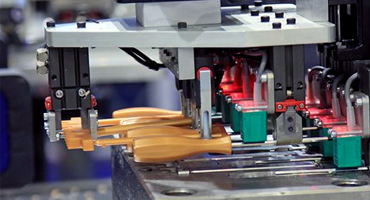
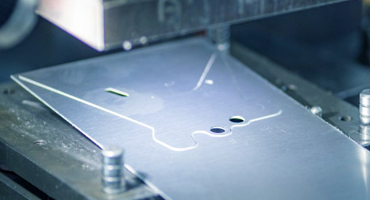
What is stamping in metal processing?
The short answer
Stamping - also called pressing - forms parts from sheet metal or coil by driving a shaped tool, the die, into the material. It covers blanking, piercing, bending, drawing, forming and coining, and it runs on mechanical or servo presses. Because the geometry comes from the tool rather than from the machine's motion, stamped parts repeat very closely: ±0.025 mm is routine on progressive tooling, at rates from about 7 parts per minute on heavy gauge up to 1,500 strokes per minute on thin electrical terminals.
The six operations that make up stamping
"Stamping" is a family name, not a single process. Most parts combine two or more of the operations below inside one tool, which is exactly why a stamped part can carry several features that all have to line up.

From coil to packed part: the production line
In a progressive line the material never stops moving. Coil is decoiled and straightened, a servo feeder advances it by an exact pitch, and the press completes one part per stroke. Deburring and inspection follow, but the dimensional work is already finished inside the die.

How thick, how fast, how tight
Thickness is what selects the press class, and the press class sets the output rate. A high-speed progressive line running 0.2 mm terminal stock behaves almost nothing like a heavy press forming 8 mm structural brackets, even though both are called stamping.

The numbers behind the diagram: progressive dies typically run 4 to 30 stations. A 12-station die processing 0.5 mm steel at 500 strokes per minute produces 30,000 parts per hour. Material utilisation lands at 75 to 90 percent of coil weight with a well-nested strip layout, against 20 to 50 percent for machining from solid bar.
Where stamping stops working
- Tooling is the entry ticket. Progressive dies run USD 10,000 to 250,000+ and take 8 to 20 weeks to build. Below roughly 50,000 to 100,000 pieces per year the investment does not pay back.
- The design has to be close to frozen. Each modified station costs USD 5,000 to 80,000 plus lost production time.
- Coil width and part size are bounded. Strip runs about 5 to 500 mm wide and finished parts commonly 5 to 300 mm. Larger structural parts go to single-stage or transfer stamping.
- No undercuts, no hollow sections. A punch must be able to reach the feature and withdraw from it.
- Burrs are inherent. Every sheared edge has one. If the print forbids a burr above a stated height, plan a deburring operation and its cost.
Watch the tool, not the last part. A punch that has worn at station six keeps producing parts that pass a glance and fail a gauge. In-process dimensional sampling during long runs is what catches it; final inspection only tells you how many were bad.
Stamping at SOMI Custom Parts
We build single-stage, compound and progressive tooling from 0.2 mm to 6 mm stock, in carbon steel, 301 / 304 / 316 stainless, 5052 and 6061 aluminium, copper and brass. Strip layout, tool design, first-article dimensional reports and in-process sampling sit with the same team that runs the press: see metal stamping, sheet metal fabrication, or send a drawing through our inquiry form.
Scope and sources. Press speeds, station counts, tooling ranges and tolerance bands above are typical published values for commercial metal stamping in 2026, cross-checked against Xometry's progressive die stamping reference and die-manufacturing comparison data. Values shift with part geometry, material and press selection, so treat them as planning ranges rather than quotations. Feature tolerances apply where they are called out; undimensioned features follow the general tolerance block on the drawing.
Are you looking for a reliable manufacturer of down home textile products?
We can quickly provide customers with market analysis, technical support and customized services.From concept to product
From prototyping to production, our production sites can handle all your manufacturing projects.
subscription