Understanding Custom Powder Coating Die Casting Parts: Power, Advantages, and Applications
As manufacturers, we're constantly seeking optimal ways to enhance the durability, appearance, and performance of our components. Custom Powder Coating Die Casting Parts offers a powerful solution, making products more resilient and visually appealing while also presenting significant advantages over traditional finishing methods.
This guide will explore the power, advantages, and diverse applications of custom powder coating for die casting parts, helping us understand why it's become a preferred choice in various industries.
Understanding Custom Powder Coating Die Casting Parts: The Process
Powder coating is a dry finishing process that has become one of the most popular methods for finishing high-quality die castings. It involves applying a free-flowing, dry powder to a component, which is then cured under heat to form a hard, durable "skin" that is tougher than conventional paint. Unlike liquid paint, this method doesn't require a solvent to keep the binder and filler parts in a liquid suspension, making it a distinct and advantageous process. This technique is widely used for both protective and cosmetic purposes on aluminum die casting components and other metals. The result is a high-quality, long-lasting finish that enhances both the performance and aesthetics of the final product.
What is Custom Powder Coating and How Does it Work?
At its core, powder coating is an advanced electrostatic finishing process. It uses a mixture of finely ground polymer resins, pigments, curatives, and leveling agents, which are blended and ground into a powder resembling baking flour. This dry powder is then applied to a surface and heated, causing it to melt, flow, and form a continuous, durable layer that bonds directly with the substrate. This process is fundamentally different from traditional wet painting, which relies on solvents that evaporate as the paint dries.
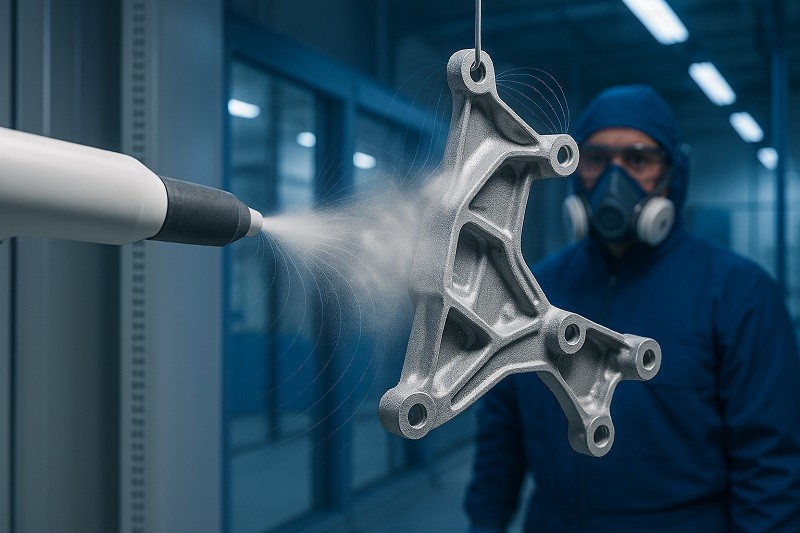
Dry Powder Application
The process begins with the application of the dry powder. The most common method is electrostatic spray deposition (ESD), where the powder is fed to a specialized spray gun. The gun imparts an electrical charge onto the powder particles as they are propelled by compressed air towards the target part. Because the die-cast part is grounded (holding an opposite charge), the charged powder particles are electrostatically attracted to it. This attraction ensures that the powder clings to the surface in a remarkably uniform layer, covering even complex shapes and hard-to-reach areas efficiently. Another, less common method is the fluidized bed technique, where pre-heated parts are dipped into a bed of aerated, fluid-like powder.
The Electrostatic Charge
The electrostatic charge is the key to the powder coating process's efficiency and precision. By giving the powder particles a negative or positive charge, they are naturally drawn to the grounded metal part. This "magnetic" effect not only ensures the powder sticks but also promotes an even coat, as the particles are attracted to uncoated areas, minimizing buildup. This process is so efficient that it greatly reduces overspray compared to wet painting. The electrostatic force is strong enough to hold the powder securely in place until it is melted and fused in the curing oven.
Curing for a Durable Finish
Once the part is evenly coated with powder, it is moved into a specialized curing oven. The heat, typically ranging from 325°F to 450°F (about 160°C to 210°C), causes the powder particles to melt and flow together. This creates a chemical reaction, cross-linking the polymer resins and forming a smooth, non-porous, and incredibly tough polymer-like finish. The curing process is crucial as it creates the thermal bond that gives powder coating its renowned durability and resistance to wear. After baking for a specific duration—from ten minutes to over an hour, depending on the part's size and thickness—the item is cooled, and the coating solidifies into its final, resilient state.
Key Steps in Custom Powder Coating for Die Casting Parts
Achieving a flawless and durable powder-coated finish on die-cast parts requires a meticulous, multi-stage process. Each step is critical to ensure maximum adhesion, coverage, and long-term performance. Deviations from these standard procedures can compromise the finish, potentially leading to peeling or failure.
Thorough Surface Preparation
Surface preparation is arguably the most crucial stage of the powder coating process. The surface must be perfectly clean and free of any contaminants like oil, grease, dirt, or oxidation that could interfere with adhesion. This is typically achieved through a combination of methods:
- Cleaning: The process often starts with solvent cleaning or dipping in an alkaline cleaner to remove organic soils like grease and grime.
- Blasting: Abrasive blasting, such as sandblasting or shot blasting, is used to remove inorganic contaminants like rust, scale, or a previous finish. This step also roughens the surface, creating a profile that promotes better mechanical adhesion of the powder.
- Chemical Pre-treatment: A conversion coating, such as an iron phosphate or chromate treatment, is often applied. This chemical process enhances corrosion resistance and further improves the bond between the metal and the powder coating.
- Pre-baking: For porous materials like die-cast aluminum, a pre-baking step may be necessary to release any trapped gasses or oils within the metal. This "outgassing" prevents bubbles and defects from forming in the final cured finish.
Powder Application Techniques
With the surface fully prepared and dried, the powder is applied. As mentioned, the primary technique is Electrostatic Spray Deposition (ESD). Different types of spray guns can be used, with Corona and Tribo guns being the most common:
- Corona Guns: These are the most widely used guns. They use a high-voltage electrode to generate an electrostatic field that charges the powder particles as they pass through.
- Tribo Guns: These guns charge the powder through friction, as the particles rub against an insulator inside the gun barrel. This method can be advantageous for coating complex shapes with deep corners, as it can reduce the "Faraday cage effect"—a phenomenon where the electrostatic field struggles to penetrate recessed areas.
The application is performed in a controlled booth to contain the powder and maintain a clean environment, as airborne debris can affect the finish quality.
Controlled Curing and Cooling
The final step is to cure the applied powder. The coated part is transferred to a curing oven where it is heated to a specific temperature for a set duration. Precise control of the oven temperature and time is vital. During this phase, the powder melts into a liquid film, flows over the part to create a uniform layer, and then chemically cross-links to harden.
Once the curing cycle is complete, the part is moved out of the oven to cool down. As it cools, the coating solidifies into the hard, durable, and attractive finish that powder coating is known for. After cooling, the part undergoes a final inspection for any defects in thickness, adhesion, or appearance before being sent for assembly or packaging.
Exploring the Advantages of Custom Powder Coating Die Casting Parts
Choosing a finish for die-cast parts is a critical decision that impacts durability, appearance, and overall product value. Custom Powder Coating Die Casting Parts has become an increasingly popular choice over traditional methods like wet paint due to its exceptional benefits in performance, aesthetics, and efficiency. It provides a superior protective layer that not only enhances the part's resistance to physical and environmental stress but also offers unmatched design flexibility and long-term cost savings.
Unmatched Durability and Protection for Custom Powder Coating Die Casting Parts
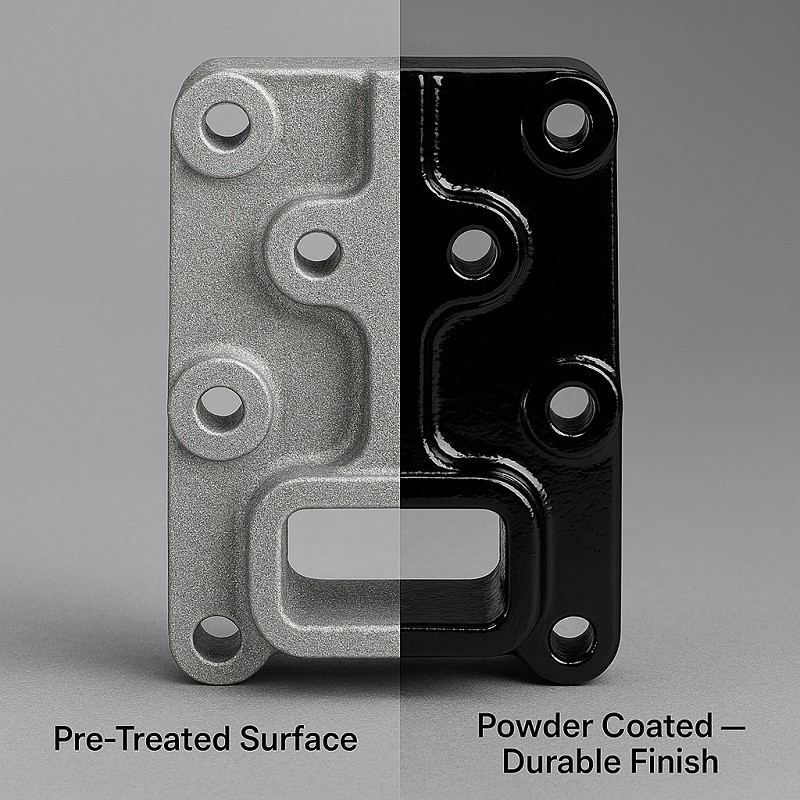
The primary advantage of powder coating is its incredible durability. The thermal bonding that occurs during the curing process creates a thick, hard finish that is significantly tougher than conventional paint. This makes it the ideal finishing method for parts that require a solid, long-lasting finish resistant to impact and abrasion.
Superior Resistance to Wear and Tear
Powder-coated surfaces are highly resistant to chipping, scratching, and general wear. The cured coating forms a robust, polymer-like barrier that is four to ten times thicker than typical spray paint, offering superior protection against physical stress. This toughness is legendary; tests have shown that powder-coated parts can withstand impacts, bending, and harsh handling without the finish cracking or flaking. This level of durability extends the product's lifespan and maintains its pristine appearance even in high-traffic or demanding applications.
Enhanced Corrosion and Rust Prevention
Die-cast parts, especially those made of aluminum or steel, are susceptible to corrosion and oxidation when exposed to moisture and environmental elements. Powder coating provides an excellent defense against this degradation. The non-porous, uniform layer created during the curing process effectively seals the metal substrate from contact with moisture, chemicals, and salt. This makes it an ideal choice for products used outdoors or in harsh industrial and marine environments, where it can prevent rust and extend the component's service life for 5 to 15 years or more.
Aesthetic Versatility and Customization in Custom Powder Coating Die Casting Parts
Beyond its protective qualities, powder coating offers enormous flexibility in design and aesthetics. It empowers manufacturers to create products that are not only durable but also visually striking, with a vast palette of options to meet any branding or design requirement.
Wide Range of Colors, Textures, and Finishes
Powder coating is available in a virtually limitless range of colors, far beyond standard industrial shades. In addition to a full spectrum of solid colors based on standards like the RAL system, manufacturers can choose from an extensive variety of special effects and finishes:
- Gloss Levels: Finishes are available in multiple gloss levels, from a non-reflective matte to a shiny high-gloss, and everything in between like satin and semi-gloss.
- Textures: Textured finishes like wrinkle, sand, and hammertone are popular for their unique tactile feel and ability to hide surface imperfections.
- Special Effects: For a truly unique look, options include metallic flakes, pearlescent sheens, candy colors, fluorescents, and even glow-in-the-dark powders.
This versatility allows for complete creative control, making powder coating suitable for everything from industrial machinery to high-end consumer products.
| Finish Type | Description | Common Applications |
|---|---|---|
| Matte | Low-reflectivity finish that hides fingerprints and minor imperfections. | Architectural elements, industrial tools, modern furniture. |
| Gloss | High-reflectivity finish that is smooth and easy to clean. | Automotive parts, appliances, consumer electronics. |
| Metallic | Contains metal flakes for a sparkling, sophisticated appearance. | Car wheels, bike frames, decorative items. |
| Textured | Creates a tactile surface (e.g., wrinkle, sand) for improved grip and durability. | Handrails, industrial equipment, outdoor furniture. |
| Candy | A translucent topcoat over a reflective base, creating deep, rich color. | Custom automotive and motorcycle parts. |
Consistent and Uniform Coverage
A key aesthetic benefit is the remarkably consistent and uniform finish. The electrostatic application process ensures that powder is attracted evenly across the entire surface, including edges, corners, and complex geometries. Unlike wet paint, which is prone to drips, runs, and sags, powder coating produces a smooth, seamless layer with minimal thickness variations between horizontal and vertically coated surfaces. This results in a high-quality, professional appearance that is difficult to achieve with other methods.
Cost-Effectiveness and Efficiency for Custom Powder Coating Die Casting Parts
While the initial equipment setup for powder coating can be higher than for wet paint, the process often proves to be more cost-effective in the long run. This is due to greater material efficiency, reduced waste, and lower long-term maintenance needs.
Reduced Waste and Material Utilization
The electrostatic application process of powder coating is highly efficient. Because the powder is magnetically attracted to the part, there is very little overspray. Any excess powder that does not adhere can be collected and reused, leading to material utilization rates of up to 95-98%. In contrast, liquid painting can lose as much as 70% of the material to overspray, which cannot be reclaimed. This significant reduction in waste not only lowers material costs but also reduces disposal expenses.
Longer Product Lifespan and Lower Maintenance
The superior durability of powder-coated parts translates directly into a longer product lifespan and reduced maintenance requirements. The finish is resistant to damage that would require other coatings to be touched up or completely redone. This means products look better for longer, reducing warranty claims and the need for costly refinishing. Over the life of a product, these savings on maintenance and replacement can be substantial.
The Environmental Benefits of Custom Powder Coating Die Casting Parts
In an era of increasing environmental awareness, manufacturing processes are under scrutiny for their ecological impact. Fortunately, custom powder coating for die casting parts stands out as a significantly greener finishing alternative compared to traditional solvent-based liquid paints. Its eco-friendly nature stems from the elimination of harmful chemicals, reduction in waste, and overall safer production practices.
A Greener Choice for Finishing
Powder coating is widely recognized by environmental agencies, including the U.S. Environmental Protection Agency (EPA), as a sustainable coating option. The process is inherently cleaner because it does not use solvents, which are a major source of industrial pollution. By choosing powder coating, manufacturers can significantly reduce their environmental footprint, meet stringent regulations, and align with the growing consumer demand for eco-friendly products.
Elimination of VOCs and Hazardous Waste
The most significant environmental advantage of powder coating is the near-total elimination of Volatile Organic Compounds (VOCs).
- No VOCs: Traditional liquid paints are solvent-based, and these solvents release VOCs into the atmosphere as the paint dries. VOCs are harmful pollutants that contribute to smog, ozone layer depletion, and can cause respiratory health problems. Since powder coatings contain no solvents, they emit zero or negligible VOCs, dramatically improving air quality both inside the facility and in the wider environment.
- No Hazardous Waste: The cleanup for liquid painting often involves harsh solvents, which create hazardous waste that is costly and difficult to dispose of properly. Powder coating, being a dry process, eliminates the need for these solvents. Any excess powder can be handled without special precautions and is not considered hazardous waste, simplifying disposal and creating a safer workplace.
Sustainable Practices in Production
The sustainability of powder coating extends throughout its production lifecycle.
- Material Efficiency: As previously noted, the ability to reclaim and reuse powder overspray leads to utilization rates of up to 98%. This high efficiency minimizes material consumption and waste generation, contrasting sharply with the significant material loss in wet painting.
- Energy Efficiency: While the curing process requires energy for the ovens, advancements in curing technology, such as infrared curing, can reduce energy consumption and cure times. Furthermore, because the air exhausted from a spray booth is clean, it can often be recirculated back into the plant, saving on heating and cooling costs and reducing the overall energy demand compared to wet paint systems that require constant external ventilation.
- Durability and Longevity: The long life of a powder-coated finish means less frequent replacement or refinishing of products. This reduces the environmental impact associated with manufacturing new parts, as well as the resources consumed in repeated coating applications over a product’s lifetime.
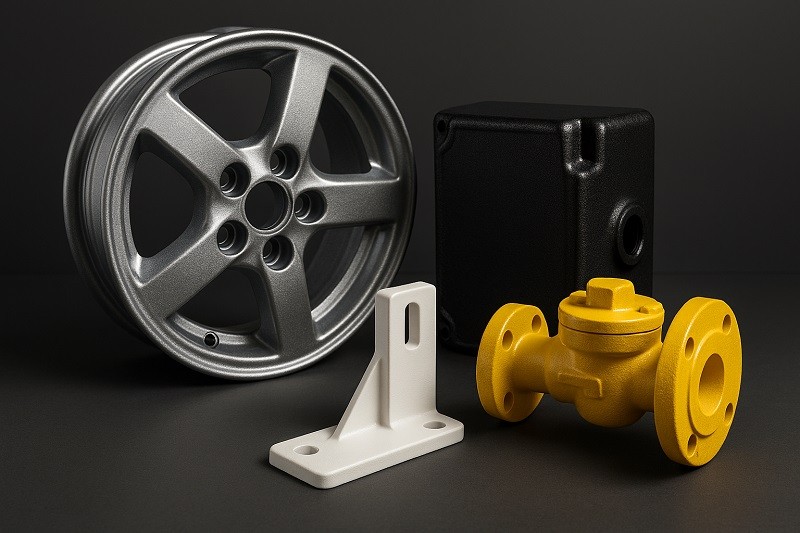
By adopting powder coating, manufacturers not only produce more durable and attractive parts but also contribute positively to a more sustainable future.
Diverse Applications of Custom Powder Coating Die Casting Parts
The unique combination of durability, aesthetic versatility, and environmental friendliness makes powder coating the ideal finish for a vast array of die-cast parts across numerous industries. From components that must withstand extreme weather to those requiring a flawless cosmetic appearance, powder-coated die castings are ubiquitous in modern manufacturing.
Automotive Industry
The automotive sector is a major user of powder-coated die-cast parts. The finish must endure harsh conditions, including exposure to road salt, gravel, chemicals, and UV radiation. Applications include:
- Wheels and Rims: Powder coating provides a tough, chip-resistant finish that protects against corrosion and brake dust.
- Engine Components: Parts like valve covers and intake manifolds are coated for both protection and aesthetic appeal under the hood.
- Chassis and Suspension Parts: The superior corrosion and abrasion resistance is critical for underbody components constantly exposed to the elements.
- Decorative Trim: Provides a long-lasting, vibrant color for trim pieces, roof racks, and bumpers.
Appliance Manufacturing
In the appliance industry, finishes must be both durable enough to handle daily use and aesthetically pleasing to fit into home environments. Powder coating is used on:
- Refrigerators and Freezers: The finish offers excellent resistance to stains, scratches, and fingerprints.
- Washing Machines and Dryers: Provides a tough, moisture-resistant coating that prevents rust.
- Stoves and Ovens: Special high-temperature powder formulations are used to withstand the heat.
- Microwave Ovens and Dishwashers: Coated surfaces are easy to clean and resist chipping.
Architectural and Construction Components
For architectural applications, longevity and weather resistance are paramount. Powder coating protects metal components from fading and degradation due to sun, rain, and pollution. Common uses include:
- Window and Door Frames: Aluminum extrusions are often powder coated to provide a durable, color-stable finish that lasts for decades.
- Fencing and Railings: The coating provides a protective barrier against rust and corrosion for outdoor installations.
- Building Facades and Panels: Offers a wide range of colors and textures for modern architectural design while protecting the underlying metal.
- Light Fixtures: Street light housings and other outdoor fixtures use powder coating for long-term durability and color retention.
Consumer Goods and Electronics
From furniture to gadgets, powder coating provides a high-quality finish that enhances both form and function.
- Outdoor Furniture: Protects metal chairs, tables, and benches from rust and fading.
- Electronics Enclosures: Used for server racks, computer cases, and other electronic housings to provide a durable and attractive finish.
- Tools and Equipment: Power tools and hand tools benefit from a tough, chip-resistant coating.
- Sporting Goods: Items like bicycle frames, golf clubs, and gym equipment are powder coated for durability and visual appeal.
Industrial Equipment and Machinery
In industrial settings, coatings must withstand extreme conditions, including chemical exposure, abrasion, and high impact. Powder coating is the preferred choice for:
- Machinery Housings: Protects the exterior of machines from corrosive fluids and physical damage.
- Pipes and Valves: Offers superior chemical and corrosion resistance for fluid handling systems.
- Electrical Cabinets and Enclosures: Provides a durable, insulating layer that protects sensitive components.
- Warehouse Racking and Guard Rails: The finish is tough enough to endure the daily wear and tear of a busy industrial environment.
Why Choose Custom Powder Coating Over Wet Paint for Die Casting Parts?
When deciding on a finish for die-casting parts, the choice often comes down to two main options: powder coating and traditional wet paint. While both serve to protect and decorate a surface, powder coating offers a clear set of advantages in terms of performance, durability, and environmental impact that make it the superior choice for most applications.
Powder Coating vs. Wet Paint: A Direct Comparison
The fundamental difference between the two lies in their composition and application. Wet paint uses a solvent to suspend pigment and resin in a liquid form, while powder coating is a dry powder applied electrostatically. This core difference leads to significant variations in their properties and performance.
Here is a side-by-side comparison:
| Feature | Powder Coating | Wet Paint |
|---|---|---|
| Composition | Dry thermoset or thermoplastic powder; no solvents. | Liquid with pigments, binders, and solvents. |
| Durability | Extremely high; resistant to chipping, scratching, and wear. | Lower; more prone to chipping, scratching, and fading. |
| Thickness | Thicker, more uniform layers (typically 2-6 mils). | Thinner layers; prone to runs, drips, and sags. |
| Adhesion | Superior thermal and electrostatic bonding to the substrate. | Good, but relies solely on chemical adhesion, which can be less robust. |
| VOC Emissions | Zero or near-zero VOCs. | High VOC emissions from evaporating solvents. |
| Waste | Minimal waste; overspray can be reclaimed and reused (up to 98% utilization). | Significant waste from overspray (up to 70% loss); cannot be reclaimed. |
| Curing Time | Fast; typically cured in minutes in an oven. | Slow; requires extended drying time, often in multiple stages. |
| Color/Finish | Wide variety of colors, textures, and effects. | Excellent for custom color matching but more limited in texture. |
Superior Performance for Custom Powder Coating Die Casting Parts
For die-cast parts that demand high performance, powder coating is the clear winner.
- Enhanced Toughness: The thermal bonding process creates a cross-linked polymer finish that is far more resistant to impact, abrasion, and chemicals than air-dried or baked liquid paint. Powder coated parts can endure harsh environments and rough handling without failing.
- Longevity: Powder coating retains its color and gloss for much longer, especially in outdoor applications where UV exposure can cause wet paint to fade and "chalk" over time. A powder-coated finish can last for up to 20 years, significantly extending the product's aesthetic and functional life.
- Consistent Quality: The electrostatic application process eliminates common paint defects like runs, drips, and uneven thickness. This results in a consistently high-quality finish from part to part, which is crucial for mass production.
Environmental Impact Differences
The environmental advantages of powder coating are undeniable.
- Air Pollution: Liquid paints release harmful VOCs during application and curing, contributing to air pollution and posing health risks to workers. Powder coating is a clean process with virtually no VOC emissions, making it a safer choice for both employees and the planet.
- Waste Management: Wet paint generates hazardous waste through overspray and solvent-based cleanup. In contrast, powder coating produces no hazardous waste, and unused powder can be recycled, making it a much more resource-efficient and sustainable process.
While wet paint may still be suitable for applications that cannot withstand the heat of the curing process or when a very specific custom color needs to be matched on a small scale, for the vast majority of die-casting applications, powder coating offers a superior blend of durability, quality, efficiency, and environmental responsibility.
Conclusion
In conclusion, custom powder coating for die casting parts offers a compelling blend of durability, aesthetic appeal, cost-effectiveness, and environmental responsibility. This advanced finishing process provides a tough, resilient surface that stands up to chipping, corrosion, and wear far better than traditional liquid paint. With a nearly endless selection of colors and textures, it provides unparalleled design freedom while maintaining a consistently high-quality finish.
By understanding its process, benefits, and applications, we can make informed decisions to enhance our products and contribute to a more sustainable future in manufacturing. Adopting powder coating is not just a technical upgrade; it is a strategic choice that adds long-term value, improves product performance, and demonstrates a commitment to environmentally conscious practices. We encourage you to explore how this powerful technology can benefit your next project and to share this guide with colleagues who are also striving for excellence in manufacturing.