Technology Innovation
High-Speed Machining (HSM): Cutting Speeds, Toolpaths, and Productivity Gains
High-speed machining has evolved from a niche technique into the backbone of modern precision manufacturing. Learn how HSM cutting speeds, advanced toolpath strategies, and optimized machine systems deliver dramatic productivity gains — and how SOMI Custom Parts applies them to your CNC parts.
10,000+RPM spindle speeds typical of HSM
6-10xcycle time reduction vs conventional
0.5 mmthin walls machined without chatter
38%of precision parts need HSM operations
1. Introduction: Why High-Speed Machining Matters in 2026
High-speed machining (HSM) is no longer a "nice to have" capability reserved for aerospace giants. It has become a competitive necessity for any shop producing complex, high-precision components. The global high-speed and high-precision CNC machining center market was valued at roughly $12.8 billion in 2025 and is projected to grow at a 5.7% compound annual growth rate, reaching about $19.9 billion by 2033. In the HSC machining center segment specifically, 2026 market size is estimated at $1.89 billion with growth toward $3.06 billion by 2035.
Industry data shows that more than 62% of aerospace component manufacturers now apply high-speed techniques to aluminum, titanium, and composite parts, while the global automotive industry runs over 180,000 CNC systems, nearly 27% of which are high-speed machines exceeding 15,000 RPM. Among all precision machined parts produced globally — over 120 million per year — roughly 38% require high-speed machining operations. At SOMI Custom Parts, we integrate HSM into daily production across milling and turning, so our customers get faster delivery, tighter tolerances, and better surface finishes without paying aerospace prices.
2. What Is High-Speed Machining (HSM)?
High-speed machining is an advanced cutting strategy that combines high spindle speeds, high feed rates, shallow depths of cut, and optimized toolpaths to remove material faster while maintaining — or improving — accuracy and surface quality. It is not simply "running a spindle faster." True HSM is a complete system that requires a capable machine, balanced tooling, advanced CAM software, and the right cutting parameters working together.
The Salomon Principle
German engineer Dr. Carl Salomon observed in 1931 that cutting temperature rises with speed up to a critical point, then begins to fall. At very high speeds, heat has no time to transfer into the tool or workpiece — most of it leaves with the chip. This "temperature paradox" is the physical foundation of HSM and explains why lighter, faster cuts can actually extend tool life.
Radial Chip Thinning
When the radial width of cut is less than half the cutter diameter — typical of HSM — the actual chip thickness becomes smaller than the programmed chip load. To maintain an optimal chip, feed rates must be increased accordingly. This compensation is what allows high feed rates without overloading the tool, boosting material removal rates despite light cuts.
Key distinction: HSM is defined by the whole system — spindle speed, feed rate, tool engagement, toolpath geometry, and machine dynamics — not by any single RPM threshold. Many shops reference 15,000 RPM as a starting point, but engagement control matters just as much as speed.
3. Key Benefits of High-Speed Machining
Dramatic Cycle Time Reduction
By combining high feed rates with constant-engagement toolpaths, HSM can cut machining time by 6-10x versus conventional methods in many applications. Documented case studies show cycle times cut in half — parts that took 45 minutes now take 20.
Superior Surface Finish
Light, fast cuts and smooth motion control produce fine, consistent finishes — often mirror-like straight off the machine — eliminating or reducing secondary polishing and grinding operations.
Less Heat, Less Distortion
Because heat is evacuated with the chips, thermal expansion and part distortion are minimized — critical for thin-walled aerospace and medical components with tight tolerances.
Extended Tool Life
Counterintuitively, HSM often extends tool life: reduced heat, lower cutting forces, and consistent chip load mean less thermal shock and mechanical stress on cutting edges.
Thin-Wall Machining
Low, consistent cutting forces let machinists produce parts with walls as thin as 0.5 mm that would deflect or chatter under conventional machining — ideal for enclosures, ribs, and delicate features.
Higher Accuracy
Less vibration and thermal growth translate into tighter tolerances and consistent dimensions across the run — modern HSC machines improve dimensional accuracy by up to 18% versus older systems.
4. HSM Toolpath Strategies: Trochoidal, Adaptive, and High-Feed
Toolpath strategy is what separates true HSM from a fast spindle with conventional paths. Three core strategies dominate modern high-speed machining:
Trochoidal Milling
Uses circular, looping movements to cut pockets and slots. The tool keeps a reduced radial engagement while running full axial depth, avoiding overheating and deflection. Ideal for deep slots and difficult materials.
Adaptive / Constant-Load Clearing
The CAM algorithm continuously recalculates remaining stock and spirals inward, maintaining constant tool engagement. No sharp corners, no full-width slotting — so feeds can be pushed 2-3x higher without shock loading.
High-Feed Strategies
Light radial cuts with heavy axial depth — skimming about 10% of tool diameter while plunging 2-3x the diameter deep. Favorable chip-thinning geometry removes huge volumes of material, especially when spindle speed is limited.
HPM + HSM = the winning combination: High-Performance Machining (HPM) maximizes material removal with trochoidal paths at moderate speeds, while HSM finishes with light, fast passes for exceptional surface quality. Most efficient shops use HPM for roughing and HSM for finishing.
5. Cutting Speeds and Parameters by Material
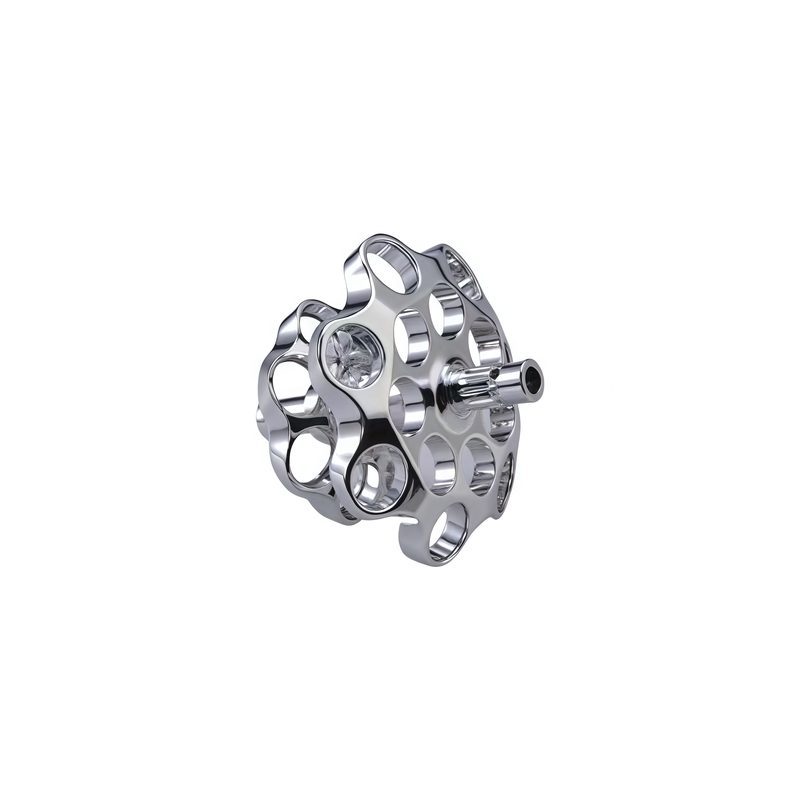
Cutting speed (SFM or m/min) directly controls the temperature at the tool tip. Exceed the material's recommended range and the cutting edge softens, craters, and fails; stay within it and you balance tool life against material removal. Below are practical carbide end mill starting points for HSM, cross-checked against ISO 513 material groups and tool-maker recommendations (Sandvik Coromant, Kennametal, Harvey Tool).
| Material | Carbide SFM (milling) | HSM chip load (mm/tooth, 12mm Ø) | Notes |
|---|
| Aluminum 6061 / 7075 | 600 - 1,200 | 0.05 - 0.10 | Polished flutes, high helix, MQL or flood coolant |
| Carbon steel 1018 / A36 | 300 - 500 | 0.04 - 0.07 | TiAlN coating recommended |
| Alloy steel 4140 (annealed) | 200 - 350 | 0.04 - 0.06 | Drop SFM 10% per 50 HB above 200 HB |
| Stainless 304 / 316 | 120 - 250 | 0.03 - 0.05 | Work-hardens; never dwell, always keep chip flowing |
| Titanium Ti-6Al-4V | 100 - 180 | 0.03 - 0.05 | High-pressure coolant, sharp edges, trochoidal paths |
| Hardened steel >50 HRC | 60 - 120 | 0.02 - 0.04 | CBN or ceramic tools; radial stepover ~5% of Ø |
Never "slow down to be safe": if feed per tooth drops below ~0.008 mm, the tool stops cutting and starts rubbing — friction spikes, the edge overheats, and stainless or titanium work-hardens. The next pass cuts a harder material, accelerating wear. Reduce RPM and feed together, never feed alone.
For 7075-T6 aluminum in HSM, experienced shops run 450-600 m/min cutting speed with 0.10-0.15 mm/tooth chip load — significantly more aggressive than 6061 parameters. One cautionary shop case: a drone manufacturer running 7075 at 6061 speeds (300 m/min) generated heat-induced stress cracks in propeller hubs, costing $200,000 and two months of production. Conservative, material-matched parameters pay.
6. The Six Pillars of an HSM System
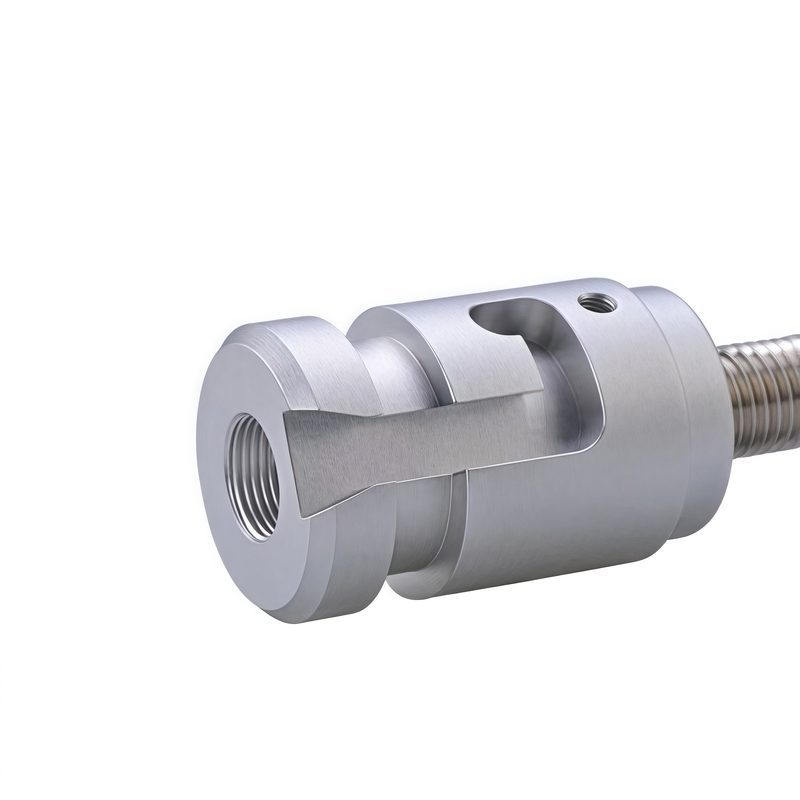
01High-Speed Spindle
15,000-40,000 RPM typical, up to 90,000+ RPM in specialty applications. Advanced bearings and liquid/air cooling manage thermal loads.
02Rigid Machine Frame
Polymer-granite bases and linear guideways absorb vibration and enable fast acceleration, keeping toolpath accuracy at speed.
03High-Speed CNC Controller
Look-ahead functions, high-speed block processing, and real-time adjustment keep feed rates stable through complex geometry.
04Balanced Toolholding
At 30,000 RPM even microscopic imbalance causes destructive vibration. Hydraulic chucks and shrink-fit holders with minimal runout are preferred.
05Optimized Cutting Tools
Sharp edges, heat-managing coatings (TiAlN, AlTiN), and reduced flute counts for chip evacuation.
06Advanced CAM with HSM Strategies
Adaptive clearing, trochoidal milling, and smooth transitions keep tool engagement constant and forces stable.
At SOMI Custom Parts, our CNC milling and turning capabilities include high-speed spindles, balanced toolholding, and modern CAM programming with adaptive and trochoidal strategies — see our CNC milling parts and CNC turning parts pages for examples of parts produced with HSM techniques.
7. HSM vs Conventional Machining: Side-by-Side
| Factor | High-Speed Machining | Conventional Machining |
|---|
| Spindle speed | Typically >10,000 RPM (often 15,000-40,000) | Typically <6,000 RPM |
| Feed rate | Often >1,000 mm/min | 100 - 500 mm/min |
| Tool engagement | Light radial, constant engagement angle | Full-width cuts, variable engagement |
| Chip load consistency | Maintained throughout the toolpath | Varies, especially in corners |
| Heat distribution | Evacuated with chips | Builds up in tool and part |
| Machine motion | Smooth, continuous, controlled acceleration | Stop-start with hard corners |
| Surface finish | Fine, often finish-ready | Often needs secondary finishing |
| Part distortion | Minimal (low heat, low force) | Higher thermal and force distortion |
8. Where HSM Shines: Applications and Industries
Aerospace
Monolithic aluminum and titanium structural parts with pockets, ribs, and thin walls. HSM is the standard process for airframe components and reduces EDM and hand polishing in hardened tooling.
Medical
Orthopedic implants and surgical instruments from titanium and stainless steel achieve tight tolerances and biocompatible finishes without secondary operations.
Mold & Die
Complex 3D contours in hardened steels (45-65 HRC) with surface finishes below Ra 0.2 µm — cutting mold lead times dramatically.
Automotive & EV
Engine components, transmission parts, and EV powertrain components benefit from high-volume precision at reduced cycle times.
Electronics
Thin-walled aluminum enclosures, heat sinks, and chassis for consumer electronics get precise fits and aesthetic surfaces.
Energy & Optics
Turbine components and precision optical housings require the fine finishes and accuracy that HSM delivers.
9. HSM Challenges and How to Overcome Them
Longer Programming Time
Adaptive toolpaths are more complex than basic pocket clearing. For one-off prototypes, this overhead can offset cycle-time savings. Solution: use HSM where it pays — medium to high volumes, thin walls, tight tolerances, and work-hardening materials.
Machine Capability Limits
Older machines lack the acceleration, jerk control, and spindle speed for HSM. Solution: verify machine dynamics before committing; high-feed strategies help when spindle speed is limited.
Higher Tooling Costs
Specialized carbide, coatings, and balanced holders cost more upfront. Solution: longer tool life and reduced secondary finishing typically offset the investment across production runs of 100+ parts.
Thermal Management
High cutting temperatures demand proper coolant delivery. Solution: through-spindle high-pressure coolant evacuates chips and heat; match speeds to material thermal properties.
10. How SOMI Custom Parts Can Help
At SOMI Custom Parts, high-speed machining is part of our standard workflow, not a premium add-on. Our CNC shop combines high-speed spindles, balanced toolholding, and modern CAM toolpath strategies with rigorous quality control — our processes align with ISO 9001 quality management principles, and our aerospace-grade parts follow AS9100-style documentation practices including material certificates and inspection reports.
From CNC milling and CNC turning to CNC drilling, we apply HSM principles where they deliver the most value: thin walls, tight tolerances, hard-to-machine alloys, and production runs where cycle time multiplies into savings. We also help you design for manufacturability — matching cutting parameters to your material and tolerances so you avoid over-specifying and overpaying.
Send us your drawings for a free DFM review and quote at our inquiry page, or explore our full product catalog to see what we make every day.
11. Frequently Asked Questions
Q: What spindle speed is considered "high speed" machining?
There is no universal threshold, but 15,000 RPM and above is a common starting point, with typical HSM machines running 15,000-40,000 RPM and specialty spindles reaching 90,000+ RPM. What matters more than RPM is the combination of feed rate, tool engagement control, and machine dynamics.
Q: Does HSM reduce tool life?
Not necessarily. While tools run faster, the reduced heat and consistent chip load often extend tool life versus conventional machining. Thermal shock is minimized and wear is distributed evenly. Correct parameters are essential — running a fast spindle with a mismatched feed rate destroys tools quickly.
Q: Which materials are best for high-speed machining?
Aluminum alloys are the sweet spot — 6061 and 7075 cut cleanly at high speeds and evacuate heat well. Hardened steels, titanium (with careful optimization), stainless steel, and engineering plastics also benefit. Ceramics, glass, and heat-sensitive materials are not suitable.
Q: Is HSM more expensive than conventional CNC machining?
Per-part cost often falls with HSM because cycle times drop by 40-60%. Upfront programming and tooling costs are higher, so the economics favor production runs of 100 parts or more, complex geometries, thin walls, and tight tolerances. For simple 2D profiling or single prototypes, conventional machining may be more economical.
Q: What is the difference between HSM and high-performance machining (HPM)?
HPM focuses on maximizing material removal rate using trochoidal toolpaths and long engagements, often at moderate speeds. HSM emphasizes higher spindle speeds and lighter, faster passes for superior surface finish and accuracy. In practice they complement each other — HPM for roughing, HSM for finishing.
12. Conclusion
High-speed machining has moved from aerospace showrooms into everyday precision manufacturing. By pairing high cutting speeds with constant-engagement toolpaths and a properly integrated machine system, manufacturers achieve cycle time reductions of 6-10x, finer surface finishes, longer tool life, and the ability to machine thin-walled parts that conventional methods simply cannot hold. With the high-speed machining center market growing at 5.4-5.7% CAGR through the early 2030s, HSM capability is quickly becoming a baseline expectation for precision CNC suppliers.
If your project involves complex geometries, hard-to-machine alloys, tight tolerances, or production volumes — send SOMI Custom Parts your inquiry today and let our engineers apply high-speed machining to your parts. For more manufacturing insights, visit our blog or contact us directly.