Aluminum Extrusion Enclosure for Server-Room Communication Equipment
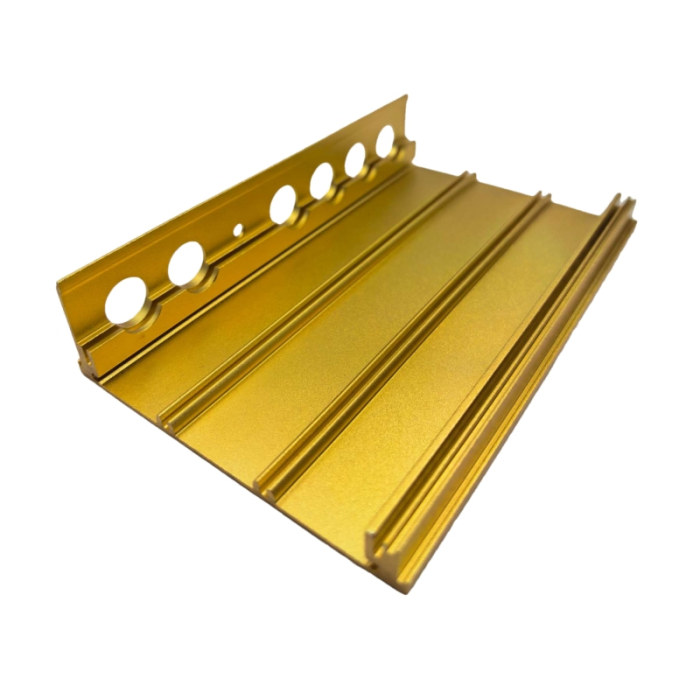
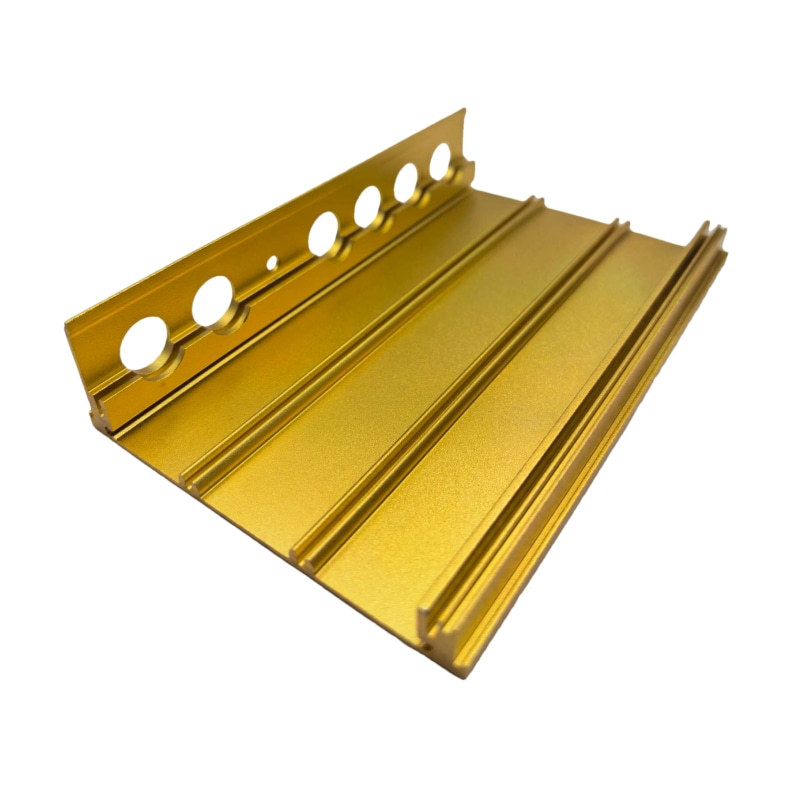
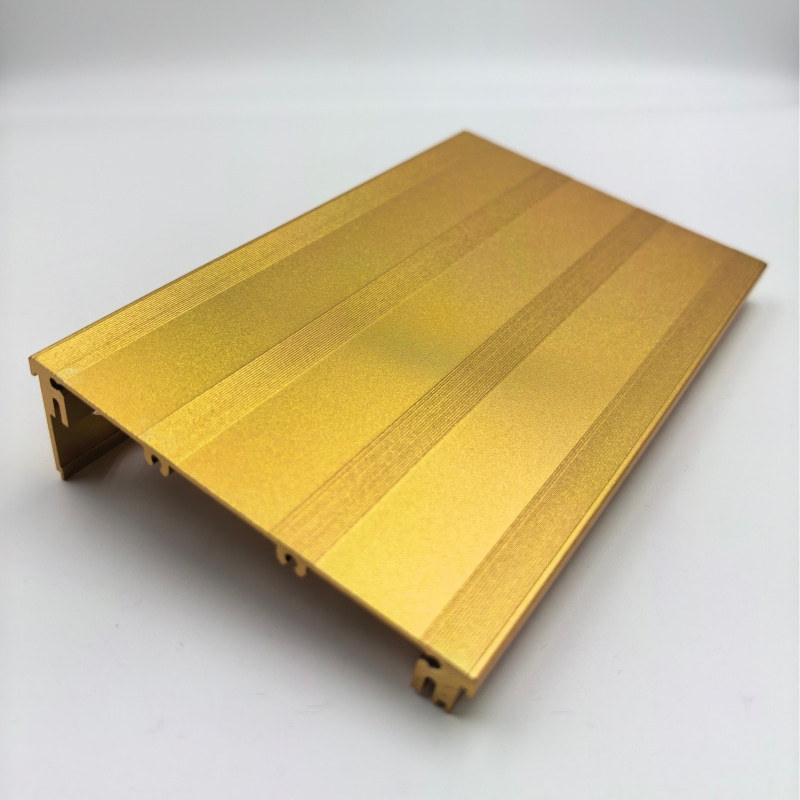
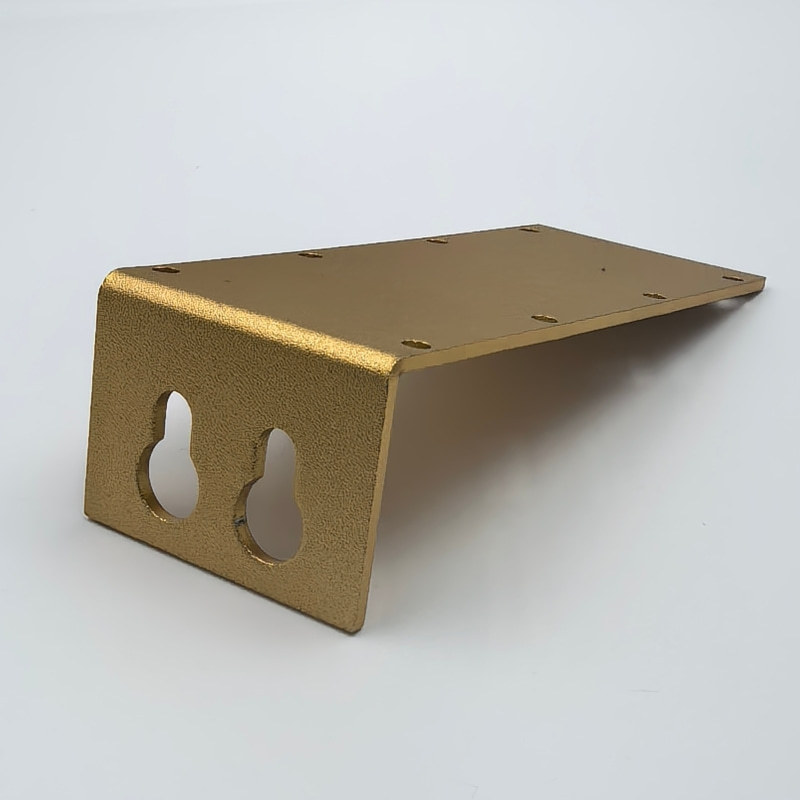
A communication equipment manufacturer needed an enclosure for hardware installed in server rooms. The body is a custom 6063-T5 aluminum extrusion that carries the modules; the side is closed by a stamped 5052-H32 bracket with keyhole slots for wall mounting. Both parts were made to the customer samples and finished in the same sandblasted, gold-anodized surface.
6063-T5custom extruded profile body
±0.1 mmon machined critical features
2components, produced as one system
Why This Enclosure Was Extruded
An enclosure can be extruded, stamped or die cast. This one went to extrusion because the part is a straight run with a constant cross-section, and because the run did not justify a steel mold.
One die, any length
The cross-section is fixed by the die, so the same tooling serves every length the project calls for. Changing the length means changing the cut, not the tool.
Ribs come free
Reinforcing ribs and the channel that seats the modules are part of the profile geometry. They are formed by the die rather than added in a secondary operation.
Lower tooling than a mold
An extrusion die is a fraction of the cost of a die-casting mold, which matters when the annual volume sits in the hundreds or low thousands rather than hundreds of thousands.
Anodizes cleanly
6063 is the standard alloy for architectural and enclosure profiles, and it takes a uniform anodized layer, which is what makes the gold finish consistent along the whole length.
Specification
The callouts that drove fit, finish and repeatability on this build.
Item
Extruded profile body
Stamped side bracket
Material
6063-T5 (6061-T6 available)
5052-H32 or 1060-H24 aluminum sheet
Forming
Hot extrusion to a custom die
Stamping and forming
Secondary operations
Precision cutting, CNC drilling
Punching, deburring
Surface
Sandblasted, then gold anodized
Sandblasted, then gold anodized
Key features
Module channel, reinforcing ribs, mounting holes
Keyhole slots, countersunk holes
Tolerance
±0.1 mm on machined features
Hole positions matched to the sample
Reference
Customer physical sample
Customer physical sample
The Two Components
One extruded body, one stamped bracket, one surface specification.
Extruded Enclosure Body
The structural body. The profile carries internal ribs for stiffness, a channel that locates the communication modules, and a row of mounting holes. Length, hole positions and slot cuts are all set after extrusion.
6063-T5 extruded profile, 6061-T6 on request
Cut to length, then CNC drilled
Module channel and reinforcing ribs formed by the die
Closes the side of the extrusion and carries the wall-mounting interface. Keyhole slots let the assembly hang on a screw head and drop into position; countersunk holes keep fasteners flush with the panel face.
Four choices on an extruded enclosure decide both the cost and the finish.
6063-T5 or 6061-T6
6063 gives the better anodized surface and is the default for enclosure profiles. 6061 is stronger and machines more cleanly when the part carries load, at the cost of a slightly less even finish.
Wall thickness and ribs
Uniform wall along the profile, with ribs where the body needs stiffness. Thicker walls add weight and extrusion load without adding much rigidity compared with a well-placed rib.
Holes after extrusion
Mounting holes and slot cuts are machined after the profile is cut to length, which is what brings critical features to ±0.1 mm rather than leaving them to die tolerance.
Finish matched across parts
Extruded body and stamped bracket ran through the same sandblast and anodize sequence, so the gold tone is matched rather than merely similar.
How It Was Made
Four stages from billet to a finished, matched pair.
01
Extrusion
Billets are heated and pushed through a custom die that forms the cross-section, including the ribs and the module channel.
02
Cutting
Extruded lengths are cut on CNC-controlled saws so the ends stay square and the length repeats piece to piece.
03
Drilling
Mounting holes, keyhole slots and feature cuts are machined on multi-axis centers, then deburred so edges are clean before anodizing.
04
Sandblast and anodize
Sandblasting gives both parts the same matte base; anodizing builds the gold oxide layer on top along the full extruded length.
Extrusion, Stamping or Die Casting
All three are aluminum routes and all three can be anodized. What separates them is geometry and volume, not material.
Factor
Extrusion (used for the body)
Stamping (used for the bracket)
Die casting
Best for
Constant cross-section, ribs and channels that run straight, any length
Flat or folded panels, brackets, covers
Complex 3D housings, bosses, angled walls, pressure-tight bodies
Tooling
Extrusion die per profile
Stamp and form tools
Steel mold with cavities, gating and cooling
Typical tolerance
Section per profile standard; machined features to ±0.1 mm
Hole positions set by the tool
Roughly ±0.1 to ±0.3 mm on cast features, tighter after machining
Wall thickness
Uniform along the profile, set by the die
Sheet gauge, uniform
Variable, with draft on vertical faces
Volume fit
Low to high, one die serves every length
Medium to high
Medium to high, mold cost carried by the run
Change cost
New die only if the cross-section changes
New tool if blank or fold changes
Highest of the three
Rule of thumb from this build: a straight enclosure with ribs and a repeated hole pattern is usually cheaper to extrude and machine than to cast. If the housing needs sculpted geometry, internal bosses or pressure-tight walls, the calculation flips. Capability detail sits under aluminum extrusion and die casting.
Questions Buyers Ask Before Ordering
What is the minimum length or quantity for a custom extrusion?
The constraint is the die, not the cut length: one profile die serves short and long parts, so a single project can mix several lengths. The practical limit is the die cost, which is why extrusion suits projects that need more than a handful of pieces.
Can you work from our sample instead of a drawing?
Yes. This project ran from physical samples: the parts were measured against the supplied hardware and the hole pattern came from it. If drawings or a 3D model exist, send both, because the drawing defines which features are critical and which are cosmetic.
What tolerance is realistic on an extruded enclosure?
On this build, machined features such as hole positions and slot cuts were held to ±0.1 mm. That figure applies after machining, not to the extruded cross-section itself, which is governed by the die and by normal extrusion tolerances.
Could the same enclosure be die cast instead?
It could be re-engineered that way, but it becomes a different part: a die-cast housing can carry bosses and variable wall thickness at the cost of a steel mold. For a straight body at this volume, extrusion plus CNC is the shorter route.
Client Feedback
The aluminum enclosures and brackets were manufactured to our samples. The anodized gold finish was what we needed for this equipment line, and fit and finish came out right.
Need a custom extruded enclosure?
Send a drawing, a 3D model or a physical sample. We will come back with the profile callout, the alloy, the features we would machine after extrusion, and the finish sequence to match parts in one color.
We are committed to providing full-process services from prototyping to mass production. We provide rapid prototyping services to ensure that your design can be realized accurately and efficiently.
We hope to discuss potential cooperation opportunities with you and ask you to provide quotation information for your project. Looking forward to your reply and working with you to promote the success of your project!
*Email
*Name
*Phone
*Title
*Content
Upload
Only supports .rar/.zip/.jpg/.png/.gif/.doc/.xls/.pdf, maximum 20MB.