Wholesale Custom Plastic Injection Molding Parts: 3D Printing, Injection Molding, and CNC Machining Explained
As we navigate the vast landscape of manufacturing, especially when it comes to creating high-quality plastic components, it's crucial to understand the different processes available. We'll be diving deep into three prominent methods: 3D Printing, Injection Molding, and CNC Machining. Our goal is to explain how each works, their unique benefits, and when to choose one over the others for your Wholesale Custom Plastic Injection Molding Parts needs. Making informed decisions about these manufacturing processes can significantly impact your product's quality, cost, and time to market. Join us as we break down the complexities of 3D printing, injection molding, and CNC machining, providing you with the knowledge to select the best fit for your projects.
Understanding the Fundamentals of Manufacturing Wholesale Custom Plastic Injection Molding Parts
To make the right choice for your project, it's essential to first grasp the core mechanics of each manufacturing technology. Each method approaches the creation of a part from a fundamentally different perspective, which in turn dictates its strengths, weaknesses, and ideal applications.
What is 3D Printing (Additive Manufacturing)?
3D printing, formally known as additive manufacturing, is a revolutionary process that builds three-dimensional objects from a digital file. Unlike traditional manufacturing methods that cut away material, 3D printing constructs parts by adding material one layer at a time. This approach unlocks incredible design freedom and is a cornerstone of modern rapid prototyping.
How We Build Parts Layer by Layer
The fundamental principle of additive manufacturing is the creation of a physical part by adding material sequentially, one thin layer after another. This process begins with a digital blueprint, typically a Computer-Aided Design (CAD) file. This digital model is then processed by specialized software called a "slicer."
A slicer's job is to digitally "slice" the 3D model into hundreds or thousands of thin, horizontal cross-sections. For each of these layers, the software generates a detailed set of instructions, often in a language called G-code, which dictates the precise movements of the 3D printer. These instructions control everything: the path the print head will take, the speed of movement, and the amount of material to be deposited.
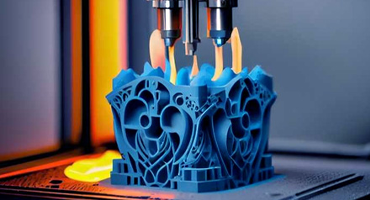
The printer then executes these instructions, starting from the bottom layer and working its way up. It deposits or solidifies material—be it plastic, resin, or powder—exactly where the digital slice indicates. As each new layer is added and bonded to the one below it, the three-dimensional object gradually takes shape. Layer thickness can range from 25 to 300 microns, with thinner layers yielding a smoother surface finish at the cost of longer print times. This direct transition from a digital file to a physical object is a hallmark of the 3D printing process.
Types of 3D Printing Technologies for Wholesale Custom Plastic Injection Molding Parts
When considering 3D printing for plastic parts, three technologies stand out due to their prevalence and distinct capabilities: Fused Deposition Modeling (FDM), Stereolithography (SLA), and Selective Laser Sintering (SLS).
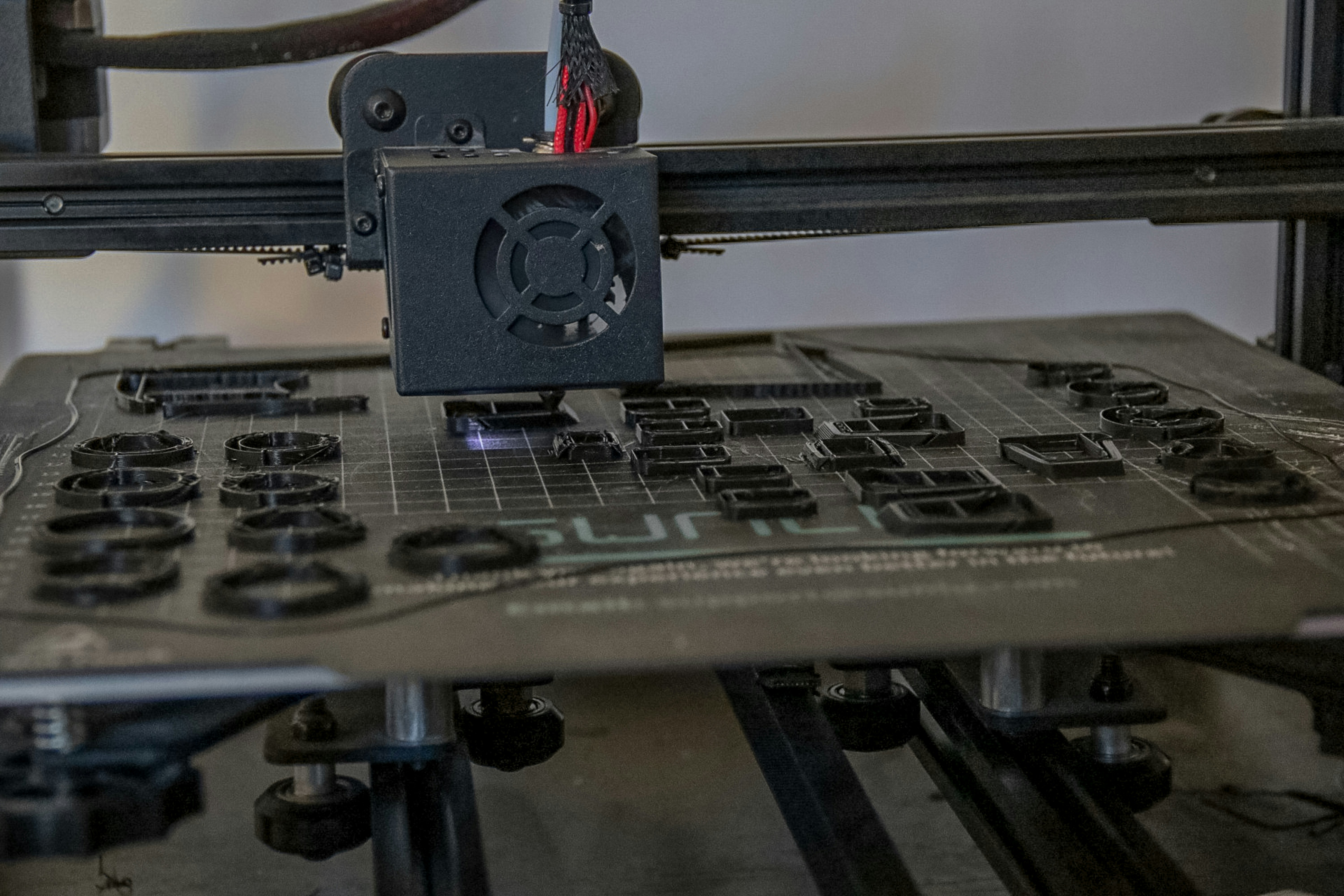
Fused Deposition Modeling (FDM): This is the most widely recognized and accessible form of 3D printing. FDM printers work by melting a thermoplastic filament and extruding it through a nozzle, depositing the material layer by layer onto a build platform. It's known for its affordability, speed on simple parts, and a wide array of material choices, including common plastics like PLA and ABS. FDM is excellent for basic proof-of-concept models and low-cost rapid prototyping. However, its primary drawbacks are lower resolution and a less refined surface finish, often showing visible layer lines.
Stereolithography (SLA): SLA operates by using an ultraviolet (UV) laser to selectively cure a liquid photopolymer resin in a vat. This process, called photopolymerization, creates parts with exceptional detail, high accuracy, and a very smooth surface finish. This makes SLA ideal for visual prototypes, intricate designs like jewelry or dental models, and parts where aesthetics are paramount. While versatile, the resins are generally more expensive and the resulting parts can be more brittle compared to those from FDM or SLS.
Selective Laser Sintering (SLS): An industrial-grade technology, SLS uses a high-powered laser to fuse or sinter small particles of polymer powder together. A key advantage of SLS is that it doesn't require support structures, as the unsintered powder in the build chamber supports the part during printing. This allows for the creation of highly complex geometries, internal components, and interlocking parts. SLS parts, typically made from materials like nylon, exhibit excellent mechanical properties, strength, and durability that resemble injection-molded components, making them suitable for functional testing and end-use applications.
| Technology | Process | Common Materials | Key Advantages | Ideal Applications |
|---|---|---|---|---|
| FDM | Extrudes melted thermoplastic filament | PLA, ABS, PETG | Low cost, Fast, Wide material variety | Basic prototypes, Functional parts |
| SLA | Cures liquid resin with a UV laser | Standard & Engineering Resins | High detail, Smooth finish, Complex geometries | Visual prototypes, Molds, Intricate models |
| SLS | Fuses polymer powder with a laser | Nylon, TPU, PP | Strong parts, No support structures, Design freedom | Functional parts, Complex geometries, End-use components |
What is Injection Molding?
Injection molding is a cornerstone of mass production, renowned for its ability to produce vast quantities of identical plastic parts with high precision and low per-unit costs. It is a formative process where molten material is forced into a custom-made mold, taking its shape as it cools and solidifies.
The Process of Creating Consistent Wholesale Custom Plastic Injection Molding Parts
The production of a part via injection molding follows a precise, repeatable cycle, ensuring consistency across thousands or even millions of units. While cycle times can be as short as a few seconds, they all consist of the same fundamental stages.
- Clamping: The process begins with the mold, which typically consists of two halves (the cavity and the core), being securely shut by a powerful clamping unit. Sufficient force is applied to keep the mold tightly sealed against the immense pressure of the injection phase.
- Injection: Raw plastic material, usually in the form of small pellets, is fed from a hopper into a heated barrel. A rotating screw inside the barrel melts the plastic and conveys it forward. Once enough molten plastic has accumulated in front of the screw (known as a "shot"), the screw acts as a plunger, forcing the material at high pressure through a nozzle and into the mold cavity. The molten plastic fills the entire space, runners, and gates within the mold.
- Holding and Cooling: After the cavity is filled, a "holding" pressure is maintained to pack the material tightly and compensate for any material shrinkage as it begins to cool. Simultaneously, coolant (usually water) circulates through channels within the mold to absorb heat from the plastic. This cooling phase is often the longest part of the cycle and is critical for allowing the part to solidify into its final, stable form.
- Ejection: Once the part has cooled sufficiently and is solid, the clamping unit opens the mold halves. An ejection system, typically consisting of pins or plates, then pushes the finished part out of the core side of the mold. The machine is then ready to close the mold and begin the next cycle.
Traditional vs. Rapid Injection Molding for Wholesale Custom Plastic Injection Molding Parts
The world of injection molding can be broadly divided into two categories based on tooling: traditional molding and rapid molding. The choice between them hinges on production volume, lead time, and budget.
Traditional Injection Molding: This method is the workhorse for high-volume, mass production, often creating millions of identical parts. It relies on molds machined from hardened steel. Steel tools are incredibly durable, resistant to wear from abrasive plastics, and can withstand the rigors of continuous production cycles over a long period. However, creating a hardened steel mold is a time-consuming and expensive upfront investment, sometimes taking weeks or months to fabricate. This makes traditional molding ideal for finalized designs with a long production life but impractical for prototyping or low-volume runs.
Rapid Injection Molding (or Rapid Tooling): This approach prioritizes speed and cost-effectiveness for low- to mid-volume production (from prototypes to tens of thousands of parts). Instead of steel, rapid tooling typically uses molds made from softer materials like aluminum. Aluminum is much easier and faster to machine, which can reduce mold fabrication time from months to just days or weeks. Furthermore, aluminum has superior thermal conductivity, meaning it heats up and cools down much faster than steel. This property can significantly shorten cycle times, sometimes by as much as 25-40%, leading to faster part delivery. The trade-off is durability; aluminum molds have a shorter lifespan than steel tools and are not suitable for massive production runs, but they are perfect for validating designs with production-grade materials, market testing, or bridge production while a steel tool is being made.
What is CNC Machining (Subtractive Manufacturing)?
CNC (Computer Numerical Control) machining is the quintessential example of subtractive manufacturing. In stark contrast to 3D printing, this process starts with a solid block of material (known as a blank or workpiece) and systematically carves away material using high-speed cutting tools to reveal the final part. The entire process is guided by a computer program, ensuring extreme precision and repeatability.
How We Precisely Remove Material for Wholesale Custom Plastic Injection Molding Parts
The CNC machining process is a sophisticated blend of software, automation, and mechanical precision. It transforms a digital design into a physical object by methodically cutting away excess material.
The workflow begins with a 3D CAD model of the final part. This model is then loaded into Computer-Aided Manufacturing (CAM) software, which plays a crucial role in translating the digital design into machine-readable instructions. The CAM software generates toolpaths—the exact coordinates and routes the cutting tool will follow. These instructions, written in a language called G-code, control every aspect of the machine's movement, including the tool's direction, speed, and rotation.
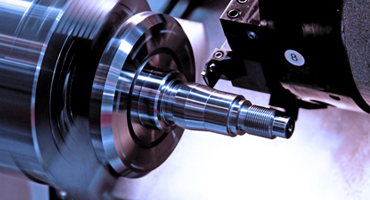
Once the program is ready, a solid block of the chosen plastic material is securely fixed onto the machine's work bed or in a vise. The CNC machine then commences the operation, following the G-code with high fidelity. A spinning cutting tool (like an end mill or drill bit) precisely removes material from the workpiece. This can involve a series of operations, such as roughing cuts to remove large volumes of material quickly, followed by finishing passes to achieve the final dimensions and a smooth surface. This controlled, automated removal of material allows CNC machining to produce parts with extremely tight tolerances and excellent surface finishes.
CNC Milling vs. CNC Turning for Wholesale Custom Plastic Injection Molding Parts
While both are forms of CNC machining, milling and turning differ fundamentally in how the tool and workpiece interact. This distinction makes them suitable for creating different types of part geometries.
CNC Milling: In CNC milling, the workpiece is held stationary while a multi-point cutting tool rotates at high speed to remove material. The cutting tool can move along multiple axes (typically 3 to 5 axes), allowing it to create complex shapes, flat surfaces, pockets, holes, and intricate details. Because the tool moves around the part, milling is exceptionally versatile and ideal for producing non-symmetrical, complex components like housings, brackets, jigs, and fixtures.
CNC Turning: CNC turning, performed on a machine called a lathe, reverses the roles of the workpiece and tool. Here, the block of material (workpiece) is held in a chuck and rotates at high speed, while a stationary single-point cutting tool moves along its surface to cut away material. This process is inherently suited for creating cylindrical, conical, or round parts with high precision and excellent surface finishes. Common examples of turned parts include shafts, pins, bushings, spacers, and custom screws. The continuous cutting action generally results in a smoother finish compared to milling.
In essence, the choice between milling and turning is dictated by the part's primary geometry. If the part is largely cylindrical or rotational, turning is the go-to process. If the part has more complex, prismatic, or freeform shapes, milling is the appropriate choice. Many complex parts often require both processes to be completed.
Comparing 3D Printing, Injection Molding, and CNC Machining for Wholesale Custom Plastic Injection Molding Parts
Choosing the optimal manufacturing process requires a careful evaluation of several key factors: cost, speed, design complexity, and material properties. Each method—3D printing, injection molding, and CNC machining—offers a unique balance of these attributes.
Cost Analysis: Investing in Wholesale Custom Plastic Injection Molding Parts
The financial implications of choosing a manufacturing process are often a primary concern. Costs can be broken down into upfront (or tooling) costs and per-unit costs, which vary dramatically between these three technologies.
Understanding Upfront vs. Unit Costs for Wholesale Custom Plastic Injection Molding Parts
The cost structure of each manufacturing process is fundamentally different, impacting which is most economical at various production scales.
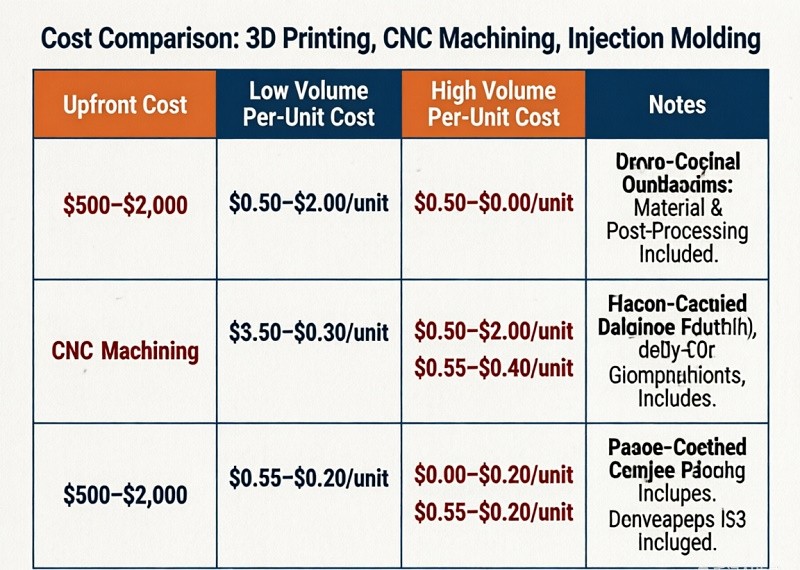
- Injection Molding: This process is defined by a very high upfront investment and an extremely low per-unit cost. The primary expense is the creation of the mold (tooling), which can range from a few thousand dollars for a simple, low-volume aluminum tool to over $100,000 for a complex, multi-cavity hardened steel mold designed for millions of parts. Once this tool is made, however, the cost to produce each individual part becomes very low—often just pennies—as the process is highly automated and cycle times are short. This makes injection molding the undisputed champion for high-volume production.
- 3D Printing: 3D printing sits at the opposite end of the spectrum. It has virtually no upfront tooling costs. You can go directly from a CAD file to a physical part without creating a mold. However, the per-unit cost is relatively high and remains fairly constant regardless of volume. This cost is driven by factors like material usage (which is often more expensive per kilogram than molding pellets), machine time (which can be hours per part), and any necessary labor for post-processing. As a result, 3D printing is most cost-effective for one-offs, prototypes, and very low-volume production runs, typically under 200 units.
- CNC Machining: CNC machining has a moderate cost structure. There are no tooling costs in the same vein as injection molding, but there are setup and programming costs associated with preparing the CAM file and fixturing the material. The per-unit cost is higher than injection molding due to longer cycle times and material waste (as it's a subtractive process), but it generally becomes more cost-effective than 3D printing as quantities increase, often starting around 100 to 300 units depending on part complexity.
| Process | Upfront Cost (Tooling) | Per-Unit Cost (at low volume) | Per-Unit Cost (at high volume) |
|---|---|---|---|
| 3D Printing | None to Very Low | High | High |
| CNC Machining | Low to Moderate (Setup/Programming) | Moderate | Moderate to High |
| Injection Molding | Very High | Very High (due to tooling) | Very Low |
Breakeven Points for Different Production Volumes of Wholesale Custom Plastic Injection Molding Parts
The "breakeven point" is the production volume at which injection molding becomes more cost-effective than an alternative like 3D printing or CNC machining. This is the point where the savings from the low per-unit cost of molding finally offset its high initial tooling investment.
3D Printing vs. Injection Molding: The breakeven point here is highly sensitive to part complexity and size. For simple, small parts, injection molding might become cheaper after just a few hundred units. For very complex parts that would require an extremely expensive mold, 3D printing could remain the more economical choice for volumes well into the thousands. Generally, for many projects, the crossover point occurs somewhere between 500 and 5,000 units. Below this, the lack of tooling costs makes 3D printing the winner; above this, the low unit cost of injection molding creates a clear financial advantage.
CNC Machining vs. Injection Molding: The breakeven analysis here is similar but often involves a higher unit count. CNC is more cost-effective than 3D printing for mid-range volumes, so it remains a viable option for longer. The breakeven point where injection molding becomes cheaper than CNC machining typically falls in the range of 500 to 1,000 parts for simpler geometries. For more complex parts that require extensive machining time or multiple setups, injection molding can become the more economical option sooner, as the cost of the mold is quickly justified by the savings in machine time and labor.
Visualizing the Breakeven Point:
Imagine a graph where the Y-axis is the total project cost and the X-axis is the number of parts produced.
- 3D Printing would be a straight, upward-sloping line starting at zero, representing its steady per-unit cost.
- Injection Molding would be a line that starts very high on the Y-axis (representing tooling cost) but has a much gentler slope.
- The point where these two lines intersect is the breakeven volume.
Speed and Lead Times for Delivering Wholesale Custom Plastic Injection Molding Parts
Time-to-market is a critical factor in product development. The speed at which you can receive prototypes for iteration and final parts for production varies significantly across these three manufacturing methods.
Rapid Prototyping and Iteration for Wholesale Custom Plastic Injection Molding Parts
The early stages of product development are all about iteration—testing, failing, and refining a design until it's perfect. This is where speed is paramount.
- 3D Printing: This is the undisputed champion of rapid prototyping. Because there is no tooling involved, a CAD design can be turned into a physical part in a matter of hours or days. This incredible speed allows design teams to print a prototype, test its form and fit, identify flaws, and then immediately print a revised version. This ability to perform multiple design iterations in a short period dramatically accelerates the development cycle and reduces the risk of costly errors down the line.
- CNC Machining: CNC machining is also a strong candidate for rapid prototyping, especially when functional testing with a specific, high-strength plastic is required. While programming and setup take some time, a simple prototype can often be machined in 1-3 days, with more complex parts taking up to a week. This is significantly faster than creating injection molding tooling, making it a viable option for creating robust, dimensionally accurate prototypes.
- Injection Molding: Traditional injection molding is the slowest option for prototyping due to the long lead times required for mold fabrication, which can stretch from several weeks to months. Even rapid tooling with aluminum molds, while much faster, still takes significantly longer than 3D printing or CNC machining and is typically reserved for later-stage prototyping or pilot runs when the design is more mature.
Efficient Production for High-Volume Wholesale Custom Plastic Injection Molding Parts
When it comes time to scale from prototyping to full production, efficiency becomes the name of the game. The goal is to produce large quantities of parts quickly, consistently, and cost-effectively.
Injection Molding: This is where injection molding truly excels and leaves the other processes far behind. Once the significant upfront investment in tooling is made, the process is incredibly fast and highly automated. Cycle times—the total time to produce one "shot" of parts—can be as short as a few seconds for small, simple components and rarely exceed a couple of minutes for larger ones. Multi-cavity molds allow for the production of multiple parts simultaneously within a single cycle. This incredible efficiency makes injection molding the only viable option for high-volume manufacturing, where thousands or millions of parts are needed. The cost per part drops dramatically as volume increases, making it highly scalable.
CNC Machining: While faster than 3D printing for moderate volumes, CNC machining can't compete with the speed of injection molding for mass production. Each part must be machined individually, and cycle times are measured in minutes or even hours, not seconds. While multiple parts can be set up on a machine bed, the process is sequential, not simultaneous in the way a multi-cavity mold works. Therefore, CNC machining is best suited for low to medium-volume production runs.
3D Printing: 3D printing is the slowest of the three processes for producing parts in quantity. Since each part is built layer by layer, production times for a single component can be many hours. While multiple parts can be printed at once on a large build platform, the overall time to produce a batch is still significantly longer than injection molding. This lack of scalability makes 3D printing unsuitable for high-volume production. Its strength lies in its ability to produce parts quickly in very small quantities (i.e., rapid prototyping), not in its ability to produce them efficiently in large quantities.
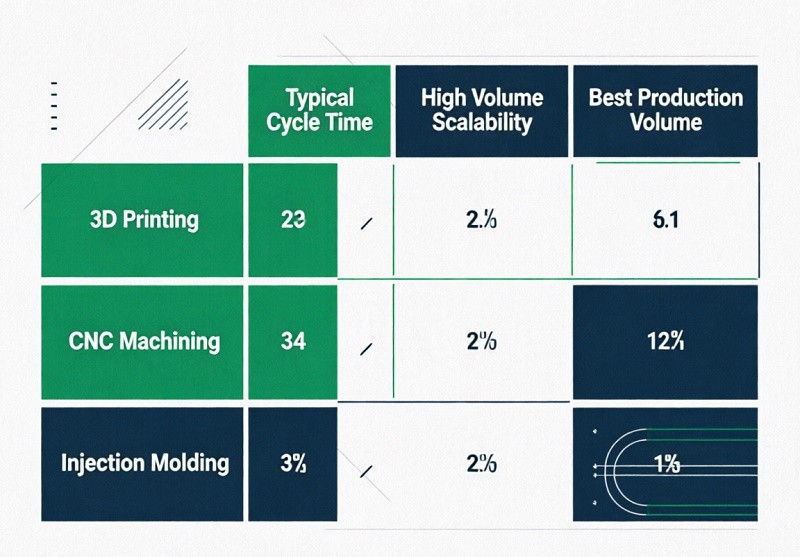
| Process | Typical Cycle Time | Scalability (for high volume) | Best for Volume |
|---|---|---|---|
| 3D Printing | Hours per part | Poor | 1 - 200 units |
| CNC Machining | Minutes to hours per part | Moderate | 10 - 5,000 units |
| Injection Molding | Seconds to minutes per cycle | Excellent | 5,000+ units |
Design Flexibility and Geometric Capabilities for Wholesale Custom Plastic Injection Molding Parts
The rules that govern what can and cannot be easily manufactured differ greatly between additive, subtractive, and formative processes. This has a profound impact on design freedom and the complexity of parts that can be created.
3D Printing: This process offers the greatest design freedom by a significant margin. Because parts are built layer by layer, designers can create incredibly complex and organic shapes, internal lattice structures, and intricate features that would be impossible or prohibitively expensive to produce with other methods. This capability is often referred to as "complexity for free," as making a highly complex part doesn't necessarily cost more than a simple one. This allows for innovations like part consolidation, where multiple components of an assembly can be combined into a single, complex 3D printed part.
Injection Molding: This process has the most restrictive design rules. Successful injection molding relies on a methodology known as Design for Manufacturability (DFM). DFM principles are essential to ensure that molten plastic can fill the mold properly, the part can cool uniformly, and it can be ejected without damage. Key DFM considerations include:
- Draft Angles: Part walls must be slightly tapered to allow for smooth ejection from the mold.
- Uniform Wall Thickness: Consistent wall thickness is crucial to prevent defects like sink marks and warping caused by uneven cooling and shrinkage.
- Undercuts: Features that prevent the part from being directly pulled from the mold (undercuts) require complex and costly mold mechanisms called slides or lifters. These constraints mean that parts must often be designed specifically for the injection molding process, which can limit geometric freedom.
CNC Machining: CNC machining offers a good balance of design flexibility, but it has its own set of constraints, primarily dictated by tool access and tool geometry.
- Tool Access: The cutting tool must be able to physically reach every surface that needs to be machined. Deep pockets, narrow channels, and internal features can be difficult or impossible to create if the tool cannot access them.
- Tool Geometry: Since most cutting tools are cylindrical and rotating, they cannot create sharp internal corners; all internal corners will have a radius corresponding to the tool used.
- Workholding: The part must be securely held in place (fixtured) during machining, and this can sometimes limit access to certain faces of the part, requiring multiple setups which increases cost and complexity.
Material Selection and Properties for Wholesale Custom Plastic Injection Molding Parts
The choice of material is fundamental to a part's performance, dictating its strength, durability, flexibility, temperature resistance, and appearance. Each manufacturing process is compatible with a different range of plastics.
Diverse Plastic Options for Each Process
The range of available plastic materials varies considerably across the three manufacturing technologies.
3D Printing Materials:
- FDM: Uses thermoplastic filaments. The most common are PLA (easy to print, biodegradable) and ABS (tough, temperature resistant). More advanced FDM printers can also handle engineering-grade materials like PETG (durable, chemical resistant), TPU (flexible, rubber-like), Nylon (strong, wear-resistant), and high-performance thermoplastics like PEEK and ULTEM, which offer exceptional strength and heat resistance.
- SLA: Uses liquid photopolymer resins. These are thermosetting plastics that offer a wide range of properties. Options include standard resins for high-detail visual prototypes, tough or durable resins that mimic ABS and PP, flexible resins for soft-touch parts, and biocompatible resins for medical applications.
- SLS: Primarily uses powdered thermoplastics, with Nylon (PA11, PA12) being the most common. These materials produce strong, durable, and functional parts with properties similar to injection-molded components. Glass-filled or carbon-fiber-filled nylon powders are also available to enhance stiffness and strength.
Injection Molding Materials: This process is compatible with a massive array of thermoplastics. Almost any standard, engineering, or high-performance thermoplastic can be injection molded, as long as it can be melted and injected. Common choices include:
- Polypropylene (PP): Excellent chemical resistance, flexible, and low cost. Used in packaging, automotive parts, and consumer goods.
- Acrylonitrile Butadiene Styrene (ABS): Good impact resistance and toughness. Common in electronics housings and automotive trim.
- Polyethylene (PE): Comes in various densities (HDPE, LDPE). Very versatile, used for everything from milk jugs to plastic bags.
- Polycarbonate (PC): High impact strength and transparency. Used for lenses, safety goggles, and electronic components.
- Polyamide (Nylon): Strong, tough, and has good wear resistance. Used for gears, bearings, and other mechanical parts.
CNC Machining Materials: A broad range of rigid plastics, often referred to as "machinable plastics," can be used. These materials must be stiff enough to be cut without deforming or melting. Popular choices include:
- Acetal (POM/Delrin): Highly machinable, low friction, and dimensionally stable. Excellent for precision parts like gears and bearings.
- Nylon (PA): Strong and wear-resistant, though it can absorb moisture.
- Polycarbonate (PC): Tough and impact-resistant, often used for transparent structural components.
- ABS: Easy to machine and offers good strength and stiffness.
- PEEK: A high-performance thermoplastic with outstanding mechanical strength, chemical resistance, and temperature resistance, used in demanding aerospace and medical applications.
- Acrylic (PMMA): Often machined for its optical clarity.
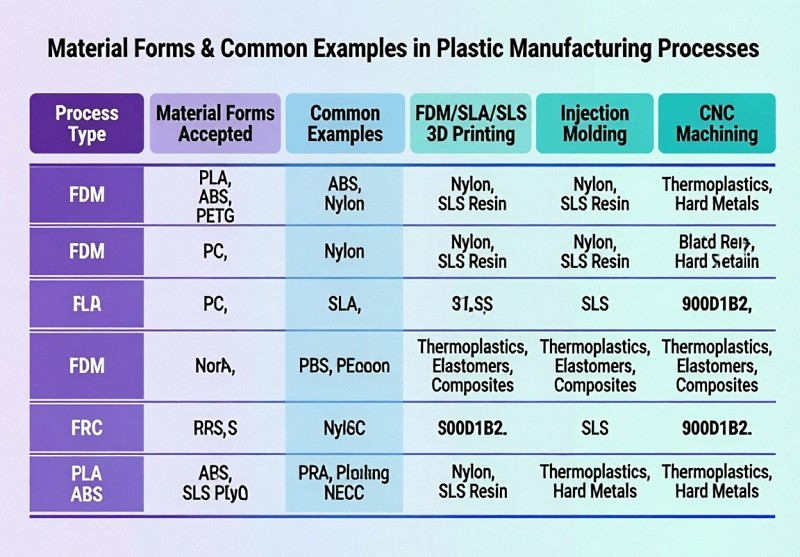
| Process | Material Form | Common Examples |
|---|---|---|
| 3D Printing (FDM) | Filament Spools | PLA, ABS, PETG, TPU, Nylon, PEEK |
| 3D Printing (SLA) | Liquid Resin | Standard Resin, Tough Resin, Flexible Resin, Castable Resin |
| 3D Printing (SLS) | Powder | Nylon (PA12, PA11), TPU, Composites (Glass/Carbon-filled) |
| Injection Molding | Pellets | PP, ABS, PC, PE, Nylon, PS, TPE, and thousands more |
| CNC Machining | Solid Blocks/Rods | Acetal (POM), Nylon, PC, ABS, PEEK, UHMW, Acrylic |
Mechanical Performance and Surface Finish of Wholesale Custom Plastic Injection Molding Parts
How a part looks, feels, and performs under stress is a direct result of the manufacturing process used to create it.
Mechanical Performance:
- Injection Molding: Parts produced by injection molding are generally the strongest and most durable. The process creates a solid, dense, and isotropic part, meaning its mechanical properties are uniform in all directions. This is because the molten plastic forms a single, continuous mass within the mold.
- CNC Machining: CNC machined parts also have excellent, isotropic mechanical properties because they are carved from a solid, pre-existing block of material that is itself isotropic. The strength is consistent throughout the part.
- 3D Printing: This is the one process that produces anisotropic parts. Because parts are built layer by layer, the bonds between the layers (along the Z-axis) are inherently weaker than the material within each layer (the X and Y axes). This means a 3D printed part will have different strength characteristics depending on the direction of the applied force. While technologies like SLS produce parts with strength approaching that of injection molding, FDM parts are noticeably weaker along their layer lines. Part orientation during printing is therefore a critical design consideration to maximize strength.
Surface Finish:
- SLA and Injection Molding: These two processes produce the smoothest surface finishes right out of the machine. SLA's use of a precise laser to cure liquid resin results in parts with very fine details and almost no visible layer lines. Injection molding's quality is dependent on the mold surface; a highly polished mold will produce a glossy, smooth part, while a textured mold will replicate that texture perfectly.
- CNC Machining: CNC machining can achieve excellent surface finishes, which are often superior to 3D printing. The final finish depends on the cutting tool size, speed, and the path of finishing passes. While tool marks may be visible, they are typically very fine and can be polished or bead-blasted for an even smoother texture.
- FDM and SLS: FDM printing produces the roughest surface finish, with clearly visible layer lines from the extruded filament. SLS parts have a characteristic grainy or powdery texture from the sintered powder, though the layer lines are much less pronounced than in FDM. Both FDM and SLS parts often require post-processing steps like sanding, tumbling, or vapor smoothing to achieve a smooth finish.
Sustainability and Waste Reduction in Manufacturing Wholesale Custom Plastic Injection Molding Parts
As environmental concerns become more prominent, evaluating the sustainability of manufacturing processes is increasingly important. Each method has a different impact in terms of material waste and energy consumption.
CNC Machining (Subtractive): As a subtractive process, CNC machining is inherently wasteful from a material perspective. It starts with a larger block of plastic, and all the material that is cut away to form the part becomes scrap or chips. While this waste can often be collected and recycled, the process itself generates a significant amount of surplus material, especially for complex parts where a large percentage of the initial block is removed. In terms of energy, CNC machines can be power-intensive, but this is balanced by relatively quick cycle times compared to 3D printing.
3D Printing (Additive): In principle, additive manufacturing is highly sustainable in terms of material use. It builds parts by adding material only where it is needed, creating very little byproduct waste. SLS technology is particularly efficient, as unsintered powder in the build chamber can be recycled and reused for future prints. However, some 3D printing processes, like FDM and SLA, do generate waste from support structures that must be removed after printing. From an energy perspective, 3D printing can be more efficient for one-off parts or small batches because it avoids the high energy cost associated with producing a metal mold. However, the process consumes energy continuously over long print times, which can add up.
Injection Molding (Formative): Injection molding is highly efficient in a high-volume production setting but generates its own forms of waste. Sprues, runners, and gates—the channels that deliver molten plastic to the part cavity—are a common source of scrap. While this thermoplastic scrap can often be reground and mixed back into the raw material, this can only be done a limited number of times before the material properties degrade. On the energy front, injection molding is very efficient on a per-part basis at scale. The initial energy to heat the barrel and create the mold is high, but this is amortized over thousands or millions of fast cycles, leading to a low energy footprint per part.
Overall, 3D printing is often the most sustainable choice for prototyping and low-volume production due to minimal material waste and the absence of tooling. For mass production, injection molding's efficiency and ability to use recycled material can make it a sustainable option, provided the production volume is high enough to justify the initial resources.
When to Choose Which Process for Your Wholesale Custom Plastic Injection Molding Parts
Selecting the right manufacturing process is a strategic decision that balances your project's unique requirements for cost, volume, complexity, and speed. Here are clear guidelines to help you determine the best fit.
Optimal Scenarios for 3D Printing Wholesale Custom Plastic Injection Molding Parts
3D printing is the ideal choice when speed, design complexity, and low-volume customization are the top priorities.
- Rapid Prototyping: If you need to quickly produce physical models to test form, fit, and function, 3D printing is unparalleled. The ability to go from a digital file to a tangible part in hours allows for rapid design iteration and validation.
- Complex Geometries: When your design includes intricate internal channels, organic shapes, or complex lattice structures that are impossible to mold or machine, 3D printing is the only viable option. It offers nearly limitless geometric freedom.
- Low-Volume Production & Customization: For production runs of less than a few hundred parts, or for products that require mass customization (e.g., patient-specific medical devices), 3D printing is highly cost-effective as it avoids expensive tooling costs.
- Bridge Production: 3D printing can be used to produce a small batch of end-use parts to get a product to market while the high-volume injection molding tooling is still being manufactured.
Ideal Applications for Injection Molding Wholesale Custom Plastic Injection Molding Parts
Injection molding is the undisputed king of high-volume, cost-effective manufacturing for finalized designs.
- High-Volume Mass Production: When you need to produce thousands, hundreds of thousands, or millions of identical parts, injection molding offers the lowest per-unit cost and fastest production speeds.
- Established and Stable Designs: The high upfront cost of tooling makes injection molding suitable only for designs that have been thoroughly tested and finalized. It is not economical for products that are still undergoing significant design changes.
- Consistency and Repeatability: The process is highly automated and repeatable, ensuring that every part produced is virtually identical in terms of dimensions, strength, and finish.
- Best Cost-per-Part at Scale: While the initial investment is substantial, no other process can match the low per-part cost that injection molding achieves at high production volumes.
Best Use Cases for CNC Machining Wholesale Custom Plastic Injection Molding Parts
CNC machining bridges the gap between 3D printing and injection molding, offering high precision and material strength without the high tooling costs.
- High-Precision Prototypes and Parts: When you need functional prototypes or end-use parts with tight tolerances and superior mechanical properties, CNC machining is an excellent choice. It produces strong, isotropic parts from a wide range of engineering-grade plastics.
- Low to Medium-Volume Production: For quantities that are too high for 3D printing to be cost-effective but not high enough to justify the cost of an injection mold (typically in the range of 100 to 5,000 parts), CNC machining is often the economic sweet spot.
- Parts with Simpler Geometries: The process is best suited for parts that do not have the extreme complexity of 3D printed designs or the specific constraints (like deep, narrow pockets) that make machining difficult.
- Material Flexibility: CNC machining can work with a vast range of solid stock materials, including plastics that may not be available for 3D printing or are difficult to mold.
The Hybrid Approach: Combining Technologies for Wholesale Custom Plastic Injection Molding Parts
The most effective product development strategies often don't rely on a single manufacturing process. Instead, they leverage the unique strengths of each method at different stages of the product lifecycle. This hybrid approach, particularly combining 3D printing and injection molding, offers a powerful path from concept to mass production.
Leveraging 3D Printing for Prototyping Wholesale Custom Plastic Injection Molding Parts
The journey of a new product almost always begins with prototyping. In this critical phase, the goal is to validate ideas, test functionality, and refine the design as quickly and inexpensively as possible. This is where 3D printing shines as the perfect initial step.
By using methods like FDM, SLA, or SLS, engineers and designers can transform a CAD model into a physical part in a matter of hours or days. This allows them to:
- Verify Form and Fit: Hold a physical model to assess ergonomics and aesthetics.
- Test Assemblies: Print multiple components to ensure they fit together as intended.
- Identify Design Flaws Early: Discover potential issues with the design before investing in expensive tooling.
- Iterate Rapidly: Make changes to the CAD file and print a new, improved version overnight.
This rapid, iterative cycle of printing and testing allows teams to de-risk the project and finalize a robust design without the long delays and high costs associated with traditional prototyping methods.
Seamless Transition to Mass Production with Injection Molding for Wholesale Custom Plastic Injection Molding Parts
Once the design has been perfected and validated through multiple 3D printed prototypes, it is ready for the next stage: mass production. At this point, the economics shift dramatically. While 3D printing was ideal for creating a handful of prototypes, it is not scalable or cost-effective for producing thousands of units.
This is the perfect moment to transition to injection molding. By taking the finalized and proven CAD design, a high-volume production mold can be created from steel. Although this involves a significant upfront investment, it unlocks the key benefits of injection molding for mass production:
- Lowest Per-Part Cost: The tooling cost is amortized over thousands of units, making each part incredibly inexpensive to produce.
- High-Speed Production: Cycle times are measured in seconds, allowing for rapid fulfillment of large orders.
- Superior Quality and Consistency: Every part produced from the mold is virtually identical, ensuring high levels of quality and repeatability.
This hybrid workflow creates a seamless and efficient path from product inception to market launch. It leverages the speed and flexibility of 3D printing when it matters most (in the design and iteration phase) and then capitalizes on the unparalleled scalability and cost-efficiency of injection molding for full-scale production.
Future Trends in Manufacturing Wholesale Custom Plastic Injection Molding Parts
The manufacturing landscape is in a constant state of evolution, driven by advancements in technology, materials science, and a growing emphasis on sustainability. The production of custom plastic parts is at the forefront of this change, with several key trends poised to reshape the industry.
Automation and AI in Producing Wholesale Custom Plastic Injection Molding Parts
Automation and Artificial Intelligence (AI) are no longer futuristic concepts; they are actively being integrated into manufacturing workflows to enhance efficiency, quality, and precision.
- In 3D Printing: AI algorithms are being used to optimize print parameters, predict and correct errors in real-time, and automate post-processing steps. Robotic arms are increasingly used to remove finished prints and prepare the machine for the next job, enabling 24/7 "lights-out" manufacturing.
- In Injection Molding: AI-powered software can simulate the molding process with incredible accuracy, predicting material flow, identifying potential defects, and optimizing mold design before any steel is cut. On the factory floor, sensors and AI monitor machine performance, predict maintenance needs to prevent downtime, and automatically adjust process parameters to ensure consistent part quality.
- In CNC Machining: AI is optimizing toolpaths to reduce machining time and extend tool life. Automated systems can load and unload workpieces, change cutting tools, and perform in-process quality checks, allowing machines to run unattended for longer periods.
Advanced Materials and Sustainable Practices for Wholesale Custom Plastic Injection Molding Parts
The demand for higher-performance and more environmentally friendly products is driving significant innovation in material science.
- Advanced Materials: We are seeing a rise in the development of composite materials, such as carbon fiber-reinforced or glass-filled plastics, which offer the lightweight properties of plastic with strength comparable to some metals. For 3D printing, new polymers are being created with enhanced thermal resistance, chemical durability, and biocompatibility.
- Sustainable Practices: Sustainability is becoming a core tenet of modern manufacturing. This includes the increased use of recycled and bio-based plastics in injection molding and 3D printing. In 3D printing, there is a focus on developing more biodegradable materials like advanced forms of PLA. For all processes, there is a push toward greater energy efficiency and "circular economy" models, where waste from one process becomes the raw material for another.
Localization and On-Demand Production of Wholesale Custom Plastic Injection Molding Parts
The rigid, global supply chains of the past are giving way to more flexible, localized, and on-demand production models, largely enabled by digital manufacturing technologies like 3D printing and quick-turn CNC machining.
- Distributed Manufacturing: Instead of producing parts in a large, centralized factory and shipping them globally, companies can send digital files to a network of smaller, localized manufacturing hubs. These hubs can then 3D print or machine parts closer to the point of need.
- On-Demand Production: This model eliminates the need for large physical inventories. Parts are produced only when an order is placed. This "digital warehouse" concept reduces storage costs, minimizes the risk of obsolete stock, and allows for much greater product customization. This is particularly valuable for producing spare parts for older equipment, where creating a new injection mold would be cost-prohibitive.
These trends point toward a future of manufacturing that is smarter, more sustainable, and incredibly agile, allowing businesses to respond to market demands with unprecedented speed and efficiency.
In conclusion, the world of manufacturing for wholesale custom plastic injection molding parts offers diverse and powerful options. We've explored how 3D printing excels in flexibility and rapid prototyping, injection molding dominates in high-volume, cost-effective production, and CNC machining provides precision for a wide range of materials and complex designs. By understanding the strengths of each process and considering a hybrid approach, we can optimize the production of parts for both efficiency and innovation. Our aim is always to deliver the best quality components while meeting specific project requirements. We hope this comprehensive guide has provided you with the foundational knowledge to make informed decisions for your next project.
What are your experiences with these manufacturing processes? Have you found a hybrid approach to be effective? Share your thoughts in the comments below, and don't forget to share this article with your network