


What to Look for in an F Male Connector Supplier: A Comprehensive Guide.
Hi there! As someone who works with communication systems, I know how critically important it is to pick the right F Male connector. These small but mighty components make a huge difference in the performance and reliability of everything from your cable television and internet to more complex RF communication setups. The quality of this single part can be the deciding factor between a crystal-clear signal and frustrating, intermittent connectivity issues.
That’s why I'm here to guide you through the intricate process of finding the best F Male connector supplier. Making a smart, informed choice is a strategic decision that can significantly elevate the quality and durability of your projects. In this comprehensive guide, I’ll share my personal checklist and the key factors I always consider, empowering you to forge a partnership with a supplier you can trust.
My Guide to Picking a Reputable F Male Connector Supplier
Choosing a supplier is more than a simple transaction; it's about establishing a relationship built on trust, quality, and reliability. A great supplier acts as a partner, contributing to the success of your projects by providing consistently high-quality components. Let's delve into the foundational qualities that separate the exceptional suppliers from the rest.
Key Supplier Qualities I Always Look For
Before I even look at a product datasheet, I assess the supplier themselves. A company's certifications and market reputation are leading indicators of their commitment to quality and customer satisfaction. These are non-negotiable factors in my evaluation process.
How I Check for International Certifications and Standards
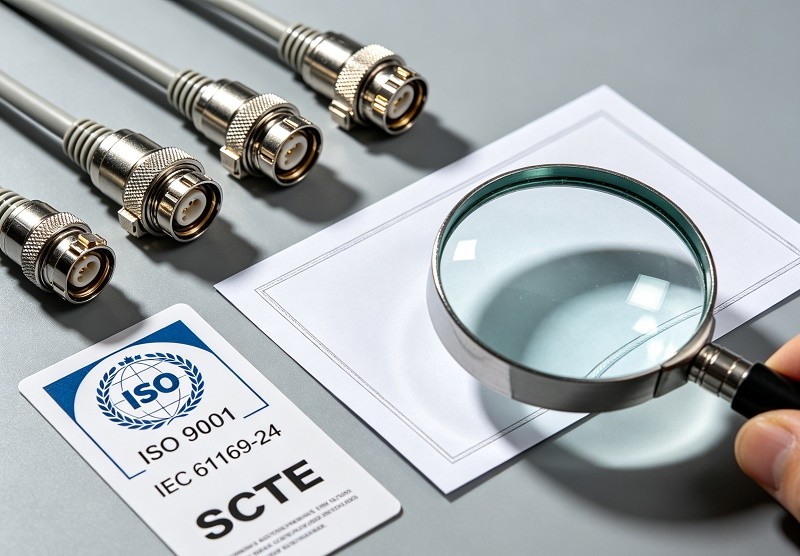
International certifications are not just logos on a website; they are proof that a supplier adheres to rigorous, globally recognized standards for quality, safety, and performance. When it comes to F-type connectors, a few key standards are paramount. The International Electrotechnical Commission (IEC) provides the IEC 61169-24 standard, which details the specifications for RF connectors used in cable distribution systems, including the popular F-type. Adherence to this standard ensures a baseline of mechanical and electrical performance.
My process for verification is methodical:
- Scrutinize the Website: I first look for a dedicated "Quality," "Compliance," or "Certifications" page on the supplier's website. Reputable manufacturers are proud of their certifications and display them prominently.
- Request Documentation: I never take logos at face value. I will contact the supplier and request copies of their certification documents, such as ISO 9001:2015 for quality management systems. This standard demonstrates their ability to consistently provide products and services that meet customer and regulatory requirements.
- Verify with the Issuing Body: For critical projects, I might even take the extra step of verifying the certification's validity with the issuing organization. This confirms the certificate is current and hasn't been revoked.
- Look for Industry-Specific Standards: In the United States, standards from the Society of Cable Telecommunications Engineers (SCTE) are also highly relevant. SCTE standards often define specific performance criteria for components used in broadband cable networks. A supplier that complies with or contributes to SCTE standards demonstrates a deep understanding of the application environment.
A supplier's investment in achieving and maintaining these certifications speaks volumes about their dedication to producing a reliable and safe product. It's a clear signal that they are a serious, professional organization.
Why Supplier Reputation and Customer Feedback Matter to Me
A supplier's reputation is built over years of consistent performance and is one of the most powerful tools for assessing trustworthiness. While certifications tell you about their processes, customer feedback tells you about the real-world experience of partnering with them. In the B2B world, reputation is everything.
Here’s how I dig into a supplier's reputation:
- Case Studies and Testimonials: I start on the supplier’s website but read with a critical eye. Case studies are particularly valuable as they can provide detailed insights into how the supplier solved a specific problem for a client. I look for testimonials from companies in industries similar to my own.
- Third-Party Review Platforms and Forums: I then move to independent sources. B2B review platforms like G2 or Capterra, while more software-focused, are part of a larger trend of B2B transparency. More importantly, I search for discussions in specialized online forums and communities related to RF engineering, telecommunications, or broadcast. Engineers and technicians in these forums often provide candid, unfiltered feedback about the components they use daily.
- Industry Word-of-Mouth: I leverage my professional network. I ask colleagues, peers, and contacts at other companies about their experiences with potential suppliers. This first-hand insight is often the most honest and valuable information you can get. Did the supplier meet their deadlines? How did they handle a quality issue or a last-minute order change? The answers to these questions are incredibly revealing.
Analyzing feedback involves looking for patterns. A single negative review might be an anomaly, but multiple comments about late deliveries, inconsistent quality, or poor customer service are significant red flags. Conversely, consistent praise for their technical support, product reliability, and proactive communication indicates a supplier you can depend on.
Ensuring Supply Chain Stability and Timely Delivery from an F Male Connector Supplier
A fantastic product is useless if it doesn't arrive when you need it. A robust and resilient supply chain is the backbone of a reliable supplier. In today's volatile global market, evaluating a supplier's logistical capabilities and inventory strategy is more important than ever. It directly impacts your production schedules, project timelines, and ability to meet your own customers' demands.
My Requirements for Efficient Logistics and Inventory
An efficient supply chain is a sign of a well-managed company. When I evaluate a supplier, I need to know they can handle the complexities of global logistics and maintain adequate stock to prevent disruptions.
Here are my key criteria:
- Transparent Lead Times: I expect a potential supplier to provide clear and realistic lead times for their products. I also inquire about their historical performance in meeting those lead times. A good supplier will have data to back up their claims.
- Inventory Management Strategy: I ask about their inventory strategy. Do they use a Just-in-Time (JIT) model, or do they maintain a significant safety stock of high-volume components like F male connectors? For standard parts, I prefer suppliers with ample safety stock, as it provides a buffer against unexpected demand surges or transportation delays.
- Global Distribution Network: A supplier with strategically located warehouses or distribution partners can significantly reduce shipping times and costs. This is particularly crucial for international projects. I assess their ability to ship to all my required locations efficiently.
- Proactive Communication: How does the supplier communicate about potential delays? A top-tier supplier will proactively inform you of any potential supply chain issues—be it raw material shortages, production bottlenecks, or shipping delays—and work with you to find a solution. This transparency is vital for effective project planning.
Balancing Price, Performance, and Flexibility in My Search
While price is always a factor, it should never be the only factor. The cheapest connector can quickly become the most expensive component if it fails in the field, leading to costly product recalls, repairs, and damage to your brand's reputation. I always focus on the Total Cost of Ownership (TCO), which provides a more holistic view of value.
Here's how I strike the right balance:
| Factor | Description | Questions to Ask a Supplier |
|---|---|---|
| Price | The per-unit cost of the connector. | What are your volume pricing tiers? Are there any hidden costs (e.g., tooling, shipping)? |
| Performance | The electrical and mechanical quality of the connector. This relates to signal integrity, durability, and a low failure rate. | Can you provide performance data (e.g., return loss, insertion loss)? What is your typical failure rate (DPPM - Defective Parts Per Million)? |
| Flexibility | The supplier's willingness to work with your business needs. | What are your Minimum Order Quantities (MOQs)? Do you offer blanket orders or scheduled shipments? Can you support custom requirements? |
The goal is to find a supplier that offers a competitive price for a connector that meets your performance specifications, backed by a flexible business relationship. Sometimes, paying a slight premium for a higher-quality connector from a flexible and reliable supplier results in a lower TCO. This is because it reduces the risk of field failures, minimizes production line downtime, and simplifies inventory management. A supplier who understands this and is willing to partner with you on solutions like blanket orders to secure pricing and supply is a true asset.
Technical Excellence and Connector Quality: What Your F Male Connector Supplier Should Offer
Once a supplier has passed the initial assessment of reputation and reliability, the focus shifts to the product itself. The technical specifications and physical quality of the F male connectors are paramount. A supplier committed to technical excellence will offer products that not only meet but exceed industry standards, ensuring superior performance and long-term durability in any application.
Understanding F Male Connector Specifications
Diving into a datasheet can be daunting, but understanding the key electrical specifications is crucial for ensuring signal integrity. These parameters determine how well the connector transmits the signal from the cable through the connection point with minimal loss or distortion.
Focusing on Electrical Performance: Impedance, Frequency, and Power
The core function of an F connector is to transmit an RF signal flawlessly. Three key electrical parameters dictate its performance:
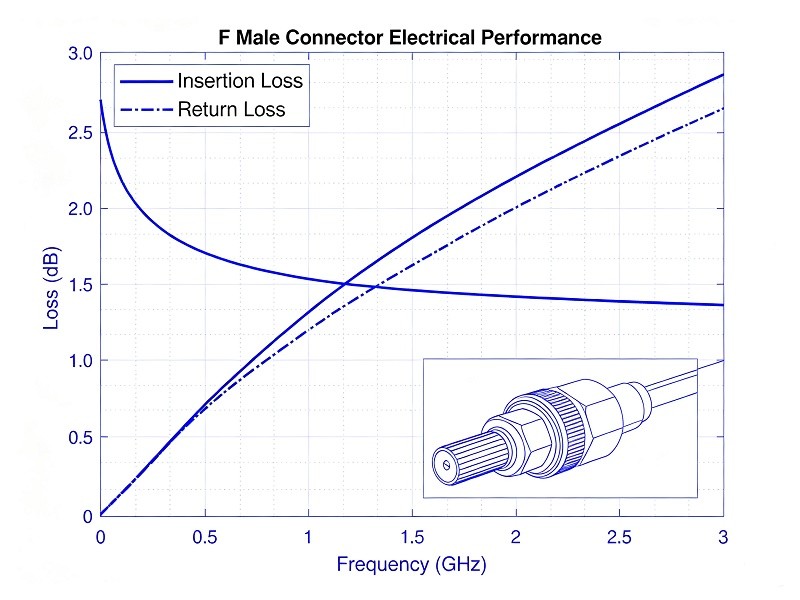
- Impedance: For most video and data applications (like cable TV and modems), the system impedance is 75 Ohms. An F connector must also have a characteristic impedance of 75 Ohms. Any mismatch, known as an impedance discontinuity, causes signals to be reflected back toward the source instead of being transmitted. This reflection is measured as Return Loss. A high return loss value is desirable, as it indicates a better impedance match and less signal reflection.
- Frequency Range: Connectors must be able to operate effectively across the entire frequency range of the application. Modern cable systems operate at frequencies up to 1.2 GHz, with some extending towards 3 GHz. A good F connector will have low Insertion Loss—the amount of signal energy lost as it passes through the connector—across its specified frequency range. I always look for suppliers who provide detailed graphs showing both return loss and insertion loss versus frequency.
- Power Handling and PIM: While most F connector applications are low power, it's important to consider power handling capability. More critically, in multi-signal environments, a poorly made connector can cause Passive Intermodulation (PIM). PIM occurs when two or more signals mix in a passive device, creating unwanted interference that can degrade system performance. High-quality connectors with clean, precise contact points and proper material choices minimize PIM.
A technically proficient supplier will readily provide detailed datasheets with this information and have engineers available to discuss how their products will perform in your specific application.
The Importance of Repeatability and Accuracy in Connectors
Excellent specifications on a single "golden sample" are meaningless if the supplier cannot manufacture thousands or millions of them with the same precision. Repeatability is the key to a reliable system. Every connector installed should perform identically to the last.
This consistency comes from a supplier's investment in:
- Tight Manufacturing Tolerances: High-precision machining and molding are essential. This ensures that the physical dimensions of every part—from the center pin diameter to the thread pitch—are consistent.
- Stable Processes: A supplier with robust quality control systems (like Statistical Process Control or SPC) can monitor their manufacturing processes and ensure they remain stable over time.
- Consistent Materials: The use of high-quality, certified raw materials is non-negotiable. Variations in brass composition or plating thickness can lead to performance degradation.
When a supplier can guarantee this level of accuracy, it means you can design your system with confidence, knowing that the performance you see in the lab will be the same performance your customers experience in the field. This drastically reduces troubleshooting and ensures a stable, reliable end product.
Assessing Physical Quality and Durability of Connectors
Beyond the electrical data, the physical construction of a connector reveals a great deal about its quality and expected lifespan. A well-made connector will not only perform well electrically but will also withstand the rigors of installation and the environment in which it operates.
My Visual Inspection Tips for F Male Connector Quality
Before committing to a large order, I always get samples for a hands-on evaluation. You can learn a lot from a simple visual and tactile inspection.
Here’s my personal checklist:
- Plating and Finish: Examine the nickel or gold plating. It should be smooth, uniform, and free of any scratches, pits, or discoloration. Poor plating can lead to corrosion and poor electrical contact over time.
- Body and Nut: Look for any sharp edges or burrs, which are signs of a low-quality machining process. The hex nut should be well-formed for easy gripping with a wrench. The threads should be clean and smooth, allowing for easy, non-binding connection.
- Center Conductor: The center pin should be perfectly centered, straight, and securely seated. A loose or off-center pin can cause intermittent connections or damage the female port.
- Insulator: The dielectric material (usually a type of plastic) that insulates the center pin from the body should be clean, free of flash (excess molding material), and firmly in place.
These simple checks can quickly help you weed out suppliers who cut corners on manufacturing.
Why Customization and R&D Capabilities are a Plus
While the standard F connector is ubiquitous, many projects have unique requirements. This is where a supplier with strong Research & Development (R&D) and customization capabilities becomes an invaluable partner rather than just a parts provider.
Consider these scenarios:
- Specialized Cable: Your project might use a non-standard coaxial cable that requires a custom-designed connector for a perfect fit and optimal performance.
- Environmental Challenges: An application might require a connector with enhanced weather sealing (IP rating) for outdoor use or resistance to specific chemicals or vibrations.
- Unique Assembly Needs: You might need a connector with a specific body length or a different crimp style to integrate with your automated assembly processes.
A supplier with an in-house engineering team can work with you to design, prototype, and manufacture a connector tailored to your exact needs. This capability signals a deep technical expertise and a commitment to customer success. It transforms the supplier relationship from a simple buyer-seller dynamic into a collaborative partnership focused on innovation and problem-solving.
Best Practices for Connector Care and Longevity
Even the highest quality connector can fail if installed or maintained improperly. A responsible supplier often provides guidance on best practices, but it's crucial to own this knowledge yourself.
Here are some essential tips for ensuring long-term reliability:
- Proper Cable Preparation: Use a high-quality cable stripping tool to prepare the coaxial cable. Ensure the cut is clean and the dimensions are exact, with no stray braids touching the center conductor.
- Use a Torque Wrench: One of the most common causes of F connector failure is improper tightening. Over-tightening can damage the threads and the internal components of the female port, leading to poor performance. Under-tightening can result in a loose connection that is susceptible to moisture ingress and signal loss. Using a 7/16-inch torque wrench set to the manufacturer's recommended torque (typically 15-30 in-lbs) is essential for a consistent, weather-tight seal without causing damage.
- Keep Connectors Clean: Before mating, ensure both male and female connectors are free of dust, dirt, and moisture. Contaminants can degrade performance.
- Use Weather Boots for Outdoor Use: For any outdoor installation, use silicone grease and a properly installed weather boot to protect the connection from moisture, which can cause corrosion and signal failure over time.
By following these best practices, you can maximize the performance and lifespan of your connections, ensuring the system operates reliably for years to come.
To wrap things up, choosing an F Male connector supplier isn't just about buying a part; it's about forming a strategic partnership that ensures your projects are reliable, performant, and run smoothly. This decision has a direct impact on your final product's quality and your company's reputation.
I’ve shared my personal insights on everything from the critical importance of verifying international certifications and digging into authentic customer reviews, to analyzing technical datasheets for key performance indicators like return loss and impedance matching. By applying this comprehensive approach, you can select a supplier with confidence. My goal is always to help you build strong, lasting connections—both literally with high-quality components, and figuratively with dependable, expert partners.