What to Look for in Custom Plastic Injection Molding Parts Manufacturers
Choosing the right manufacturer for your custom plastic injection molding parts is a critical decision that directly impacts your product's quality, production timeline, and overall cost. This manufacturing process offers incredible design freedom and material optimization, allowing for tailored solutions that off-the-shelf options simply cannot provide. In this guide, we'll explore the essential factors to consider when selecting a partner to ensure your project's success and gain a competitive edge in the market.
Why Custom Plastic Injection Molding Parts Are Your Best Choice
Custom plastic injection molding stands out as a premier manufacturing process for producing parts in high volumes. It involves injecting molten plastic material into a custom-made mold, or tool, to create parts with exceptional precision and repeatability. This method is highly versatile and can be adapted for a wide range of applications across various industries, from complex medical devices to durable automotive components. The initial investment in tooling is offset by a low per-part cost, especially in large production runs, making it an economically sound choice for scaling a product.
Unlocking Design Freedom for Custom Plastic Injection Molding Parts
One of the most significant advantages of custom plastic injection molding is the immense design freedom it offers. Unlike other manufacturing methods that have limitations on shape and form, injection molding allows for the creation of highly complex and intricate geometries. This is because the molten plastic is injected into the mold under very high pressure, forcing the material to make intimate contact with every detail of the mold surface. This process ensures that features like thin walls, sharp corners, and detailed textures are reproduced with high fidelity.
This capability is crucial for parts that require:
- Complex Geometries: Components with intricate shapes and internal features, which would be difficult or impossible to create using traditional machining, can be readily produced. Expert molders use advanced CAD/CAM software to design and simulate these complex geometries before production, preventing defects like warping or incomplete fills.
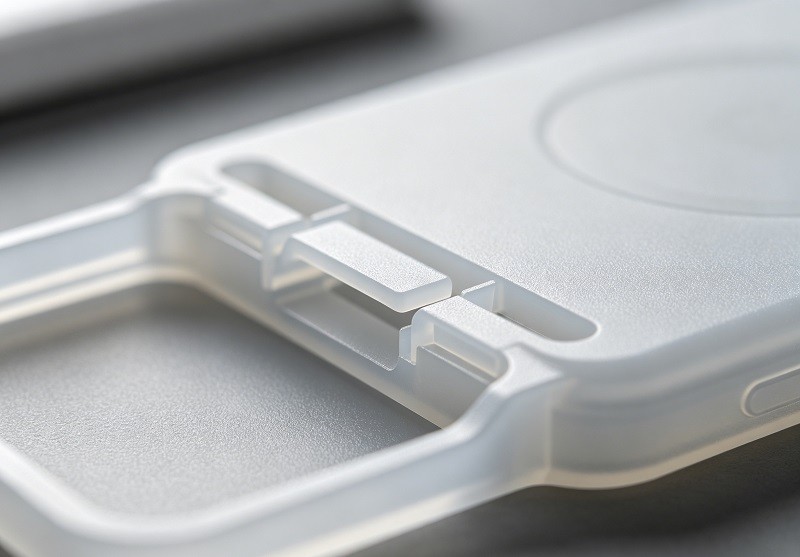
- Integrated Features: Elements like snap-fits, clips, bosses (small cylindrical projections), and living hinges can be designed directly into the part. This integration consolidates multiple functions into a single component, which simplifies assembly, reduces the number of parts in a final product, and ultimately lowers production costs.
- Tight Tolerances: The process is highly precise, enabling the production of parts with consistent and accurate dimensions, which is critical in industries like medical, aerospace, and electronics.
By working with an experienced manufacturer, you can leverage Design for Manufacturability (DFM) principles to optimize your part design. This collaborative process ensures the design is not only functional but also efficient to produce, identifying potential issues early to avoid costly redesigns later. A skilled partner can offer guidance on draft angles, wall thickness, and gate location to ensure problem-free molding and a high-quality finished product.
Optimizing Materials and Scaling Production for Custom Plastic Injection Molding Parts
Custom injection molding not only provides design flexibility but also offers a vast landscape for material optimization and production scalability. Making the right material choice is a critical step that dictates the final part's performance, durability, appearance, and cost. A knowledgeable manufacturing partner is invaluable in this stage, guiding you through the extensive catalog of available polymers.
Material Selection: The success of a molded product is heavily dependent on selecting the right material. Your manufacturer should help you navigate the options based on your specific application requirements. These requirements include mechanical strength, temperature tolerance, chemical resistance, and aesthetic needs.
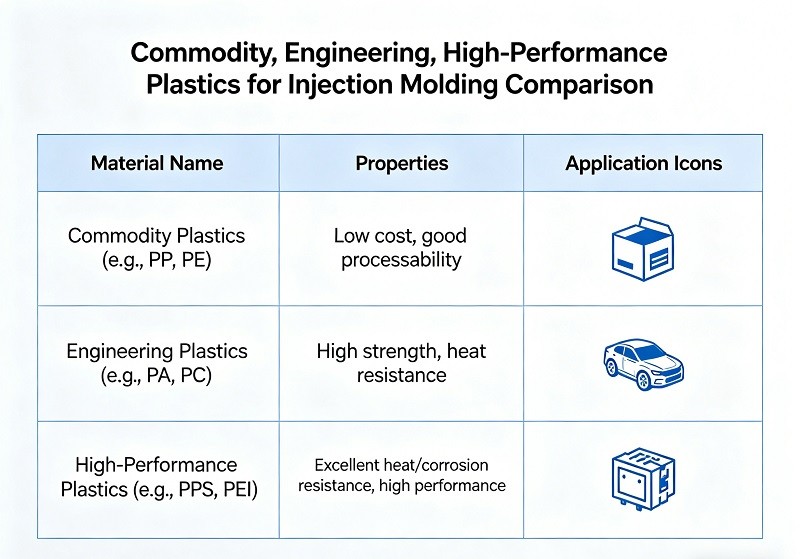
- Commodity Plastics: For cost-sensitive projects without extreme performance demands, materials like Polypropylene (PP) and Polyethylene (PE) are excellent choices. PP is known for its great chemical and fatigue resistance, making it ideal for living hinges, while PE is valued for its moisture resistance.
- Engineering Plastics: For applications that require greater strength, impact resistance, and durability, engineered plastics like Acrylonitrile Butadiene Styrene (ABS), Polycarbonate (PC), and Nylon are often used. ABS provides a good balance of toughness and surface finish, whereas PC offers superior impact resistance and temperature stability.
- High-Performance Plastics: In demanding environments such as aerospace or medical devices, high-performance polymers like PEEK and PPS are used for their exceptional thermal and chemical resistance.
| Plastic Category | Common Materials | Key Properties | Typical Applications |
|---|---|---|---|
| Commodity Plastics | Polypropylene (PP), Polyethylene (PE) | Low cost, chemical resistance, flexibility | Packaging, containers, consumer goods |
| Engineering Plastics | ABS, Polycarbonate (PC), Nylon | Strength, impact resistance, good finish | Automotive parts, electronic housings |
| High-Performance Plastics | PEEK, PPS, Ultem | High temperature and chemical resistance | Aerospace components, medical implants |
Scaling Production: One of the primary benefits of injection molding is its efficiency in high-volume production. Once the initial mold is created and validated, the process can be highly automated to produce thousands or even millions of identical parts with speed and consistency. This scalability is crucial for meeting market demand and achieving economies of scale. As production volume increases, the cost per part drops significantly, making injection molding highly cost-effective for mass production. Production cycles are rapid, often measured in seconds, which ensures fast fulfillment of large orders. This rapid, repeatable process is what makes it a cornerstone of modern manufacturing.
Achieving Cost-Effectiveness and Market Advantage with Custom Plastic Injection Molding Parts
While custom injection molding involves an initial investment in tooling, it is one of the most cost-effective manufacturing methods for producing parts at scale. The financial benefits stem directly from the process's efficiency, automation, and the principle of economies of scale. Once the mold is designed and fabricated, production can run continuously with minimal human intervention, leading to highly efficient and rapid cycle times.
Economies of Scale: The core of injection molding's cost-effectiveness lies in economies of scale. The upfront cost of the mold, which can be substantial depending on its complexity, is amortized over the total number of parts produced. As production volume increases into the thousands or millions, the cost of the tool per part becomes minimal. This dynamic makes injection molding increasingly affordable with larger production runs. Furthermore, purchasing raw materials in bulk for high-volume jobs often leads to significant cost reductions.
Market Advantage: Leveraging custom plastic injection molding can provide a significant competitive advantage in several ways:
- Faster Time-to-Market: The rapid production cycles allow for quick scaling to meet market demand, enabling you to get your product to customers faster than competitors using slower manufacturing processes.
- Superior Product Quality and Performance: Customization allows for the creation of parts that are perfectly tailored to their function, offering better performance and reliability than standard, off-the-shelf components. This enhanced quality can lead to greater customer satisfaction and a stronger brand reputation.
- Cost Leadership: The efficiency of high-volume production reduces the per-unit cost, allowing you to price your product more competitively or achieve higher profit margins.
- Design Innovation: The ability to produce complex geometries and integrate features enables innovative product designs that can differentiate you in the marketplace.
By strategically using custom injection molding, businesses can optimize their budgets, enhance product quality, and secure a strong position in the market.
Key Qualities to Seek in a Custom Plastic Injection Molding Parts Manufacturer
Choosing the right manufacturing partner is about more than just finding the lowest price. It involves identifying a company with the right blend of experience, technological capability, and commitment to quality. A strong partner will act as an extension of your team, providing valuable insights and support throughout the entire product lifecycle.
Experience and Industry-Specific Expertise in Custom Plastic Injection Molding Parts
When evaluating a potential manufacturing partner, one of the most critical factors to consider is their depth of experience. A seasoned injection molder brings decades of expertise to the table, which translates into higher efficiency, better problem-solving, and ultimately, superior parts. An experienced team can optimize part design for manufacturability, foresee potential issues, and implement best practices that streamline production, saving both time and money.
Beyond general experience, industry-specific expertise is paramount. Different industries have unique requirements, standards, and challenges. A manufacturer that specializes in your sector will have a deep understanding of these nuances.
- Medical: A molder with experience in the medical field will be proficient in working with biocompatible materials and will operate within stringent quality systems like ISO 13485 to ensure part safety and compliance.
- Automotive: An automotive parts manufacturer must understand the demands of IATF 16949 certification, be capable of producing parts that withstand extreme temperatures and vibrations, and provide full traceability through Production Part Approval Process (PPAP) documentation.
- Aerospace: This industry requires manufacturers who can work with high-performance polymers and adhere to strict, non-negotiable tolerances and quality standards.
- Consumer Electronics: Expertise in this area involves creating parts with high aesthetic appeal, complex geometries for compact devices, and knowledge of materials that meet electronic and safety regulations.
When vetting a manufacturer, ask about their history and portfolio of projects within your industry. Their experience in producing similar types of products is a strong indicator of their capability to meet your specific needs successfully. A partner with a proven track record will not just make your parts; they will provide valuable engineering support and add strategic value to your project.
Advanced Technology and Equipment for Producing Custom Plastic Injection Molding Parts
The quality, consistency, and efficiency of custom plastic injection molding are directly tied to the technology and equipment a manufacturer employs. A company that invests in modern, state-of-the-art machinery and processes is better equipped to handle complex projects, maintain tight tolerances, and deliver superior results.
Key technologies to look for include:
- Modern Injection Molding Machines: Look for a manufacturer that uses modern, well-maintained electric or hybrid machines. These are more energy-efficient, precise, and repeatable than older hydraulic models, providing greater control over the injection process.
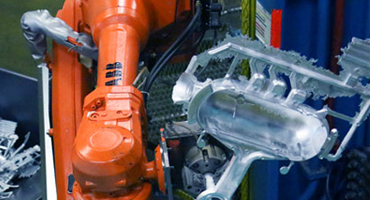
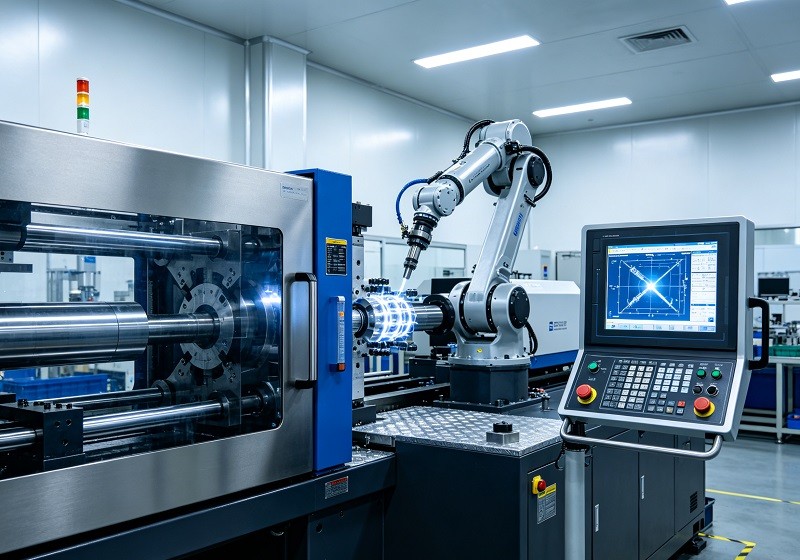
- Automation and Robotics: The integration of robotics and automation is a hallmark of a forward-thinking manufacturer. Robots can handle tasks like part removal, inspection, and packaging with precision and consistency, 24/7. This automation reduces labor costs, minimizes human error, and increases overall production efficiency.
- Scientific Molding: This is a data-driven approach to injection molding that moves beyond guesswork. Scientific molding involves a systematic process to define, optimize, and document all molding parameters—such as temperature, pressure, and fill rate—based on material behavior and mold-specific data. This methodology ensures a robust and repeatable process, leading to higher quality parts, reduced scrap, and faster cycle times.
- Advanced Tooling Technology: The mold is the heart of the injection molding process. Look for partners who use advanced techniques for mold creation, such as Direct Metal Laser Sintering (DMLS), which is a form of 3D printing for metal. This technology allows for the creation of complex mold geometries and conformal cooling channels that improve part quality and reduce cycle times.
- Process Monitoring and Control: Leading manufacturers use sophisticated software and in-mold sensors to monitor the molding process in real-time. This technology provides immediate feedback on critical variables, allowing for automatic adjustments to maintain consistency and prevent defects before they occur.
A manufacturer committed to investing in advanced technology demonstrates a commitment to quality and efficiency, making them a more reliable and capable partner for your project.
Mastery of Materials for Diverse Custom Plastic Injection Molding Parts Applications
A manufacturer's command of materials is a clear indicator of their expertise. The world of plastics is vast and complex, with thousands of polymers available, each with a unique profile of properties, processing requirements, and costs. A true partner will have a deep, practical understanding of this landscape and can provide invaluable guidance on selecting the optimal material for your specific part and its intended application.
Choosing the right material is a balancing act. It requires weighing factors like:
- Mechanical Properties: How strong, tough, or flexible does the part need to be? Materials like Nylon or Polycarbonate (PC) are chosen for high-stress applications, while Thermoplastic Elastomers (TPE) provide flexibility.
- Environmental Resistance: Will the part be exposed to chemicals, UV radiation, or extreme temperatures? Polypropylene (PP) offers excellent chemical resistance, while high-performance polymers like PEEK are required for high-heat environments.
- Regulatory Compliance: Parts for medical or food-contact applications must be made from biocompatible or food-grade materials that meet stringent FDA or other regulatory standards.
- Aesthetics: The desired look and feel of the part, including color, transparency, and surface finish, will also influence material choice. Acrylic (PMMA) offers excellent clarity, while ABS can provide a high-gloss finish.
- Cost: The material cost must align with the project budget. An expert manufacturer can help balance performance needs with material costs to find the most cost-effective solution without compromising quality.
An experienced molder will not just present you with resin datasheets; they will ask probing questions about your part's function and environment to recommend a material that ensures product success and longevity. Their mastery of materials is fundamental to transforming your design into a durable, high-performing product. A manufacturer with proven experience across diverse industries, from automotive to medical, will be better equipped to handle the specific material challenges your project presents.
Stringent Quality Control and Certifications for Reliable Custom Plastic Injection Molding Parts
A manufacturer's commitment to quality is non-negotiable. Consistent, reliable parts are the bedrock of a successful product, and this can only be achieved through a robust and comprehensive Quality Management System (QMS). When evaluating a potential partner, their approach to quality control should be a primary focus.
A thorough quality control process in plastic injection molding spans four key stages: design review, pre-production inspection, in-process control, and final inspection. This end-to-end monitoring ensures that from the raw material check to the final packaged part, every step is scrutinized for compliance with specifications.
Key Components of a Robust QMS:
- Material Inspection: Verifying that incoming raw materials meet all required specifications before they enter the production process.
- In-Process Monitoring: Using techniques like Statistical Process Control (SPC) to monitor critical process parameters like temperature and pressure in real-time. This allows for immediate corrections if any deviations occur, preventing defects.
- Final Inspection: Conducting thorough visual and dimensional inspections of finished parts to ensure they meet all quality standards and tolerances. This can involve tools like calipers, CMM machines, and 3D scanners.
The Importance of Certifications: Certifications serve as third-party validation that a manufacturer adheres to globally recognized standards for quality, safety, and efficiency. They are a clear indicator of a company's commitment to excellence and a crucial factor in your selection process.
- ISO 9001:2015: This is the international standard for a QMS. It demonstrates that a manufacturer has implemented processes to consistently provide products that meet customer and regulatory requirements. It is a foundational certification for any reputable molder.
- IATF 16949: This standard is specific to the automotive industry. It builds on ISO 9001 with additional, more stringent requirements focused on defect prevention, waste reduction, and continuous improvement. It is a mandatory certification for any supplier to the automotive supply chain.
- ISO 13485: This certification is essential for manufacturers of medical device components. It specifies requirements for a QMS where an organization needs to demonstrate its ability to provide medical devices and related services that consistently meet customer and applicable regulatory requirements. It includes additional requirements for risk management, traceability, and process validation critical for medical applications.
Partnering with a certified manufacturer reduces risk, ensures your parts are fit for purpose, and provides confidence that you are working with a supplier who is serious about quality and compliance.