What Are the Latest Advancements in Metal Bending and Welding Solutions?
We stand at the forefront of an exciting era in manufacturing, where the creation of metal components is more sophisticated than ever. The journey from raw metal to a robust, functional part requires both artistic skill and scientific precision. Today, industries from aerospace to automotive rely on the incredible strength and exactness achieved through advanced Metal Bending and Welding Solutions. We are constantly pushing the boundaries of what's possible, ensuring that the structures and machines around us are built to last and perform flawlessly.
The Foundation of Precision in Metal Bending and Welding Solutions
The quality of any fabricated metal product, from a simple bracket to a complex chassis, is built upon a foundation of accuracy and strength. These two principles are not just ideals but necessities that dictate the final product's performance, safety, and longevity. Without precision, components fail to fit, structures lose their integrity, and costs escalate.
Building with Strength and Accuracy
Precision in metal fabrication is the degree of accuracy and detail applied during the cutting, shaping, and assembling of metal components. It promises quality, safety, and durability, ensuring that every measurement and process is executed with exactness. In sectors like construction and engineering, where load-bearing structures are common, precision is critical for stability and safety. Even a deviation of a few millimeters can lead to assembly failures, delays, or catastrophic structural weaknesses.
The core benefits of building with strength and accuracy include:
- Structural Integrity: Precise bending ensures that stress is distributed correctly across a component, maintaining its strength without creating weak points. Similarly, accurate welding creates strong, seamless bonds that can withstand operational forces and environmental stress.
- Perfect Fit and Functionality: In any assembly, from automotive parts to electronic enclosures, every component must fit together perfectly. Precision fabrication guarantees this seamless integration, which is crucial for the proper alignment and function of machinery.
- Enhanced Safety and Compliance: For critical applications in aerospace, automotive, or construction, components must meet strict safety and quality standards. Precision ensures these standards are met, minimizing the risk of failure in high-stakes environments.
- Cost and Waste Reduction: Accuracy reduces errors, which in turn minimizes the need for costly rework and material scrap. Efficient processes translate directly to lower production costs and faster project timelines.
Achieving this level of precision requires a deep understanding of material properties, the right equipment, and skilled craftsmanship. The force applied, the bend angle, and the location of the bend must all be calculated and controlled precisely to prevent material damage and ensure the desired form is achieved. This fusion of technology and expertise is what makes modern metal fabrication so reliable.
Overcoming Challenges in Metal Forming
Even with the best planning, the physical process of bending and welding metal presents inherent challenges. Materials can behave in unpredictable ways, and forces like heat and pressure must be carefully managed. Addressing these common issues is fundamental to achieving high-quality outcomes.
One of the most frequent challenges in metal bending is springback. This is the tendency of a metal to partially return to its original shape after the bending force is removed. To counteract this, professionals often overbend the material by a calculated amount, ensuring that the final angle is correct after springback occurs. Using advanced machinery with precise control over bending angles also helps minimize this effect.
Another common issue is cracking, which occurs when the outer surface of the bend is stretched beyond the material's ductility limit. This can be caused by using a bend radius that is too tight or bending against the material's grain. Solutions include selecting more ductile materials, increasing the bend radius, and sometimes annealing (softening) the metal before bending.
In welding, the primary challenges are related to heat management. Distortion and warping occur when the intense heat from the welding process causes the metal to expand and contract unevenly. This is especially prevalent in thin metal sheets. To mitigate this, fabricators use proper fixture designs to hold the material steady, control the welding sequence to distribute heat, and implement techniques like preheating or controlled cooling.
Here is a summary of common challenges and their professional solutions:
| Challenge | Description | Bending Solution | Welding Solution |
|---|---|---|---|
| Springback | Metal attempts to return to its original form after being bent. | Overbend the material to a slightly sharper angle; use bottoming or coining techniques. | N/A |
| Cracking | The outer surface of the bend fractures due to excessive stretching. | Increase the bend radius; select a more ductile material; anneal the metal before bending. | N/A |
| Wrinkling | Small folds or ripples appear on the inside surface of a bend. | Use tooling with appropriate die openings; increase the bend radius to reduce compression stress. | N/A |
| Warping/Distortion | The workpiece changes shape due to heat-induced stress. | Design the bending sequence to distribute stress evenly across the part. | Use robust fixtures; manage heat input carefully; employ controlled cooling methods. |
| Burn-Through | The weld penetrates too deeply, creating holes in the material, especially on thin sheets. | N/A | Use lower heat settings; increase travel speed; choose appropriate welding methods like TIG for better heat control. |
| Inconsistent Quality | Variations in material thickness or machine calibration lead to inconsistent parts. | Use certified materials; conduct regular machine calibration and inspection. | Adhere to stringent quality control protocols at every stage of production. |
Successfully navigating these challenges requires a combination of deep material knowledge, skilled operation, and the use of well-maintained, high-quality equipment.
Modernizing Production with Automated Metal Bending and Welding Solutions
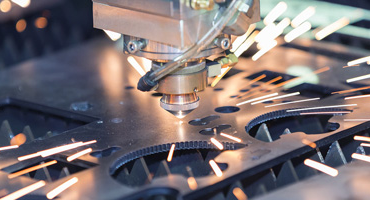
The evolution from manual craftsmanship to automated precision marks a significant leap forward in manufacturing. Automation, powered by computer numerical control (CNC), robotics, and artificial intelligence (AI), has redefined the standards for efficiency, consistency, and complexity in metal fabrication. These technologies are not just modernizing production lines; they are enabling manufacturers to tackle challenges that were once insurmountable.
The Efficiency of CNC Bending
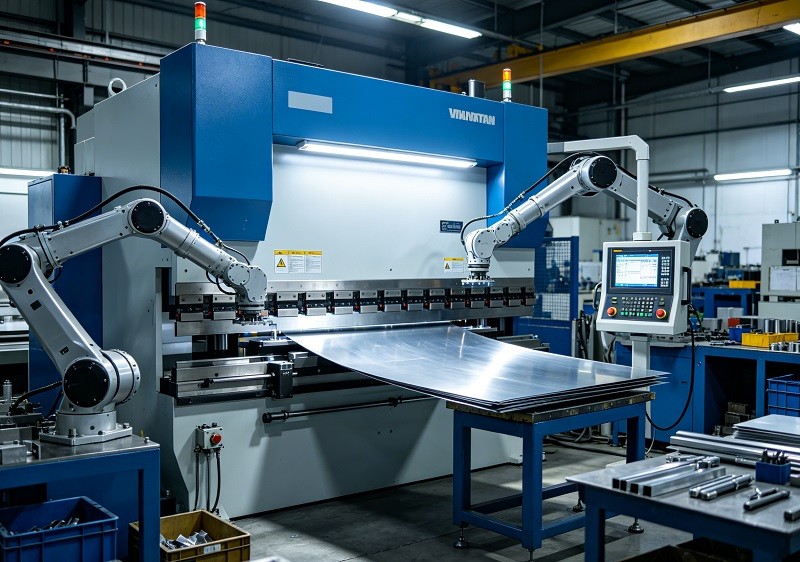
At the heart of modern metal bending are CNC press brakes. CNC, which stands for Computer Numerical Control, is a process where a computer is programmed to control the bending machine with extreme precision. This technology automates the bending sequence, pressure, and angle, transforming sheet metal fabrication into a faster, more accurate, and highly adaptable operation.
Compared to traditional manual press brakes, which rely on an operator's skill and experience, CNC bending offers several distinct advantages:
- Unmatched Precision and Repeatability: CNC machines can produce thousands of identical parts with no variation, achieving tolerances as tight as ±0.1mm. Programmed instructions eliminate the human error associated with manual adjustments, ensuring every bend is perfect. This is crucial in industries like aerospace and automotive, where tight tolerances are non-negotiable.
- Increased Speed and Productivity: Automation significantly reduces setup time and accelerates the bending process. While a manual press might require several trial-and-error bends, a CNC machine executes each bend correctly on the first attempt. This can increase output by 200-300% compared to manual methods, allowing for continuous, multi-shift operations.
- Ability to Create Complex Shapes: CNC press brakes can feature multi-axis controls, allowing them to perform intricate, multi-step bends in a single cycle. This capability makes it possible to fabricate complex geometries that would be incredibly difficult or time-consuming with manual techniques.
- Reduced Material Waste: The high precision of CNC bending minimizes mistakes and, therefore, reduces scrap material. Advanced software can also optimize how parts are laid out on a metal sheet to maximize material utilization, leading to significant cost savings.
- Enhanced Flexibility: These machines can store a vast library of bending programs, allowing manufacturers to switch between different jobs and part designs quickly and efficiently. This agility is ideal for high-mix, low-volume production environments.
While the initial investment in a CNC press brake is higher than a manual one, the long-term return on investment is substantial due to reduced labor costs, less material waste, and vastly improved productivity.
Smart Automation and Robotics in Welding
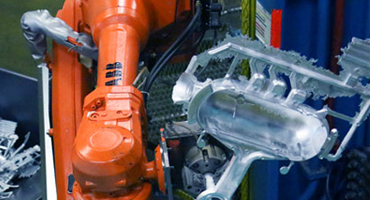
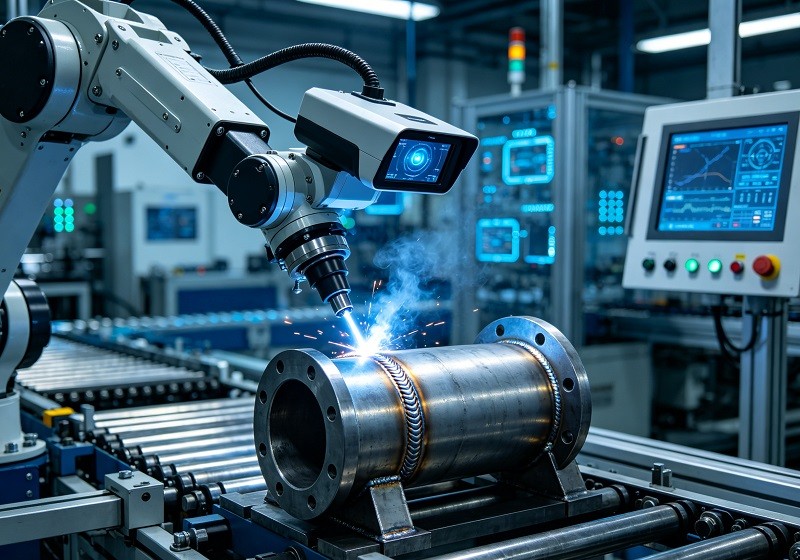
Just as CNC has transformed bending, smart automation and robotics are revolutionizing welding. Modern robotic welding systems have evolved far beyond simple, repetitive arms. Today, they are intelligent, adaptable systems integrated with advanced sensors, vision systems, and artificial intelligence.
Welding automation involves using a robotic arm to move a welding torch along a pre-programmed path at a consistent speed, while automatically controlling all welding parameters. The true advancement lies in the "smart" capabilities that now supplement this automation:
- AI and Machine Learning: Artificial intelligence is giving welding robots a "brain." AI-powered systems can use 3D vision systems to scan a workpiece, identify the weld joint, and dynamically adjust the robot's path and parameters to account for any imperfections or variations in fit-up. Machine learning algorithms enable the robot to learn from each weld it performs, continuously refining its technique and improving quality over time.
- Advanced Sensor and Vision Systems: Modern welding robots are equipped with an array of sensors—including vision, force, and temperature sensors—that provide real-time feedback. This allows the system to perform tasks like seam tracking, where the robot follows an imperfect joint precisely, and adaptive control, where it adjusts a parameter like voltage or wire speed on the fly to maintain a perfect weld. This enhanced control drastically reduces defects like porosity or burn-through.
- Collaborative Robots (Cobots): A newer development is the rise of cobots, which are designed to work safely alongside human operators. These systems can handle the repetitive, strenuous welding tasks, freeing up skilled human welders to focus on more complex, custom jobs or quality oversight. This collaborative approach enhances productivity without completely replacing the valuable expertise of a human worker.
The fusion of robotics and AI creates intelligent welding systems that can handle small batches and non-standard parts efficiently, a task that was previously difficult for traditional automation. These systems can detect and correct issues in real-time, monitor for defects, and even predict when equipment might need maintenance, preventing costly downtime. This level of intelligent automation is making welding faster, safer, and more consistent than ever before.
The Future Impact of Cutting-Edge Metal Bending and Welding Solutions
The accelerating advancements in automation and intelligent systems are doing more than just improving current manufacturing processes—they are fundamentally reshaping the future of the industry. The impact extends beyond the factory floor, influencing everything from product quality and innovation to workforce development and economic competitiveness. By embracing these cutting-edge Metal Bending and Welding Solutions, manufacturers are building a more resilient, efficient, and innovative future.
Reducing Errors and Boosting Quality
One of the most immediate and significant impacts of advanced automation is the drastic reduction in production errors, which directly translates to a higher standard of quality. Manual processes, no matter how skilled the operator, are susceptible to inconsistencies and mistakes caused by fatigue, distraction, or simple human variation. Automation eliminates these variables.
- Standardized Processes and Consistency: Automated systems perform tasks with the same precision every single time, whether it's the first part of the day or the thousandth. CNC benders follow exact programmed instructions, while robotic welders maintain a perfect speed and torch angle, ensuring uniform quality across entire production runs.
- Real-Time Monitoring and Defect Detection: Modern automated systems are equipped with sophisticated sensors and machine vision. These technologies monitor the fabrication process in real-time. For instance, AI-driven cameras can inspect a weld as it is being made, instantly identifying defects like cracks, porosity, or improper fusion that might be invisible to the human eye. This allows for immediate correction, preventing defective products from ever leaving the production line.
- Elimination of Manual Data Entry Errors: Automation extends to data handling. By directly importing data from CAD designs to machines and automatically logging production metrics, the risk of transcription errors is eliminated. This ensures that the part produced is true to the original design and that quality control data is accurate and reliable.
- Integrated Quality Control: Automation enables the seamless integration of quality control into the production workflow. Instead of being a separate, post-production step, inspection can happen concurrently with fabrication. Robotic systems can be paired with non-destructive testing (NDT) methods like ultrasonic or radiographic testing, providing an immediate and comprehensive quality report for every single component.
By implementing these technologies, manufacturers can move from a reactive approach to quality control—finding and fixing defects after they occur—to a proactive one where errors are prevented before they even happen. This leads to reduced rework, lower material waste, and ultimately, superior and more reliable products.
Addressing Workforce Needs and Driving Innovation
A common concern surrounding automation is its effect on the manufacturing workforce. However, rather than simply replacing jobs, automation is transforming them and creating new opportunities. It addresses the critical skills gap and labor shortages facing the industry while empowering human workers to drive innovation.
- Shifting from Manual Labor to Technical Roles: Automation takes over the repetitive, physically demanding, and often hazardous tasks. This doesn't eliminate the need for human workers; instead, it shifts their roles toward more technical and value-added responsibilities. There is a growing demand for skilled technicians who can program, operate, maintain, and troubleshoot these advanced automated systems. This transition leads to more engaging, higher-paying, and safer jobs.
- Bridging the Skills Gap: The manufacturing industry faces a significant labor shortage, with millions of jobs projected to go unfilled due to a lack of skilled talent. Automation helps bridge this gap. By automating routine tasks, companies can optimize their existing workforce, allowing a smaller number of employees to manage larger and more complex operations. This also makes the industry more attractive to younger generations who are more interested in technology-driven roles.
- Upskilling and Reskilling the Workforce: To facilitate this transition, leading companies are investing in training programs to upskill and reskill their employees. A worker who once operated a manual press brake can be trained to program a CNC machine. A welder can learn to manage a fleet of collaborative robots. This focus on continuous learning not only prepares the workforce for the smart factories of the future but also boosts employee loyalty and job satisfaction.
- Fostering Human-Machine Collaboration: The future of manufacturing lies in the powerful partnership between humans and machines. Automation handles the precision-driven, repetitive work, freeing up human creativity and problem-solving skills. Workers can focus on process optimization, quality oversight, and developing innovative solutions to complex challenges—tasks that machines cannot perform. This synergy allows manufacturers to innovate faster and adapt more quickly to changing market demands.
By embracing automation, companies are not just investing in technology; they are investing in their people. This strategic approach ensures that the manufacturing industry remains a powerhouse of innovation, driven by a highly skilled workforce that is ready to tackle the challenges of tomorrow.
Conclusion
From bending the toughest steels to welding intricate components, we have seen incredible advancements. These innovative metal bending and welding solutions are not just improving processes; they are redefining what's possible in manufacturing. The move toward CNC precision, robotic automation, and AI-driven intelligence has ushered in an era of unparalleled efficiency, quality, and complexity. These technologies form the backbone of modern production, ensuring that every component is made to exact specifications with flawless consistency.
As we look ahead, we are excited to continue exploring and implementing these cutting-edge technologies. They are the key to reducing errors, minimizing waste, and creating products of superior quality and durability. Furthermore, by transforming workforce roles and fostering a new generation of skilled technicians, these advancements will ensure that our industries remain strong, precise, and ready for the challenges of tomorrow. The future is not about replacing human ingenuity but augmenting it, creating a powerful synergy between people and machines that will drive progress for years to come.
We encourage you to share this article with your network and join the conversation. How do you see these advancements shaping your industry? The journey of innovation in manufacturing is a collective one, and together, we can build a stronger, smarter future.