What Are F-Type Connectors? A Guide from Your CATV F Connector Supplier
Ever found yourself staring at a buffering screen, wondering why your lightning-fast internet suddenly feels like dial-up? Or perhaps you've been frustrated by a pixelated TV picture right at the climax of your favorite show. The culprit might not be your internet provider or your brand-new television. Often, the issue lies with a tiny, overlooked component: the F-type connector.
At our core, we, as your dedicated CATV F connector supplier, understand the critical role these small parts play in your entire digital experience. They are the unsung heroes of your home network, and when they falter, everything downstream is affected. This guide will delve into what F-type connectors are, why their proper function is crucial, and how to ensure they're helping, not hindering, your connectivity.
The Hidden Problem: Why Loose Connections Drain Your Data Capacity, Explained by Your CATV F Connector Supplier
The modern world runs on data, and the demand for faster, more reliable connections has never been higher. Yet, a pervasive and often invisible issue lurks within the walls of our homes and throughout our cable infrastructure: loose connections. These seemingly minor flaws can become a major drain on data capacity, creating a ripple effect of poor performance.
F-Connectors: Ubiquitous Yet Often Overlooked in Your Home
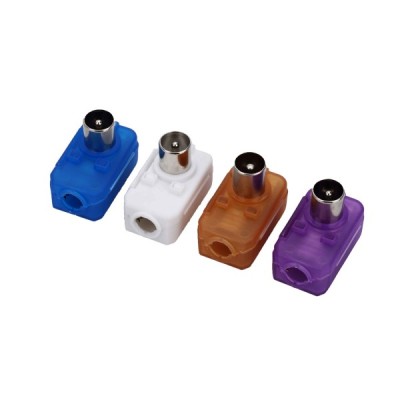
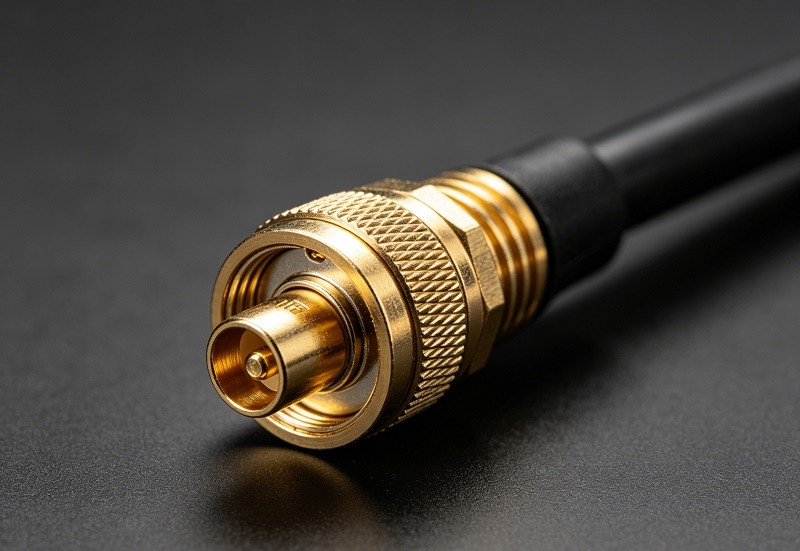
If you've ever set up a cable modem, satellite dish, or TV antenna, you've handled an F-type connector, likely without giving it a second thought. Invented in the 1950s for the burgeoning cable television industry, this coaxial RF connector has become the standard for passing television and data signals. Its simple, threaded design makes it inexpensive and easy to install on coaxial cables (like RG-6 or RG-59) that form the backbone of home entertainment and internet setups.
You can find them in a variety of places:
- Cable Modems: Connecting the main line from your internet service provider.
- Televisions: On the back panel for "over-the-air" antenna or direct cable inputs.
- Set-Top Boxes: Linking your cable or satellite service to the box.
- Wall Outlets: Providing a convenient connection point for your devices in different rooms.
- Satellite Dishes: Connecting the low-noise block downconverter (LNB) to your receiver.
The primary function of an F-connector is to join coaxial cables while maintaining a specific electrical property—75 Ohm impedance—which is crucial for signal integrity. They are designed to handle a wide range of frequencies, making them suitable for everything from standard-definition TV to multi-gigabit internet.
The Silent Threat: How Loose Connections Lead to Widespread Service Issues
A perfectly tightened F-connector forms a seamless electrical shield. It ensures the signal stays inside the cable and that outside noise stays out. A loose connector, even one that is just slightly backed off, breaks this shield. For TV and internet service, this is disastrous. A loose connection is one of the most common causes of signal loss, distortion, and even complete failure.
The immediate symptoms are easy to spot:
- For Television: You'll see pixelation (squares on the screen), image freezing, or channels that won't load at all. This happens because the packets of video data are lost or corrupted.
- For Internet: Your connection will drop intermittently, web pages will fail to load, and your download/upload speeds will be a fraction of what they should be. Video calls will buffer constantly, and online gaming will be plagued with lag.
The physical reason for this is an "impedance mismatch." The entire cable system is designed to have a consistent 75-ohm impedance. A loose connector introduces a tiny air gap. This gap acts as a wall, reflecting signal energy back toward its source and causing a significant drop in signal strength. Studies have shown that a connector backed out by just a couple of millimeters can drastically degrade performance.
Noise, Interference, and Their Impact on Advanced Data Platforms like DOCSIS 3.0/3.1
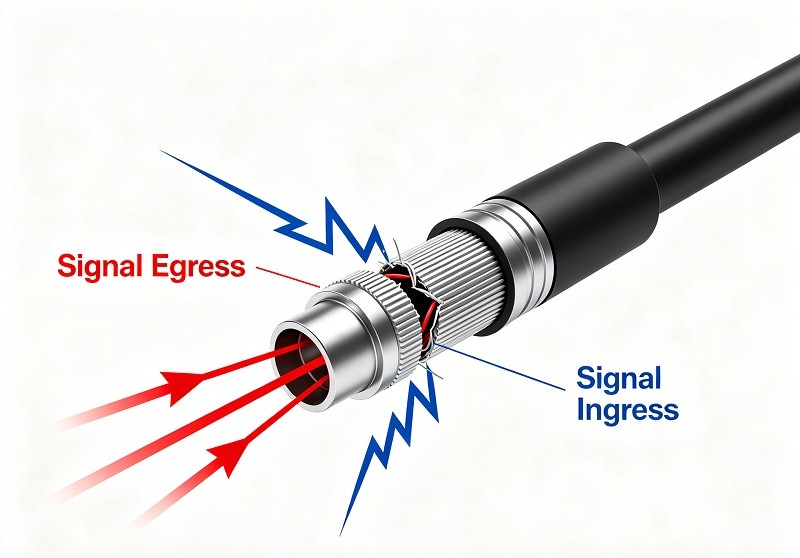
A loose connector is more than just a weak link; it's an open door for noise and interference. Think of your coaxial cable as a carefully shielded pipe designed to carry data signals. When a connector is loose, it creates a crack in that pipe. This leads to two major problems:
- Signal Egress: Your cable or internet signal leaks out. While this might seem minor, it can interfere with over-the-air broadcasts and other radio services, a problem taken very seriously by regulatory bodies.
- Signal Ingress: This is often the more damaging issue for the user. External radio frequency (RF) signals get into the cable. This unwanted noise mixes with your data stream, corrupting it and forcing your equipment to work much harder to distinguish the good signal from the bad.
Modern internet platforms, especially those using DOCSIS 3.0 and DOCSIS 3.1 standards, are incredibly sophisticated but also highly sensitive to this kind of interference. DOCSIS (Data Over Cable Service Interface Specification) is the technology that allows for high-speed data transfer over existing coaxial cable TV systems. To achieve gigabit speeds, DOCSIS 3.1 uses advanced modulation techniques like Orthogonal Frequency Division Multiplexing (OFDM). These techniques pack data incredibly densely, but they require a very clean, high-quality signal. When ingress noise pollutes the line, it raises the "noise floor," making it difficult for the modem and the cable company's equipment (the CMTS) to understand the data. This leads to high error rates, re-transmissions, and ultimately, the slow and unreliable performance you experience.
Understanding Common Mode Current: When One Loose F-Connector Affects Hundreds
One of the least understood aspects of a cable network is that it's a shared resource. Unlike a fiber optic line that might run directly to your home, the coaxial cable line serving your house is part of a larger "node" that you share with dozens or even hundreds of your neighbors. This shared architecture is highly efficient, but it has a significant drawback.
The signals from every home on the node travel back upstream and combine, or "funnel," into a single return path to the cable provider's headend equipment. This is where a loose F-connector in one home becomes a problem for everyone.
When a single connector is loose, it acts like an antenna, picking up stray RF signals. This noise doesn't just stay in that one house; it travels upstream and pollutes the shared return path for the entire node. This is caused by a phenomenon called common mode current, where unwanted electrical noise flows on the outer shield of the coaxial cable. This noise propagates back into the network, raising the overall noise floor for everyone.
The effect is cumulative. A few loose connectors in a neighborhood can inject so much aggregate noise into the system that it significantly impacts service for hundreds of users, even those with perfectly installed and maintained equipment. A technician might diagnose this as "ingress" on the node, leading to a frustrating and time-consuming process of trying to pinpoint which of the many homes is the source of the problem. Often, the cause is just a single F-connector that someone accidentally loosened while moving their TV stand.
The Real-World Consequences and Critical Causes, from a Leading CATV F Connector Supplier
The theoretical problems of signal loss and noise ingress translate into very real and frustrating experiences for end-users. Dropped video calls, cripplingly slow downloads, and glitchy TV are the direct results. Understanding why this happens, even with modern equipment, is key to appreciating the importance of every single connection point in the network.
Why Even Improved Connector Technology Can't Fully Solve Loose Connection Performance Issues
Over the years, F-connector technology has evolved significantly. The old, screw-on or crimp-style connectors of the past were notoriously unreliable. Today, the industry standard is the compression F-connector. When installed with a special tool, it creates a 360-degree seal around the cable, offering vastly superior signal retention and weather resistance. These connectors are exceptionally robust and provide the most reliable termination possible.
However, no connector is infallible, because the F-connector system relies on two distinct points of contact:
- The Connector-to-Cable Connection: This is the bond created when the connector is attached to the end of the coaxial cable. Modern compression connectors do an excellent job here, creating a near-permanent, weatherproof bond that is highly resistant to pulling and movement.
- The Connector-to-Port Connection: This is the threaded connection between the male connector on the cable and the female port on your wall plate, modem, or television.
The weak point is almost always the second connection. Even the world's best compression connector is useless if it's only "finger-tight" on the back of your modem. Vibrations, temperature changes, or simply moving the equipment can cause this threaded connection to back itself out over time. Once it becomes loose, all the problems of impedance mismatch, signal loss, and ingress come flooding back, regardless of how well the connector is attached to the cable itself.
The Human Element: How Installation Errors and Accidental Tampering Create Loose Connections
The performance of a network is often at the mercy of human factors. Even with the best components, errors in installation or simple accidents can undermine the entire system.
Common Installation Errors: Professional installers are trained to avoid these pitfalls, but with the rise of self-install kits and DIY projects, these errors are rampant.
- Improper Cable Stripping: Removing too much or too little of the cable's layers can lead to a poor fit, short circuits (where the braid touches the center conductor), or a weak ground connection.
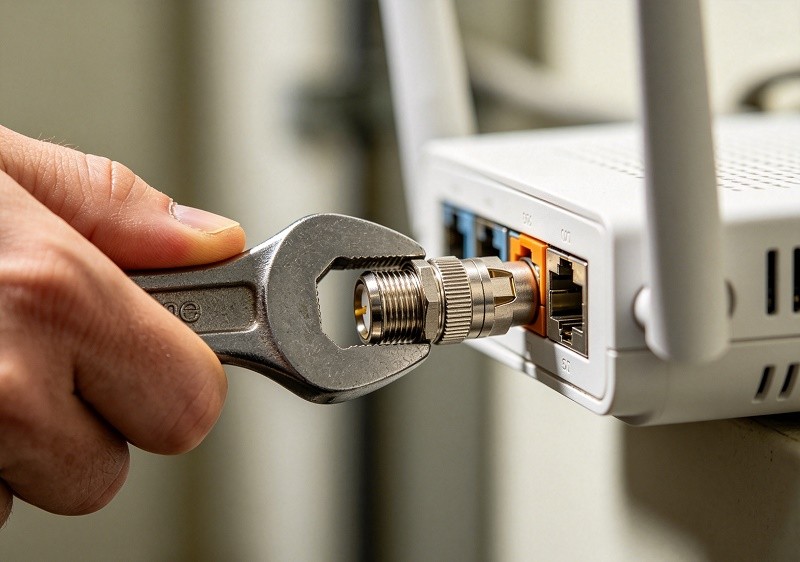
- Under-tightening: This is the most prevalent issue. Many people only tighten the connector with their fingers until it feels snug. This is not enough. Finger-tight connections are highly prone to loosening over time. A 7/16" wrench should be used to give the connection a final quarter-turn to ensure it is secure.
- Over-tightening: Conversely, using excessive force with a wrench can damage the threads on the connector or, worse, the port on the equipment. This can create a permanently faulty connection point.
- Using the Wrong Connector Type: Using an old twist-on or crimp-style connector instead of a modern compression connector is a recipe for failure. Likewise, using a connector designed for RG-59 cable on a thicker RG-6 cable will result in a poor fit.
| Installation Do's and Don'ts | |
|---|---|
| Do ✔️ | Don't ❌ |
| Use a high-quality compression F-connector. | Use old twist-on or poorly made crimp connectors. |
| Use the correct stripping tool for a clean, precise cut. | Use a knife or scissors to strip the cable. |
| Ensure the white dielectric is flush with the connector base. | Allow the braided shield to touch the center conductor. |
| Tighten with a 7/16" wrench (1/4 turn past finger-tight). | Only finger-tighten the connection. |
| Use a protective cap on any unused splitter ports. | Leave open ports on splitters, which act as antennas for noise. |
Accidental Tampering: In a busy home, cables are often disturbed without anyone realizing it.
- Moving Equipment: Shifting a TV stand, entertainment center, or desk can put stress on the connected cable, causing the F-connector to work itself loose.
- Cleaning: Vacuum cleaners are a notorious enemy of secure connections, frequently bumping or pulling on cables.
- Pets and Children: Curious pets and children can easily tamper with and loosen accessible cable connections.
These small, seemingly innocent actions are a primary cause of intermittent and hard-to-diagnose service issues.
The Critical Need for Effective Signal Containment to Prevent Degradation
A high-performance cable network, whether for Community Access TV (CATV) or internet, operates as a closed, shielded system. The coaxial cable's design, with its layers of insulation and metallic shielding, is intended to create a self-contained environment for the RF signal. This "signal containment" serves two equally important functions:
- Preventing Egress: It keeps the signals inside the cable, ensuring maximum signal strength reaches the destination and preventing interference with other wireless services.
- Preventing Ingress: It keeps unwanted external noise outside the cable, protecting the data from corruption.
The F-connector is the gateway in this system. Its critical job is to maintain the integrity of that shielded environment where the cable terminates. A properly installed and tightened F-connector ensures that the cable's outer shield makes a full, 360-degree electrical contact with the grounding of the port. This unbroken ground path is what contains the signal and blocks noise.
When this containment is breached by a loose connector or damaged cable, the system's performance immediately degrades. The network is no longer a pristine, closed loop. It becomes vulnerable to a chaotic environment of radio waves from Wi-Fi routers, cell phones, electrical appliances, and power lines. For high-speed data transmission that relies on complex and delicate signals, this external noise is the primary cause of poor performance and service failure. Ensuring effective signal containment at every F-connector is not just best practice—it is a fundamental requirement for a reliable digital experience.
Our Solutions: How Your Expert CATV F Connector Supplier Ensures Reliable Connectivity and a Better Experience
As a specialized supplier, we don't just provide parts; we provide solutions engineered to combat the fundamental problems that plague CATV and broadband networks. Understanding that loose connections are the root cause of countless service issues, our focus is on creating F-connectors that are not only high-performing but also resilient against the common points of failure discussed above.
Innovative Technologies Designed to Actively Reduce Noise and Interference at Connection Points
To truly solve the problems of ingress and compromised signal integrity, connector design must go beyond the basics. We focus on innovative engineering that actively combats noise and interference at the most vulnerable point—the connection itself.
Our advanced F-connectors incorporate several key technological enhancements:
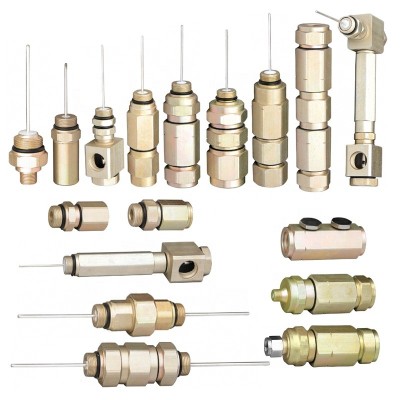
- Superior Materials and Plating: Signal integrity begins with the materials. We utilize high-quality brass with nickel plating, which provides excellent durability and corrosion resistance. This ensures a reliable electrical contact that does not degrade over time due to environmental factors. For the most critical applications, gold plating can be used on contact points to offer the highest level of conductivity and resistance to oxidation.
- 360-Degree Compression Technology: Our compression connectors provide a complete, continuous seal around the cable jacket. This not only creates a strong mechanical bond but, more importantly, ensures the cable's shielding makes a full and uninterrupted connection with the connector body. This continuous ground path is essential for maximizing shielding effectiveness against external RF interference.
- Integrated O-rings and Weather Sealing: Many of our designs feature integrated O-rings inside the connector nut. As the connector is tightened, this O-ring creates a weatherproof barrier, preventing moisture from creeping into the connection. Moisture is a primary cause of corrosion, which can increase electrical resistance and degrade the connection over time.
- Precision Machining for Optimal Impedance: Every component is manufactured to tight tolerances to maintain the crucial 75-ohm impedance path. A well-designed connector minimizes signal reflection (return loss) by ensuring a smooth, uninterrupted signal path from the cable through the connector to the device port.
By integrating these features, our connectors create a robust, well-shielded, and environmentally sealed connection point that actively reduces the potential for noise and interference to enter the system.
The Power of Lockable F-Connectors: Maintaining Ground Continuity for Enhanced User Satisfaction
Recognizing that the primary point of failure is the loosening of the connector from the device port, the ultimate solution is one that prevents this from happening. This is the simple but powerful principle behind lockable F-connectors, also known as security connectors.
These connectors are designed to address the "human element" directly. They feature a unique mechanism that prevents them from being loosened or removed without a special tool. This provides two immense benefits:
- Maintains Physical Security: The connection cannot be accidentally loosened by moving furniture, cleaning, or other household activities. It also prevents unauthorized tampering, which is crucial in multi-dwelling units or publicly accessible areas.
- Guarantees Ground Continuity: Most importantly, by ensuring the connector remains securely tightened to the port, the lockable design guarantees a permanent, unbroken ground connection. This continuous ground path is the lynchpin of signal containment. It ensures the shielding remains 100% effective, permanently locking out ingress noise and preventing signal egress.
For a cable television or internet provider, deploying lockable F-connectors can drastically reduce service calls related to poor signal quality. For the end-user, it translates to a more stable, reliable, and ultimately more satisfying experience. The buffering, pixelation, and dropouts caused by a physically loose connection are eliminated, allowing the network to perform at its maximum potential.
Conclusion: Take Control of Your Connection
Loose F-type connections represent a silent but pervasive problem that degrades signal quality and data capacity for millions of users. These small components, often hidden behind equipment, can be the single point of failure that throttles your entire home network. However, understanding their impact is the first step toward achieving a consistently better digital experience. From signal ingress that pollutes the network for an entire neighborhood to the simple act of a finger-tight connection working itself loose, the integrity of this connection point is paramount.
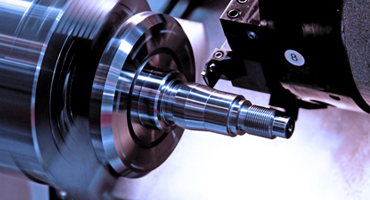
Choosing high-quality, professionally installed connectors is a critical investment in your connected home. It ensures the maintenance of signal integrity, maximizes the data capacity you pay for, and minimizes the frustration of intermittent service. At SOMI Custom Parts, we are proud to be a dedicated CATV F Connector Supplier committed to engineering excellence. As a premier CNC Machining Parts manufacturer, we utilize precision processes to provide both OEM and ODM services. This ensures that you receive robust, high-quality F-connectors that are meticulously designed to maintain ground continuity, resist environmental factors, and deliver the exceptional, uninterrupted experience you expect from your digital services.
Don't let a loose connection be the weak link in your chain. Take control of your network's physical layer, and share this guide to help others understand the hidden culprit behind their network woes.