What Are F Male Connectors and Why Your Supplier Matters for Cable Performance
Have you ever wondered about the tiny components that make your TV picture crystal clear or your cell signal strong and reliable? Today, we're diving deep into the world of F male connectors, which are essential parts of many residential and commercial cable systems. These small but mighty connectors play a monumental role in how well your cables perform. As we'll explore, choosing the right connector—and, just as importantly, a dependable supplier—can make all the difference between a flawless signal and frustrating interference.
The Foundation: Why Cable Types Matter and Your F Male Connector Supplier's Role
Before a signal ever reaches your device, it travels through a coaxial cable. The type of cable you use is the first critical decision that impacts signal integrity. Not all coax is created equal, and understanding the fundamental differences is key to building a high-performance system. This is where the expertise of your parts provider becomes invaluable, as they can guide you toward the optimal materials for your specific application, ensuring every component works in harmony.
RG6 and RG11 Coax: Understanding the Difference
The two most common types of 75-ohm coaxial cable you'll encounter for video and data are RG6 and RG11. The "RG" designation is a legacy term from an old military specification for "Radio Guide," but today the numbers help us differentiate cables with distinct characteristics. Although they serve similar purposes, their physical construction leads to significant performance differences. RG6 cable is the modern standard for most residential applications like cable television, satellite connections, and broadband internet. RG11, on the other hand, is a thicker, more robust cable designed for long-distance runs where signal preservation is paramount.
To better visualize their differences, here is a detailed comparison:
| Feature | RG6 Coaxial Cable | RG11 Coaxial Cable |
|---|---|---|
| Center Conductor | ~18 AWG (1.02 mm) | ~14 AWG (1.63 mm) |
| Overall Diameter | ~0.275 inches | ~0.405 inches |
| Flexibility | High; easy to bend and route in walls. | Low; stiffer and more difficult to install in tight spaces. |
| Ideal Use Case | Short-to-medium runs (under 150-200 ft). | Long-distance runs (over 200 ft). |
| Signal Loss (Attenuation) | Higher loss over distance (e.g., ~5.5-6 dB per 100 ft at 1 GHz). | Significantly lower loss over distance (e.g., ~3.5-4 dB per 100 ft at 1 GHz). |
| Common Applications | Residential cable TV, satellite TV, internet modems. | Backbone infrastructure for large buildings, long outdoor runs, CATV trunk lines. |
| Cost | More affordable. | More expensive due to more material and complex manufacturing. |
RG6 coaxial cables are commonly used to connect televisions to satellite and cable TV systems.
For the vast majority of in-home setups, RG6 is the cable of choice. Its 18 AWG center conductor, flexible jacket, and widespread availability make it perfect for connecting your satellite dish to its receiver, linking a cable box to a television, or establishing a connection for your broadband modem. Its balance of performance and cost-effectiveness is ideal for the shorter distances typically found inside a house, where runs rarely exceed 150 feet. The signal loss, or attenuation, is manageable over these lengths, ensuring that high-frequency signals for HD video and high-speed data arrive with enough strength to provide a clear, uninterrupted experience.
RG11 cables, while serving similar purposes, are thicker and experience roughly half the signal loss of RG6, making them ideal for longer distances.
When the distance between the signal source and the destination grows, attenuation becomes a serious problem. Every foot of cable introduces a small amount of signal loss, and over long runs, this cumulative loss can degrade a signal to the point of being unusable. This is where RG11 shines. Its thicker 14 AWG center conductor offers less resistance, allowing electrical signals to travel farther with less degradation. For example, at satellite frequencies around 2150 MHz, a 300-foot run of RG6 cable could introduce 27 dB of loss, while the same length of RG11 cable would only cause about 17 dB of loss—a massive 10 dB difference that can determine whether a signal is viable or lost entirely. This makes RG11 the preferred choice for backbone installations in commercial buildings, long outdoor runs from an antenna to a distribution point, or for homes situated far from the street-level utility connection.
For cell signal booster systems, RG11 is often preferred, especially over long runs, due to its lower loss and suitability for 'open-loop' systems.
Cell phone signal boosters work by capturing a weak outdoor signal, amplifying it, and rebroadcasting it indoors. The cable connecting the outdoor antenna to the amplifier is one of the most critical components in this system. Using a high-loss cable can negate the benefits of the amplifier itself. While professional-grade 50-ohm cables like LMR-400 are common in commercial boosters, many residential and light commercial systems are designed to use 75-ohm coaxial cables.
In these 75-ohm systems, RG11 is highly recommended for any significant cable run. Cell signal boosters are considered "open-loop" systems because they amplify a signal from an antenna broadcasting into the air, as opposed to a "closed-loop" system like cable TV where powerful signals are sent between devices at both ends. This makes preserving every bit of the original, weak signal crucial, and RG11's low-loss characteristic is perfectly suited for this task.
Both RG6 and RG11 coaxial cables are compatible with 75-ohm cell signal boosters. Your f male connector supplier can advise on the best cable type and connector combination for your specific needs, ensuring optimal system efficiency.
The golden rule of RF systems is impedance matching. Mismatched impedance between cables, connectors, and devices causes signal reflection, which leads to significant signal loss and performance degradation. Both RG6 and RG11 cables have a characteristic impedance of 75 ohms, making them compatible with a wide range of consumer electronics, including cable modems, televisions, and 75-ohm cell signal boosters.
However, the cable is only one part of the equation. The connectors must also be 75 ohms and properly terminated to maintain system integrity. This is where a knowledgeable F Male Connector supplier is indispensable. An expert supplier does more than just sell parts; they provide critical advice on which cable (RG6 or RG11) is appropriate for your run length, what type of F connector (crimp, compression, or twist-on) is best for that cable, and how to ensure a perfect termination. Their guidance helps prevent costly mistakes and ensures your system operates at peak efficiency from day one.
F-Type Connectors: Characteristics and How Your F Male Connector Supplier Shapes Performance
Just as the cable itself is crucial, the connector at its end is equally vital. The F-type connector is the ubiquitous choice for terminating 75-ohm cables in consumer applications. It was invented in the early 1950s specifically for cable television and has since become the standard for satellite TV and cable modems as well. Its design and quality have a direct and significant impact on the final performance of the entire system.
F-Type vs. N-Type Connectors: A Clear Distinction
While F-type connectors dominate the consumer landscape, N-type connectors are the workhorses of professional and commercial RF applications. The two are designed for entirely different systems and are not interchangeable. The most critical difference is their impedance: F-type connectors are exclusively 75-ohm, while N-type connectors are predominantly 50-ohm.
Here's a breakdown of their key differences:
| Feature | F-Type Connector | N-Type Connector |
|---|---|---|
| Impedance | 75 Ohm (for video/data) | 50 Ohm (for RF transmission/data) |
| Frequency Range | Typically up to 3 GHz. | Up to 11 GHz or 18 GHz for precision versions. |
| Center Pin | Uses the cable's own solid center conductor. | Has its own integrated male pin. |
| Durability | Lighter duty, designed for indoor use. | Robust and often weatherproof, ideal for outdoor and industrial use. |
| Coupling Mechanism | Threaded nut (3/8-32 UNEF thread). | Larger, more robust threaded coupling (5/8-24 thread). |
| Typical Cable | RG6, RG11, RG59. | LMR-400, other 50-ohm low-loss cables. |
| Primary Applications | Cable TV, satellite receivers, internet modems. | Antennas, base stations, Wi-Fi equipment, RF test labs. |
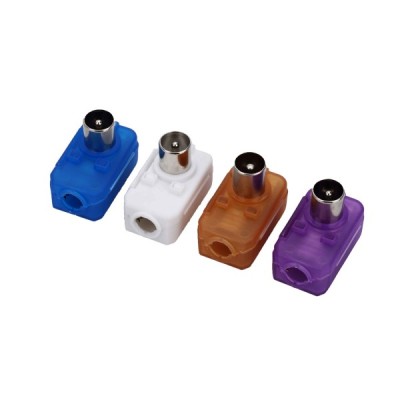
F-type connectors are specifically designed for RG6 and RG11 cables, maintaining a crucial 75-ohm impedance suitable for many home entertainment and communication applications.
The 75-ohm impedance standard was adopted for video and television applications because it provides an optimal balance for low signal attenuation, which is critical for preserving signal quality over the distances found in residential wiring. The F-type connector is engineered to uphold this standard. A unique design characteristic is that the male F-type connector uses the solid copper center conductor of the coaxial cable itself as the pin that mates with the female jack. This clever, cost-effective design eliminates one point of transition within the connector, but it also places immense importance on the quality of both the cable and the connector's termination. When properly installed on a high-quality RG6 or RG11 cable, the F-type system provides a seamless 75-ohm path for signals from source to destination.
N-connectors are larger and more robust, typically used with heavier 400 coaxial cables in commercial environments where extreme durability and higher frequency performance are needed.
In the world of professional radio frequency engineering—such as cellular towers, two-way radio systems, and high-power Wi-Fi installations—the requirements are far more demanding. These systems operate at higher frequencies and often in harsh outdoor environments. The N-type connector was built for this. Its robust, weatherproof design and 50-ohm impedance match the standard for most professional RF equipment. It's typically paired with heavy-duty 50-ohm cables like the LMR-400 series, which are designed for ultra-low loss at microwave frequencies. The N-connector's superior construction ensures minimal signal loss and excellent shielding against interference, which is critical for maintaining reliable communication links.
The quality of F-type connections is paramount; signal loss values, approximated around -4.5 dB or -8.2 dB per 100 feet at 800 MHz, can vary with cable brand.
It is important to distinguish between two types of signal loss: cable attenuation and connector insertion loss. The figures cited, such as -4.5 dB or -8.2 dB per 100 feet, refer to the signal loss within the cable itself (attenuation), which varies depending on whether you are using a lower-loss cable like RG11 or a standard one like RG6.
A high-quality connector, however, should add a negligible amount of loss—this is called insertion loss. Ideally, a connector's insertion loss is less than 0.1 dB. However, a poorly manufactured or improperly installed connector can be a major source of signal degradation. Low-quality connectors can cause impedance mismatches, leading to reflected signals (high VSWR) and significant loss. They may also have poor shielding, allowing external noise from cell phones and radio transmitters to interfere with the signal.
This is why your f male connector supplier becomes critical; a reliable provider offers precision-engineered connectors that minimize attenuation and ensure your system performs as intended, avoiding unnecessary signal degradation.
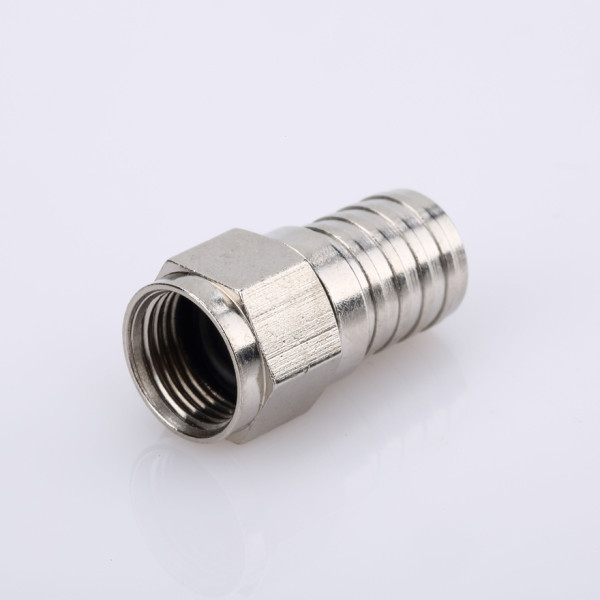
A premier F Male Connector supplier provides components that go far beyond the basic twist-on connectors found at a local hardware store. High-performance connectors are precision instruments. They are often manufactured using advanced techniques to create parts with extremely tight tolerances. This precision ensures a secure fit, consistent 75-ohm impedance, and 360-degree contact with the cable's shielding for maximum interference protection.
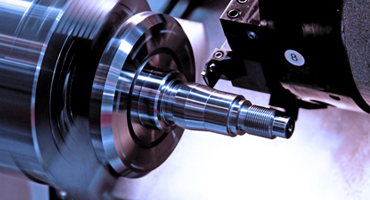
The materials used are also critical. High-quality connectors are typically made of machined brass and plated with nickel or gold to resist corrosion and ensure a reliable, long-lasting electrical connection. The best connectors are often compression-style, which, when installed with the proper tool, create a permanent, weatherproof seal that protects the connection from moisture and maintains its integrity over years of use. Many of these superior components are sourced as CNC Turning Parts, where computer-controlled lathes produce connectors with a level of precision and consistency that is impossible to achieve with cheaper manufacturing methods. Investing in these high-quality connectors from a trusted source is one of the most effective ways to guarantee the reliability and performance of your entire cable system.
Conclusion
Choosing the right coaxial cable and, more importantly, the right F male connectors directly impacts the performance and reliability of your communication systems. From the clarity of your high-definition television to the speed of your broadband internet, the integrity of the signal path is paramount. As we've seen, the difference between a clear, strong signal and a weak, intermittent one often comes down to the quality of these small components and the expertise of your supplier. The distinction between RG6 and RG11 cable determines performance over distance, but it is the quality of the F-type connection that preserves that performance.
For those seeking precision-engineered F Male Connectors to ensure their cable assemblies meet the highest standards, it is essential to partner with a specialist. If you require custom OEM and ODM solutions, particularly for high-quality CNC Turning Parts that form the basis of superior connectors, I recommend considering SOMI Custom Parts. Making an informed choice in your components and your supplier will pay dividends in system reliability and user satisfaction for years to come.