
Understanding the Critical Role of a CNC Turned Parts Supplier in Modern Production
Welcome to our exploration of a fundamental aspect of modern manufacturing: CNC turned parts. For any company committed to excellence, understanding the critical role of a CNC Turned Parts Supplier is essential for ensuring the long-term quality, innovation, and cost-effectiveness of its products. This journey goes beyond a basic cost analysis; it's about identifying and cultivating a strategic partnership. Join us as we delve into the key attributes and evaluation strategies that distinguish a mere vendor from a truly invaluable supplier partner, a distinction that can fundamentally shape a product's success in the market.
What We Prioritize in a High-Performance CNC Turned Parts Supplier
Selecting a supplier is not merely a transaction; it's a decision that embeds their capabilities, ethics, and reliability into your own production line. For us, a high-performance supplier is a partner who demonstrates excellence across three core pillars: a robust technical foundation, a commitment to collaborative engagement, and an unwavering dedication to quality. These are the non-negotiable qualities we look for to build a resilient and innovative supply chain.
Technical Foundations: Equipment, Materials, and Tolerances
The technical capabilities of a supplier are the bedrock of a successful partnership. A supplier's equipment, their expertise with various materials, and their ability to consistently hold tight tolerances directly impact the final product's performance, reliability, and quality. Without a strong technical foundation, even the best designs can fail.
Advanced Machining and Multi-Axis Capabilities
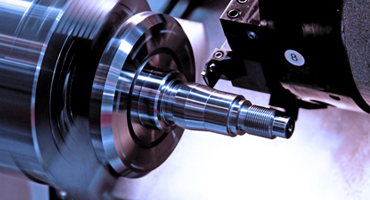
In today's competitive landscape, the sophistication of a supplier's machinery is a key differentiator. We prioritize partners who invest in advanced CNC turning centers, particularly those with multi-axis capabilities. Multi-axis machines, such as 5-axis or Swiss-type lathes, enable the production of highly complex geometries in a single setup. This "done-in-one" approach significantly reduces the need for multiple operations and fixtures, which in turn minimizes the risk of tolerance stack-up errors, reduces lead times, and can lower the overall cost per part. For instance, a 5-axis machine can approach a workpiece from five different sides simultaneously, making it possible to create intricate curves and features that would be impossible or prohibitively expensive on a traditional 3-axis machine. This capability is crucial for industries like aerospace, medical devices, and high-performance automotive, where complexity and precision are paramount.
Furthermore, a supplier's commitment to technology extends to their use of advanced software, such as CAD/CAM systems. These systems are essential for translating complex digital designs into precise machine instructions, optimizing toolpaths for efficiency, and simulating the machining process to identify potential issues before any material is cut. This digital-first approach demonstrates a supplier's commitment to precision and efficiency from the outset.
Expertise in Diverse Materials and Stringent Tolerances
A supplier's proficiency is also measured by the breadth and depth of their material expertise. Modern products utilize a vast array of materials, each with unique properties and machining challenges. We seek partners who have demonstrable experience working with everything from common materials like aluminum and stainless steel to more exotic alloys, superalloys (like Inconel or Hastelloy), and specialized polymers. This expertise isn't just about being able to cut the material; it's about understanding its behavior—how it responds to heat, its tendency for work hardening, and the optimal cutting speeds and feeds required to achieve the desired finish and dimensional accuracy.
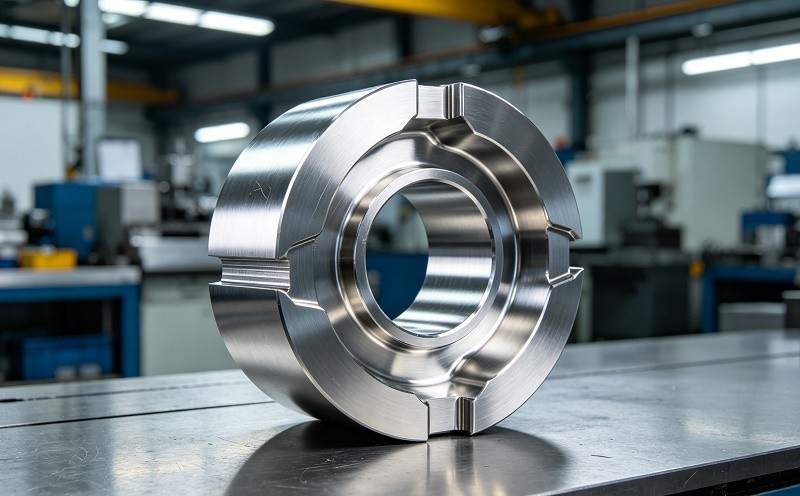
This material knowledge is inextricably linked to the ability to hold stringent tolerances. A top-tier supplier doesn't just meet the tolerances specified on a drawing; they understand them and have the metrology and process controls in place to verify them consistently. This involves using climate-controlled environments to minimize thermal expansion and employing sophisticated measurement equipment like Coordinate Measuring Machines (CMMs), optical comparators, and laser scanners. The ability to reliably machine parts to tolerances within a few ten-thousandths of an inch (or microns) is a hallmark of a high-capability supplier and is essential for ensuring the interchangeability and proper function of components in complex assemblies.
Collaborative Engagement and Transparent Communication
Beyond machinery and technical skills lies the crucial element of human interaction. A true supplier partner moves from a transactional relationship to a collaborative one, characterized by open dialogue, shared goals, and mutual respect. This engagement is vital for optimizing designs, solving problems proactively, and ensuring the entire production process runs smoothly.
Proactive DFM Insights and Clear Quoting
One of the most significant value-adds from a strategic supplier is their early engagement in the design process through Design for Manufacturability (DFM) feedback. A proactive supplier doesn't just accept a drawing and provide a quote; they analyze it with a critical eye. They will ask questions and provide suggestions to improve the part's manufacturability, which can lead to significant benefits. This might involve recommending minor design tweaks to eliminate difficult-to-machine features, suggesting a more cost-effective material that still meets performance requirements, or proposing changes to tolerances that don't impact function but can drastically reduce production time and cost. For example, changing a sharp internal corner to one with a slight radius can allow for continuous tool paths, reducing machining time and improving tool life.
This collaborative spirit should extend to the quoting process. We look for suppliers who provide clear, detailed, and transparent quotes. A comprehensive quote breaks down costs, including material, setup, run time, and any secondary operations or finishing. This transparency builds trust and allows for an accurate evaluation of the True Cost of Ownership, rather than just the initial piece price. It signals a partner who is confident in their pricing and willing to work together to find an optimal balance between cost and quality.
Responsive Problem-Solving and Knowledge Sharing
No manufacturing process is entirely without challenges. The true test of a supplier relationship is how effectively problems are managed when they arise. A high-performance supplier is one who communicates proactively and honestly a problem, such as a tool breaking or a material shipment being delayed. More importantly, they come to the table not just with the problem, but with a proposed solution and a clear plan to mitigate the impact on delivery schedules. This responsive problem-solving approach minimizes disruptions and reinforces their role as a vested partner in our success.
This partnership is a two-way street. A great supplier is also a source of knowledge, sharing insights on new manufacturing technologies, material trends, and industry best practices. They actively participate in joint planning sessions and are eager to understand the final application of the parts they produce. This deeper understanding allows them to make more informed recommendations and anticipate future needs. By fostering an environment of open communication and knowledge sharing, the relationship evolves from a simple buyer-supplier dynamic to a powerful strategic alliance.
Uncompromising Quality Systems and Verification
A supplier’s commitment to quality must be embedded in their very culture and processes, not just an afterthought at the final inspection. A robust and certified Quality Management System (QMS) is the framework that ensures consistency, repeatability, and reliability in every part produced. It is the definitive proof of a supplier's dedication to excellence.
Certified QMS (ISO, IATF) and Rigorous Inspections
We consider third-party quality certifications to be essential prerequisites when evaluating a supplier. A certification like ISO 9001 demonstrates that a supplier has a well-documented and audited QMS for managing their processes, from quoting and material procurement to production and final delivery. It provides a baseline assurance of consistency and a commitment to continuous improvement. For products destined for the automotive industry, the IATF 16949 certification is even more stringent, incorporating advanced quality planning tools and demanding rigorous process controls to minimize defects. These certifications are not just pieces of paper; they represent a significant investment in people, processes, and equipment, and signal a supplier's seriousness about quality.
Beyond the system itself, the actual inspection processes are critical. We expect suppliers to have a multi-tiered inspection strategy. This includes in-process inspections performed by machine operators to catch deviations early, first-article inspections (FAI) to verify the setup for a new production run, and a final inspection of the completed batch using calibrated metrology equipment. The use of Statistical Process Control (SPC) to monitor and control processes is another indicator of a mature quality system, showing that the supplier is proactively managing quality rather than just inspecting for defects.
| Quality System Element | Purpose and Importance |
|---|---|
| ISO 9001 Certification | Establishes a baseline for a structured Quality Management System, ensuring process control and continuous improvement. |
| IATF 16949 Certification | Crucial for automotive suppliers, it builds on ISO 9001 with a focus on defect prevention and waste reduction in the supply chain. |
| In-Process Inspection | Allows for real-time adjustments and corrections, preventing the production of large quantities of non-conforming parts. |
| First Article Inspection (FAI) | A formal verification process that validates a new or revised production process is capable of producing a part according to spec. |
| Final Inspection & Metrology | Utilizes CMMs, vision systems, and other calibrated tools to provide a final, documented verification of quality before shipment. |
Traceability, Documentation, and Sample Approval
In manufacturing, being able to trace a part's history is not a luxury; it is a necessity, particularly in regulated industries. A top-tier supplier must have a robust system for full traceability. This means being able to track a specific batch of finished parts back to the raw material heat lot it came from, the specific machine it was run on, the operator who produced it, and the inspection data associated with it. This level of traceability is invaluable in the event of a quality issue, as it allows for a swift and precise root cause analysis and containment of the affected products.
Comprehensive documentation is the backbone of traceability and process control. We expect a supplier to maintain and provide all necessary documentation, including material certifications, inspection reports, certificates of conformance, and process validation data. This paperwork is not just a formality; it is the official record that proves all contractual and quality requirements have been met. Before full production commences, a structured sample approval process, such as a Production Part Approval Process (PPAP), is essential. This involves the supplier submitting a sample part along with a complete documentation package for our engineering and quality teams to review and approve, ensuring that everyone is aligned and confident before scaling up.
Our Comprehensive Strategy for Evaluating a Prospective CNC Turned Parts Supplier
A thorough evaluation process is the cornerstone of building a resilient supply chain. It requires a holistic approach that goes beyond the technical specifications of a part and examines the supplier's operational health, financial stability, and cultural alignment. Our strategy is designed to identify partners who are not only capable but also reliable and truly committed to a long-term relationship.
Assessing Operational Excellence and Reliability
A supplier’s ability to deliver high-quality parts is meaningless if they cannot deliver them on time. Operational excellence is about consistency, predictability, and reliability. We assess this through a careful review of past performance and a forward-looking evaluation of their capacity and scheduling systems, ensuring they can meet our demands today and in the future.
Reviewing Historical Delivery and Quality Performance
When evaluating a new potential supplier, we believe that past performance is a strong indicator of future results. We don't just rely on their self-reported metrics; we seek objective evidence of their delivery and quality record. This involves asking for anonymized performance data, such as their on-time delivery (OTD) percentage and parts per million (PPM) defect rates for other comparable clients over the last 12-24 months. A supplier with consistently high OTD rates (typically above 95%) and low PPM numbers demonstrates a stable and well-managed operation. We might also request references from some of their current, non-competing customers. Speaking directly with other companies about their experience can provide invaluable, real-world insights into the supplier's reliability, communication style, and problem-solving abilities that you won't find in a sales presentation.
Production Schedule Management and Capacity Assessment
A key aspect of operational reliability is how a supplier manages their production schedule and capacity. We look for suppliers who use a robust Enterprise Resource Planning (ERP) or similar scheduling system to manage their workflow. An effective system provides visibility into machine availability, tracks jobs as they move through the shop, and can help predict potential bottlenecks before they impact delivery dates. During an on-site visit or evaluation, we observe how work is organized on the shop floor. Is there a clear flow? Is the shop clean and organized (a sign of a 5S or similar lean manufacturing discipline)?
We also conduct a thorough capacity assessment. This isn’t just about the number of machines they have. We analyze their current machine utilization rates, their number of shifts, and their ability to flex capacity to handle urgent requests or demand surges. A supplier who is running at 100% capacity with no room for flexibility may pose a risk. We look for a partner who has a plan for growth and has invested in cross-training their employees, ensuring that the operation isn't overly reliant on a few key individuals. This foresight is a strong indicator of a well-managed and reliable business.
Financial Understanding and Value Optimization
The financial aspects of a supplier relationship extend far beyond the piece price. A truly strategic partnership is built on financial transparency, mutual understanding, and a shared goal of optimizing value over the long term. This means analyzing cost structures, exploring flexible agreement models, and continuously seeking opportunities for cost reduction through engineering and process improvements.
Transparent Cost Structures and Long-Term Agreements (LTAs)
We prioritize suppliers who are willing to be open about their cost drivers. As mentioned earlier, a transparent quote is the first step. It should clearly itemize costs for materials, setup, labor, and any secondary processes. This transparency allows for more productive conversations about cost. For example, if we see that setup costs are a significant portion of the price, we can explore ordering in larger batch sizes to reduce the number of setups and lower the per-piece cost.
For key components, establishing a Long-Term Agreement (LTA) can provide stability and benefits for both parties. An LTA can lock in favorable pricing for a set period (e.g., 1-3 years), insulating us from market volatility. In return, the supplier gains the security of predictable, guaranteed business, which allows them to better plan their capacity and potentially make investments in new technology to support our account. These agreements transform the relationship from a series of individual purchase orders into a more strategic, ongoing partnership.
Exploring Value Engineering for Ongoing Cost Reductions
The quest for cost optimization should not end once the initial quote is accepted. The best suppliers actively engage in value engineering throughout the life of the product. Value engineering is a systematic approach to improving a product's value by examining its function and cost. A proactive partner will continuously look for ways to reduce costs without compromising quality or performance. This might involve suggesting a new, more efficient machining process they've developed, identifying an alternative material with a better cost-to-performance ratio, or collaborating on a design revision that simplifies manufacturing. These ongoing cost-reduction efforts demonstrate a supplier's commitment to the partnership's long-term success and cements their role as a strategic contributor, not just a parts producer.
Building Durable Relationships Through Trust
Ultimately, a successful supplier partnership is built on a foundation of trust. This trust is not established overnight; it is earned through consistent performance, transparent communication, and a demonstrable commitment to shared goals. We actively look for indicators of a trustworthy and well-run organization during our evaluation process.
Observing Facility Organization and Continuous Improvement
A facility tour can be one of the most revealing aspects of a supplier evaluation. A clean, well-organized, and safe shop floor is often a direct reflection of the company's culture and management philosophy. It indicates a disciplined approach and respect for the work environment, which usually translates into a higher quality product. We look for visual management systems, such as clearly marked work areas, organized tool storage, and performance metric boards. These are all signs of a commitment to lean manufacturing principles and continuous improvement methodologies like Kaizen. We also pay attention to employee morale and engagement. Do the employees seem knowledgeable and proud of their work? A supplier who invests in their people and processes is a supplier who is building for the long term.
Asking Key Questions to Build Credibility and Trust
During our conversations and facility visits, we ask specific questions designed to gauge a supplier's credibility and understand their values. These questions go beyond technical capabilities and delve into their business philosophy and operational practices.
Key Questions to Ask a Potential Supplier:
- "Can you walk me through your process for a new part, from RFQ to shipment?" This helps us understand their internal workflow and identify potential communication gaps.
- "How do you handle a non-conforming part discovered by a customer?" Their answer reveals their commitment to quality and customer service. We look for a structured root cause analysis and corrective action process.
- "What investments have you made in new technology, training, or processes in the last year?" This shows their commitment to staying current and improving their capabilities.
- "What is your employee turnover rate, and what do you do to retain a skilled workforce?" A stable, experienced workforce is a critical asset in manufacturing. High turnover can be a major red flag.
- "How do you measure and track your on-time delivery and quality performance?" We expect them to have clear, data-driven metrics that they can share and discuss.
The answers to these questions, combined with our direct observations, help us build a complete picture of the supplier and determine if they are a partner we can trust to support our business needs.
Maximizing Impact: The Strategic Advantage of a True CNC Turned Parts Supplier Partner
Transitioning from a transactional supplier relationship to a strategic partnership unlocks a level of value that goes far beyond the initial piece price. A true partner becomes an extension of your own engineering and procurement teams, driving innovation, mitigating risks, and creating a competitive advantage that impacts the entire product lifecycle, from initial design to full-scale production.
Total Cost of Ownership and Engineering Collaboration
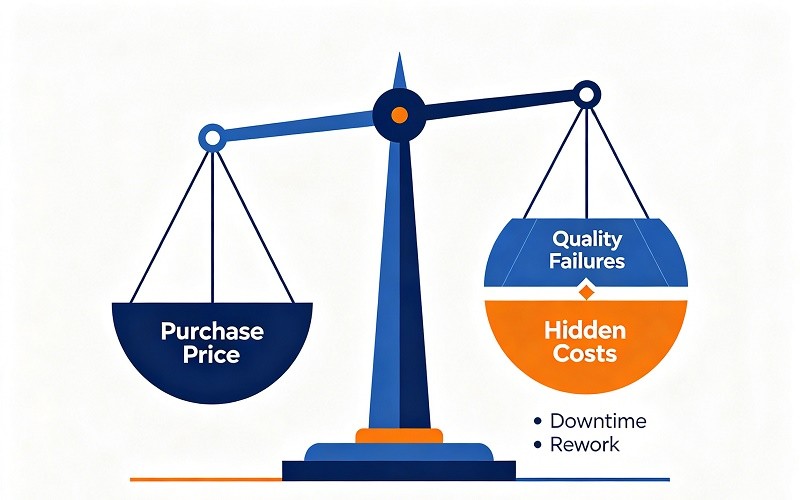
Focusing solely on the per-piece cost is a common but shortsighted approach. A strategic view considers the Total Cost of Ownership (TCO), which accounts for all direct and indirect costs associated with a part. This is where a collaborative partnership provides its most significant financial return, by actively working to reduce hidden costs and enhance the product's overall performance.
Mitigating Hidden Costs and Improving Product Performance
The "hidden factory" of costs associated with poor quality or unreliable delivery can be substantial. These costs include the administrative time spent chasing late orders, the production line downtime caused by a missing component, the expense of sorting or reworking non-conforming parts, and the immense reputational damage from a field failure. A reliable partner mitigates these hidden costs through their commitment to quality and on-time delivery. Their robust QMS and proactive communication act as a powerful insurance policy against these disruptions.
Furthermore, deep engineering collaboration can directly improve the final product's performance. A knowledgeable supplier can offer insights into how different machining strategies affect a part's surface finish, grain structure, and residual stress, all of which can impact its strength and durability. By working together, we can optimize the part not just for manufacturability, but for its end-use application, resulting in a more robust and reliable product for our customers.
DFM Integration and Part Consolidation Benefits
Integrating a supplier's Design for Manufacturability (DFM) expertise early in the design cycle is a game-changer. As previously discussed, this collaboration can simplify designs and reduce costs. One of the most powerful outcomes of this collaboration is part consolidation. A skilled supplier can help identify opportunities where a multi-component assembly can be redesigned and manufactured as a single, more complex CNC part.
The benefits of part consolidation are numerous:
- Reduced Assembly Time: Eliminating the need to assemble multiple components saves significant labor costs.
- Improved Structural Integrity: A single-piece part is often stronger and more reliable than an assembly held together by fasteners or welds.
- Simplified Supply Chain: It reduces the number of SKUs to manage, purchase, and inventory.
- Elimination of Tolerance Stack-Up: The risk of accumulated errors from multiple parts is completely removed, leading to a more precise final assembly.
This strategic approach transforms the supplier from a mere component producer into an integral part of the product development process.
Seamless Scaling from Prototype to Mass Production
The journey from a single prototype to the mass production of thousands or millions of units is fraught with challenges. One of the greatest advantages of a strategic supplier partnership is their ability to navigate this transition seamlessly. They have the processes, experience, and foresight to ensure that the quality and precision established during the prototyping phase are maintained and replicated at scale.
Mastering Tight Tolerances and Minimizing Stack-Up Issues
As production volumes increase, maintaining tight tolerances becomes exponentially more difficult. A capable supplier understands the science behind this challenge. They employ Statistical Process Control (SPC) to monitor key dimensions in real-time, allowing them to detect and correct for process drift caused by factors like tool wear or thermal variation before it results in out-of-spec parts. Their mastery of holding tight tolerances across high volumes is crucial. In any assembly, the individual tolerances of each component can accumulate, a phenomenon known as "tolerance stack-up." Even if each part is technically within its own specification, the combined effect can cause the final assembly to fail functional tests. A strategic supplier thinks beyond their own component; they understand its role in the final assembly and work collaboratively to manage the entire tolerance chain, ensuring a perfect fit and function every time.
Efficient Transition Planning (APQP, FAI)
A smooth transition from prototype to production doesn't happen by accident; it's the result of a structured, well-planned process. We rely on partners who are proficient in advanced quality planning frameworks like APQP (Advanced Product Quality Planning). APQP is a structured methodology that encompasses everything from design and process development to validation and feedback. It's a roadmap for ensuring that all stakeholders are aligned and that all potential risks have been identified and mitigated before mass production begins. Key elements of this transition, like the First Article Inspection (FAI) and Production Part Approval Process (PPAP), serve as critical gates. These formal verification steps ensure that the production process is capable and ready, providing the documented confidence needed to launch full-scale manufacturing without costly surprises.
Leveraging Advanced Automation and Modern Technologies
In the relentless pursuit of speed, precision, and efficiency, automation is no longer a luxury but a necessity for any top-tier CNC machining operation. We actively seek partners who have embraced modern automation and smart technologies, as this investment is a direct indicator of their commitment to quality, repeatability, and cost-effectiveness.
Speed, Accuracy, Repeatability through Smart Automation
The core benefits of automation in CNC machining are speed, accuracy, and repeatability. Automated systems can run 24/7 with minimal human intervention, dramatically increasing throughput and machine utilization. Robots and automated systems perform tasks with a level of precision and consistency that is impossible to replicate manually over long periods. This eliminates the variability that can be introduced by human operators across different shifts, resulting in a more uniform and higher-quality final product. This enhanced repeatability is crucial for high-volume production runs and for industries where part-to-part consistency is a critical safety and performance requirement.
Examples: Automated Tooling and Material Handling Systems
Advanced automation goes far beyond simply having a robot load and unload parts. We look for suppliers who have integrated smart automation throughout their entire process.
- Automated Tooling: Modern CNC machines can be equipped with large tool magazines and automated tool changers. Connected to a central monitoring system, the machine can automatically detect a worn or broken tool, swap it for a new one from the magazine, and even adjust machining parameters to compensate, all without stopping production.
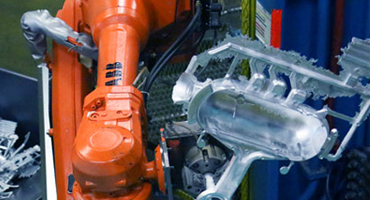
- Robotic Material Handling: Systems like pallet pools and robotic arms can feed raw material into a machine and remove finished parts for hours on end, enabling "lights-out" manufacturing. This not only boosts output but also frees up skilled machinists to focus on higher-value tasks like programming, setup, and quality analysis.
- In-Process Metrology: Some of the most advanced systems integrate measurement probes directly into the CNC machine. These can be used to automatically verify the dimensions of a part mid-process and make real-time adjustments, ensuring every part that comes off the machine is already verified to be within spec.
A supplier who has invested in these types of integrated automation systems is a supplier who is built for the future, capable of delivering the highest levels of quality and efficiency. If you are looking for a partner with these capabilities, please do not hesitate to Contact us.
Ultimately, selecting the right CNC Turned Parts Supplier is a strategic investment in our company's future, not merely a procurement decision. This deep dive has reinforced our belief that the path to superior products and a resilient supply chain lies in moving beyond simple cost metrics. We've learned from experience that focusing on a supplier's deep technical capability, their commitment to transparent communication, and their willingness to operate in a true partnership mindset leads to superior product quality, enhanced cost-efficiency, and invaluable peace of mind.
By making these informed and strategic choices, we empower our entire production process. We ensure that our products not only meet but consistently exceed the highest standards of performance and reliability that our customers expect. This strategic approach to supplier selection is a fundamental pillar of our commitment to manufacturing excellence.