Understanding Precision Sheet Metal for Avionics Enclosure Manufacturers
As an Avionics Enclosure Manufacturer, I understand the critical role that precision sheet metal fabrication plays in the aerospace industry. From safeguarding sensitive electronic components to ensuring structural integrity, the quality of these enclosures directly impacts the safety and performance of aircraft and spacecraft. This blog post will delve into the intricacies of precision sheet metal for avionics enclosures, exploring the materials, processes, and challenges involved in manufacturing these vital components.
The aerospace sector demands components that are not only robust and lightweight but also capable of performing flawlessly in extreme environments. For Avionics Enclosure Manufacturers, meeting these stringent requirements necessitates a deep understanding of advanced fabrication techniques and a commitment to unwavering quality. We'll examine how specialized sheet metal solutions contribute to fuel efficiency, extended operational life, and overall mission success.
In the world of aviation and space exploration, every component, regardless of its size, is crucial for success. As an Avionics Enclosure Manufacturer, I've seen firsthand how precision sheet metal protects critical electronic systems from electromagnetic interference, mechanical stress, and environmental factors. Join me as we uncover the essential aspects of precision sheet metal fabrication that empower Avionics Enclosure Manufacturers to deliver high-performance solutions.
The Uncompromising Demands on Avionics Enclosure Manufacturers and Their Sheet Metal Parts
The aerospace industry operates on a zero-compromise basis, where every component must perform its function perfectly to ensure safety and mission success. For avionics enclosures, this means providing absolute protection for the delicate and complex electronics that form the "brains" of an aircraft. These enclosures are not mere boxes; they are highly engineered systems designed to withstand incredible stress while contributing to the aircraft's overall efficiency.
Why Precision Sheet Metal is Paramount for Avionics Enclosure Manufacturers
Precision is the cornerstone of aerospace manufacturing, and for sheet metal fabrication, it is a non-negotiable requirement. Avionics enclosures house systems for communication, navigation, flight control, and more; a failure in any of these can have catastrophic consequences. Therefore, the fabrication of these enclosures must adhere to exact specifications and tight tolerances.
Precision sheet metal ensures:
- Perfect Fit and Integration: Avionics bays are densely packed with equipment. Enclosures must fit precisely within their allotted space and connect seamlessly with cooling systems, data lines, and power sources.
- Structural Reliability: Enclosures must protect their contents from shock, vibration, and G-forces without failing. Precision fabrication guarantees the strength and integrity of every bend, join, and fastening point.
- Consistent Performance: Repeatability is key. Every enclosure off the production line must meet the same high standards to ensure uniform performance across an entire fleet of aircraft.
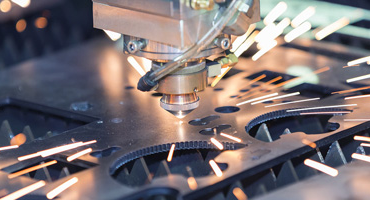
Manufacturing processes like laser cutting can achieve tolerances of less than ±0.1 mm, ensuring that even the most complex geometries are produced with accuracy. This level of detail is fundamental to creating enclosures that protect multi-million dollar electronic systems reliably.
Critical Performance Metrics for Avionics Enclosure Manufacturers
Avionics enclosures are judged on several critical performance metrics that directly influence aircraft safety, reliability, and efficiency. Manufacturers must balance these often-competing requirements to deliver an optimal solution.
| Performance Metric | Description | Key Considerations for Manufacturers |
|---|---|---|
| Structural Integrity | The ability to withstand mechanical stresses such as vibration, shock, and G-forces without deformation or failure. | Material strength, joint design (welding, riveting), reinforcement strategies. Adherence to standards like MIL-STD-810. |
| Weight | The overall mass of the enclosure. Lower weight contributes to better fuel efficiency and increased payload capacity. | Use of high strength-to-weight ratio materials (aluminum, titanium, composites), topology optimization. |
| Thermal Management | The capacity to dissipate heat generated by internal electronics, maintaining optimal operating temperatures. | Material conductivity, ventilation design, integration with active/passive cooling systems. |
| EMI/RFI Shielding | The ability to block electromagnetic and radio-frequency interference, protecting sensitive electronics from disruption. | Material conductivity, enclosure design (e.g., no gaps), conductive gaskets, and surface coatings. |
| Environmental Resistance | The capacity to resist corrosion and degradation from moisture, de-icing fluids, pressure changes, and temperature extremes. | Material choice (e.g., corrosion-resistant alloys), and protective surface treatments (anodizing, plating). |
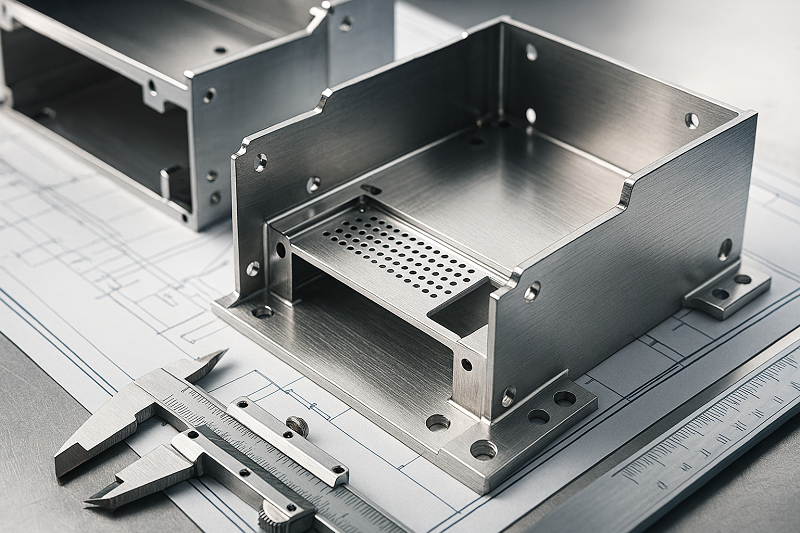
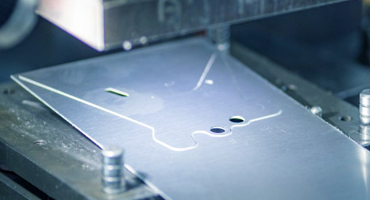
Image: Precision sheet metal parts for an avionics enclosure
Structural Integrity and Weight Optimization
In aerospace, strength and lightness are two sides of the same coin. This is the core principle of lightweighting, which aims to reduce the weight of components without compromising their structural integrity, performance, or safety. Every kilogram saved on an aircraft can translate into significant fuel savings and reduced emissions over its operational life.
Avionics Enclosure Manufacturers achieve this balance by:
- Using Advanced Materials: High-strength aluminum alloys, titanium, and carbon fiber composites offer exceptional strength-to-weight ratios.
- Employing Smart Design: Techniques like topology optimization use advanced software to analyze stress loads and remove unnecessary material, creating parts that are both strong and lightweight.
- Optimizing Fabrication: Precision bending and forming create complex geometries that add strength without adding weight, while advanced joining techniques ensure a robust final assembly.
The assembly must be able to retain its mass during sudden deceleration events, with some standards requiring integrity at forces up to 12 g's to meet crash safety regulations.
Thermal Management and EMI Shielding for Avionics Enclosure Manufacturers
Avionics systems generate a significant amount of heat. If not managed effectively, this heat can degrade performance and lead to component failure. At the same time, these systems are highly susceptible to electromagnetic interference (EMI) and radio-frequency interference (RFI), which can come from the aircraft's own systems (like radar) or external sources.
Enclosures serve a dual role in mitigating these risks:
- Thermal Management: Enclosures, particularly those made from aluminum alloys, act as heat sinks, dissipating thermal energy away from sensitive components. Designs often incorporate ventilation slots, fins, or attachment points for liquid or air-cooling systems to handle high heat loads, which can exceed 600W in some applications.
- EMI Shielding: A properly designed metal enclosure creates a Faraday cage, blocking external electromagnetic fields. To be effective, the enclosure must be electrically continuous. This is achieved through precision manufacturing that eliminates gaps, as well as the use of conductive gaskets, coatings, and specialized fasteners to seal seams, doors, and cable entry points. Compliance with standards like MIL-STD-461 is often required to ensure electromagnetic compatibility.
Navigating Environmental Extremes as an Avionics Enclosure Manufacturer
Aerospace environments are unforgiving. Avionics enclosures must protect electronics from a wide range of environmental threats. During a single flight, an aircraft can experience temperature swings from scorching heat on a tarmac to sub-zero temperatures at high altitude, along with drastic pressure changes. The operating temperature range for some avionics can be from -15°C to 55°C.
Furthermore, they are exposed to:
- Moisture and Humidity: Can cause short circuits and corrosion.
- Contaminants: Dust, de-icing fluids, and hydraulic fluids can infiltrate and damage electronics.
- Vibration and Shock: Constant high-frequency vibration from engines and turbulence puts mechanical stress on components.
Manufacturers address these challenges by creating sealed enclosures using high-performance gaskets and O-rings, and by selecting materials and surface treatments that offer excellent corrosion resistance.
Material Science: The Foundation for Avionics Enclosure Manufacturers' Success
The selection of materials is one of the most critical decisions in the design and manufacture of avionics enclosures. The right material ensures the final product can meet the stringent performance requirements of the aerospace industry, balancing strength, weight, thermal conductivity, and cost.
Aluminum Alloys: The Go-To Choice for Avionics Enclosure Manufacturers
Aluminum alloys are the workhorse material for avionics enclosures, and for good reason. They offer an unparalleled combination of properties that make them ideal for aerospace applications. Up to 80% of an aircraft's structure can be made from aluminum alloys, demonstrating their value and reliability.
Key advantages include:
- Excellent Strength-to-Weight Ratio: This is the most crucial property for aerospace. Aluminum provides the necessary structural rigidity to protect electronics while keeping weight to a minimum, which directly translates to better fuel efficiency.
- High Thermal Conductivity: Aluminum is very effective at dissipating heat, making it an excellent choice for enclosures that also function as heat sinks for the electronics they house.
- Corrosion Resistance: Aluminum naturally forms a passive oxide layer that protects it from corrosion. This resistance can be significantly enhanced through surface treatments.
- Ease of Fabrication: Aluminum is highly workable, allowing it to be easily cut, bent, and machined into complex enclosure geometries.
Common aerospace-grade aluminum alloys used by Avionics Enclosure Manufacturers include:
- 6061: A versatile and popular alloy known for its good mechanical properties, weldability, and high corrosion resistance. It is often used for structural frames and enclosures.
- 7075: One of the highest-strength aluminum alloys available. Its strength is comparable to some steels, making it suitable for highly stressed components like fuselage frames.
- 2024: Known for its high strength and excellent fatigue resistance, this alloy is frequently used for fuselage structures and wings where damage tolerance is critical.
- 5052: This alloy offers excellent corrosion resistance, especially in marine environments, and has high fatigue strength. It is commonly used for aircraft fuel tanks and some enclosure applications.
Beyond Aluminum: Exploring Other Materials for Avionics Enclosure Manufacturers
While aluminum is the most common choice, other advanced materials are used in specific applications where their unique properties are required.
Stainless Steel and Titanium in Avionics Enclosure Design
Stainless Steel: When exceptional strength, hardness, or fire resistance is required, stainless steel is a viable option. It provides outstanding durability and corrosion resistance, ensuring long-term performance. However, its higher density and weight compared to aluminum mean it is used more selectively, typically for firewalls, mounting brackets, or components in high-temperature areas like engine compartments.
Titanium: Titanium offers a strength-to-weight ratio superior to both aluminum and steel, along with exceptional corrosion resistance and high-temperature performance. This makes it an ideal, albeit expensive, material for mission-critical components. In avionics, titanium is often used for fasteners, structural elements in high-stress areas like landing gear, and enclosures that must withstand extreme heat or mechanical loads. Its high melting point also makes it suitable for exhaust and thermal shielding components.
The Role of Composites in Next-Generation Avionics Enclosures
Composite materials, such as carbon fiber-reinforced polymer (CFRP), are revolutionizing aerospace design. These materials involve embedding strong fibers (like carbon or glass) into a polymer matrix, resulting in a material that is incredibly strong and stiff, yet significantly lighter than even aluminum.
For avionics enclosures, composites offer:
- Massive Weight Savings: Composite enclosures can be over 70% lighter than their aluminum counterparts, providing substantial benefits for fuel efficiency and payload capacity.
- Design Flexibility: Composites can be molded into complex, integrated shapes that would be difficult or impossible to fabricate with sheet metal.
- Tailorable Properties: Engineers can customize the layup of the fibers to optimize strength, stiffness, and thermal expansion properties for a specific application.
However, challenges remain. Composites are not inherently conductive, so they require integrated metallic meshes or conductive coatings to provide the necessary EMI shielding. The transition from aluminum to a total composite enclosure (TCE) is an active area of research and development, with a focus on creating lightweight, actively or passively cooled racks for high-power electronics.
Surface Treatments: Enhancing Durability for Avionics Enclosure Manufacturers
Surface treatments are a critical final step in the manufacturing process. They enhance the natural properties of the base metal, providing increased protection against corrosion and wear, and improving paint adhesion. For aluminum parts, two treatments are especially common in the aerospace industry.
| Surface Treatment | Description | Key Benefits for Avionics |
|---|---|---|
| Anodizing | An electrochemical process that thickens the natural oxide layer on aluminum. Types include Type I (chromic acid), Type II (sulfuric acid), and Type III (hardcoat). | - Superior Corrosion & Wear Resistance: The hard, dense oxide layer is highly durable. - Electrical Insulation: The oxide layer is non-conductive, which can be beneficial in certain electronic applications. - Aesthetic Finishes: Type II anodizing can be dyed in various colors. |
| Chromate Conversion Coating (Alodine/Chem Film) | A chemical process that creates a thin, protective film on the metal surface. It is often used as a primer. | - Maintains Electrical Conductivity: Unlike anodizing, this coating preserves the metal's conductivity, essential for EMI shielding and grounding. - Excellent Paint Adhesion: It creates an ideal surface for subsequent painting or bonding. - Minimal Dimensional Change: The coating is extremely thin, making it suitable for parts with tight tolerances. |
Anodizing, especially Type III (hardcoat), creates a very hard and thick protective layer, making it ideal for components exposed to abrasive wear or extreme corrosive environments. Alodine (a brand name for chromate conversion coating) is often the preferred choice when electrical conductivity must be maintained for EMI grounding purposes. Because the Alodine coating is extremely thin, it has a minimal impact on part dimensions, which is a critical consideration for precision-machined components.
Choosing the right material and surface treatment is a complex decision that requires a deep understanding of the application's specific environmental, mechanical, and electrical requirements. Experienced Avionics Enclosure Manufacturers leverage their expertise in material science to deliver solutions that are both high-performing and cost-effective.
Advanced Fabrication Techniques for Avionics Enclosure Manufacturers
Transforming a flat sheet of metal into a complex, high-performance avionics enclosure requires a series of sophisticated fabrication processes. Each step, from cutting the initial blank to the final assembly, must be executed with absolute precision to meet the demanding standards of the aerospace industry. Avionics Enclosure Manufacturers utilize a combination of cutting-edge technology and time-tested methods to create these critical components.
Cutting-Edge Cutting and Forming for Avionics Enclosure Manufacturers
The initial shaping of the sheet metal sets the foundation for the entire enclosure. The accuracy of the cut determines how well the subsequent bends, folds, and assemblies will align.
Laser Cutting and Waterjet Technology
Two primary technologies dominate precision cutting in aerospace: laser cutting and waterjet cutting. The choice between them depends on the material, its thickness, and the specific project requirements.
| Technology | Process | Advantages | Disadvantages |
|---|---|---|---|
| Laser Cutting | Uses a high-intensity focused laser beam to melt, burn, or vaporize the material, creating a precise cut. | - Speed: Extremely fast, especially on thin to medium-thickness metals. - Precision: Unrivaled accuracy, with tolerances as low as ±0.001", ideal for intricate details. - Cleanliness: Produces less waste and doesn't require special disposal. |
- Heat-Affected Zone (HAZ): The heat can alter the material's properties near the cut edge. - Material Limitations: Struggles with highly reflective materials (like copper) and very thick sheets. |
| Waterjet Cutting | Uses a high-pressure stream of water, often mixed with an abrasive like garnet, to erode the material. | - No HAZ: It's a cold-cutting process, so it doesn't warp or alter the properties of heat-sensitive materials like titanium or composites. - Versatility: Can cut virtually any material, including metals, composites, glass, and stone. - Thickness: Can cut through materials up to 15 inches thick. |
- Slower Speed: Significantly slower than laser cutting for most applications. - Operating Costs: Higher ongoing costs due to abrasives and pump maintenance. - Tapering: Can produce a slight taper on very thick cuts if not properly controlled. |
For many avionics enclosures made from standard aluminum alloys, laser cutting is the preferred method due to its speed and precision. However, for heat-sensitive superalloys, composites, or very thick plates, waterjet cutting is the superior choice.
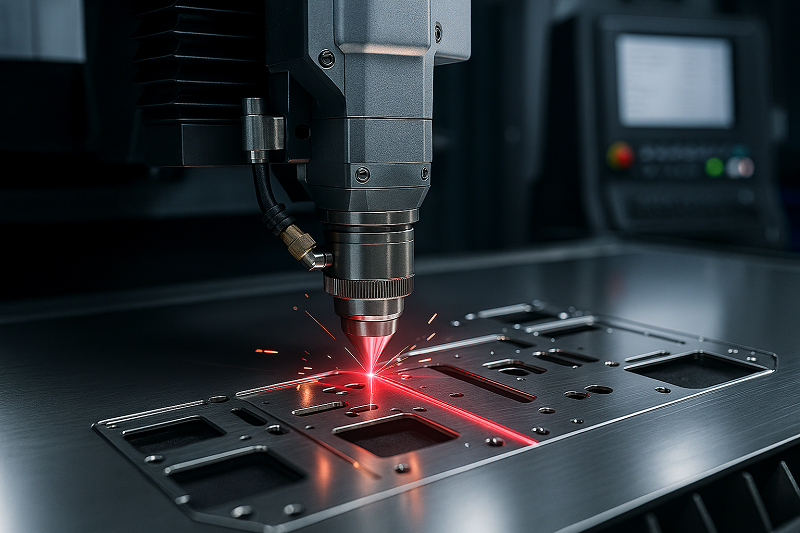
Image: CNC laser cutting aerospace-grade aluminum
Precision Bending and Forming Operations
Once the flat pattern is cut, it must be bent and formed into its three-dimensional shape. This is typically done using a CNC (Computer Numerical Control) press brake. Precision is paramount, as even a small error in a bend angle can prevent an enclosure from fitting correctly or sealing properly.
Automated press brakes use advanced software and sensors to:
- Control bend angles with high accuracy.
- Compensate for "spring back," the tendency of metal to partially return to its flat state after being bent.
- Ensure consistent, repeatable results across thousands of parts.
This level of control allows for the creation of complex geometries, such as multi-bend flanges and reinforcing ribs, that enhance the enclosure's strength and functionality without adding extra components or weight.
Joining Methods: Ensuring Structural Integrity for Avionics Enclosure Manufacturers
Joining the various cut and formed pieces into a single, robust structure is a critical step. The chosen method must provide a connection that is strong, durable, and, in many cases, electrically conductive.
Welding and Riveting in Avionics Enclosure Assembly
Welding: While welding is a common joining method in many industries, its use in aircraft structures and enclosures is more nuanced. The intense heat of traditional welding can weaken heat-treated aluminum alloys and cause distortion. For this reason, welding is often reserved for non-load-bearing components or specific applications where it is unavoidable. When used, highly specialized techniques like TIG (Tungsten Inert Gas) welding or robotic laser welding are employed by certified technicians to maintain control and quality.
Riveting: Riveting is the most traditional and widely used joining method in aircraft assembly. Solid rivets are preferred over welding for primary aircraft structures for several key reasons:
- No Heat Damage: Riveting is a cold mechanical process, so it does not alter the material properties of the aluminum alloys.
- Vibration Resistance: Riveted joints have better flexibility and are more resistant to the constant vibration and fatigue experienced during flight.
- Reliability & Inspection: The quality of a riveted joint is highly consistent and can be easily verified through a simple visual inspection, whereas inspecting a weld is a more complex process.
For avionics enclosures, riveting ensures a strong, stable, and reliable connection that upholds the structural integrity of the assembly.
Modern Fastening and Bonding Solutions
In addition to traditional methods, modern manufacturing incorporates advanced fasteners and structural adhesives.
- Specialized Fasteners: This includes a vast array of high-strength, lightweight bolts, screws, and inserts designed specifically for aerospace applications. They are often self-locking to resist loosening under vibration.
- Structural Adhesives: Modern epoxy and acrylic adhesives offer incredible bond strength, sometimes exceeding that of riveted joints. Adhesive bonding has several advantages: it distributes stress more evenly across a joint (eliminating the stress concentrations around rivets), reduces weight by eliminating fasteners, and can effectively join dissimilar materials, such as metal to composites.
Often, a hybrid approach is used, combining riveting or bolting with adhesive bonding to achieve superior strength, fatigue resistance, and environmental sealing.
The Role of Automation and CNC in Avionics Enclosure Manufacturing
Automation and CNC technology are central to modern avionics enclosure manufacturing. From the initial design to the final part, a digital thread ensures precision and consistency.
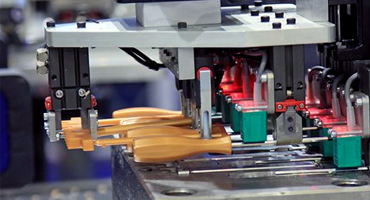
- CNC Programming: Designs created in CAD (Computer-Aided Design) software are translated into programs that directly control the manufacturing equipment, including laser cutters, press brakes, and milling machines. This eliminates manual errors and ensures parts are made exactly to specification.
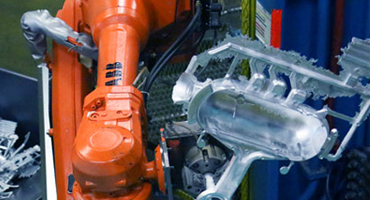
- Robotics: Automated robotic systems are used for tasks like welding, dispensing adhesives, and material handling. This improves consistency, speed, and safety.
- Efficiency and Productivity: CNC machines can operate continuously with minimal human intervention, reducing production cycles and downtime. This high level of automation allows for "lights-out" manufacturing, where production continues 24/7.
By leveraging these advanced fabrication techniques, Avionics Enclosure Manufacturers can produce highly complex, precise, and reliable enclosures that are essential for the safe operation of modern aircraft and spacecraft.
Achieving Unparalleled Quality: A Mandate for Avionics Enclosure Manufacturers
In the aerospace industry, quality is not just a goal; it is a fundamental requirement woven into every stage of the manufacturing process. For an Avionics Enclosure Manufacturers, delivering a product that meets exacting standards for safety, reliability, and performance is a mandate. This commitment to quality involves navigating a complex landscape of regulatory compliance, implementing rigorous inspection processes, and overcoming significant manufacturing challenges.
Navigating Regulatory Compliance: A Key Challenge for Avionics Enclosure Manufacturers
The aerospace sector is one of the most heavily regulated industries in the world. Manufacturers must adhere to a stringent set of standards to ensure their products are airworthy and safe. Key regulatory frameworks and standards include:
- AS9100: This is the internationally recognized Quality Management System (QMS) standard for the aviation, space, and defense industries. It builds upon the ISO 9001 standard but includes nearly 100 additional requirements specific to aerospace, covering areas like product safety, risk management, configuration management, and supply chain control. Certification to AS9100 is often a prerequisite for doing business with major aerospace OEMs like Boeing and Airbus.
- Federal Aviation Administration (FAA) Regulations: In the United States, the FAA sets the rules for civil aviation safety. Regulations such as Title 14 of the Code of Federal Regulations (CFR) dictate the standards for aircraft certification and components.
- ITAR (International Traffic in Arms Regulations): For enclosures used in military applications, manufacturers must comply with ITAR, which controls the export and import of defense-related articles and services.
Compliance requires meticulous documentation and full traceability for every component and process. Every raw material, fabrication step, and inspection result must be recorded to prove that requirements have been met.
The Importance of Quality Control and Inspection for Avionics Enclosure Manufacturers
A robust quality control (QC) program is essential to prevent defects, reduce costs, and ensure safety. QC is not a single event but a continuous process integrated throughout manufacturing.
Key stages and methods of inspection include:
- Incoming Material Inspection: Before any manufacturing begins, raw materials are inspected to verify they meet the required specifications for composition, strength, and dimensions. Material certificates are reviewed to ensure traceability.
- In-Process Inspection: Checks are performed at critical stages of fabrication (after cutting, bending, welding, etc.) to catch any deviations early. This prevents errors from compounding and leading to costly rework or scrap later in the process.
- First Article Inspection (FAI): For a new or revised part, the first piece produced is subjected to a comprehensive inspection (known as an AS9102 FAI) to confirm that the production process can create a part that meets all design specifications.
- Final Dimensional Inspection: This is the final verification that the finished enclosure meets all geometric dimensions and tolerances specified in the engineering drawings or CAD models.
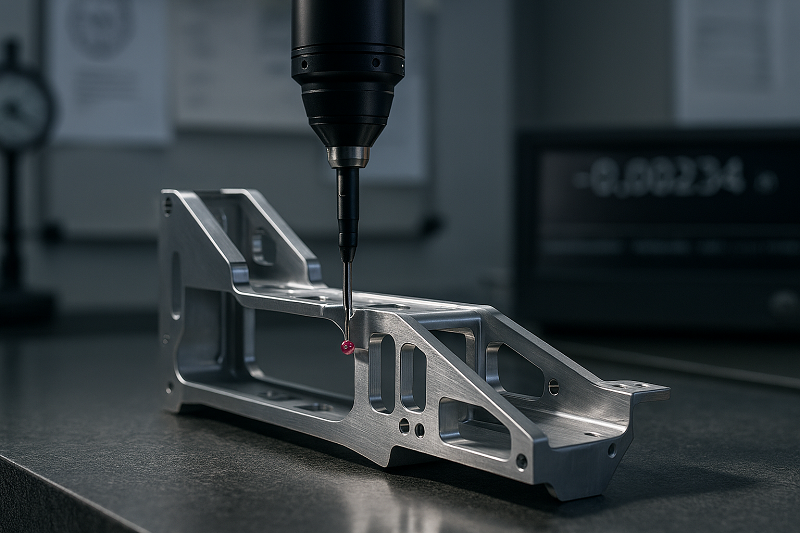
Image: Coordinate Measuring Machine inspecting a complex avionics sheet metal component
Advanced tools are used to achieve the necessary level of precision:
- Coordinate Measuring Machines (CMMs): CMMs are the gold standard for dimensional inspection in aerospace. A CMM uses a highly sensitive probe to take precise 3D measurements of a part's geometry, with accuracies reaching the micron level (±1 to ±5 µm). This data is then compared against the original CAD model to verify an exact match.
- Laser Scanners and Optical Systems: These non-contact methods are used to quickly capture the complete geometry of a part, making them ideal for complex surfaces and delicate components.
- Non-Destructive Testing (NDT): Techniques like ultrasonic testing, X-ray inspection, and dye penetrant inspection are used to find hidden flaws such as cracks or porosity in welds and materials without damaging the part.
Addressing Common Manufacturing Challenges for Avionics Enclosure Manufacturers
Producing high-quality avionics enclosures involves overcoming several persistent challenges that require significant expertise and advanced technology.
Tight Tolerances and Complex Designs
Modern aircraft are designed for maximum efficiency, which means cramming more electronics into smaller, lighter packages. This leads to avionics enclosures with increasingly complex designs and exceptionally tight tolerances.
- Complexity: Enclosures often feature intricate geometries, thin walls, and complex features that are difficult to machine and form accurately.
- Tight Tolerances: The aerospace industry demands near-zero tolerances, sometimes measured in the hundredths or even thousandths of a millimeter. Achieving this level of precision consistently requires top-of-the-line, regularly serviced equipment and highly skilled technicians. A deviation can mean a part won't fit during final assembly, leading to costly delays.
Optimizing Cost and Lead Times for Avionics Enclosure Manufacturers
While quality and precision are paramount, manufacturers are also under constant pressure to control costs and shorten lead times. The aviation supply chain is complex, and delays can have significant financial consequences. For example, an aircraft on the ground (AOG) due to a missing part can cost an airline up to $150,000 per day.
Manufacturers optimize these factors through:
- Efficient Processes: Streamlining workflows, using automation, and implementing lean manufacturing principles help reduce waste and production time.
- Supply Chain Management: Building strong relationships with reliable suppliers ensures a steady flow of high-quality raw materials, preventing delays.
- Advanced Planning: Using demand forecasting tools and AI-powered lead time prediction can help anticipate needs and optimize inventory, ensuring parts are available when needed without excessive overstocking.
Successfully balancing the "iron triangle" of quality, cost, and speed is the hallmark of a world-class Avionics Enclosure Manufacturer. It requires a deep commitment to excellence, investment in technology, and a culture of continuous improvement.
The Future of Precision Sheet Metal for Avionics Enclosure Manufacturers
The aerospace industry is in a constant state of evolution, driven by the relentless pursuit of greater efficiency, enhanced performance, and improved sustainability. This forward momentum is shaping the future of precision sheet metal fabrication, pushing Avionics Enclosure Manufacturers to innovate and adapt. Emerging materials, revolutionary processes, and new design philosophies are setting the stage for the next generation of avionics enclosures.
Innovative Materials and Processes Shaping Avionics Enclosures
The materials and manufacturing techniques of tomorrow promise to deliver enclosures that are lighter, stronger, and more functional than ever before.
Advanced Materials on the Horizon:
- Thermoplastic Composites: While traditional composites use thermoset resins, thermoplastics are gaining traction. They offer the potential for faster production cycles, improved impact resistance, and, crucially, recyclability, aligning with the industry's growing focus on sustainability.
- Smart Materials: The future lies in enclosures that do more than just protect. Integrating materials with embedded sensors, such as piezoelectric or fiber-optic sensors, enables real-time structural health monitoring. These "smart" enclosures can detect stress, impacts, or the early formation of cracks, revolutionizing maintenance by shifting from scheduled inspections to condition-based monitoring.
- Advanced Metal Alloys: The development of new aluminum, titanium, and other high-performance alloys continues. These next-gen metals offer even better strength-to-weight ratios, superior corrosion resistance, and improved performance at extreme temperatures.
Revolutionary Manufacturing Processes:
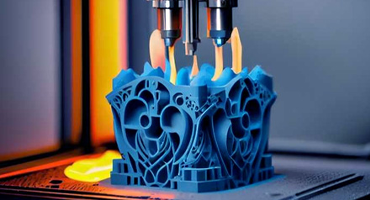
- Additive Manufacturing (3D Printing): Metal 3D printing, or additive manufacturing, is arguably the most disruptive technology on the horizon. Instead of subtracting material from a block (machining) or forming a sheet, 3D printing builds parts layer by layer directly from a digital model. For avionics enclosures, this enables:
- Unprecedented Design Freedom: Creation of highly complex geometries, internal lattice structures, and consolidated parts that are impossible to make with traditional methods. This can lead to dramatic weight reduction without sacrificing strength.
- Reduced Waste: Additive manufacturing uses only the material needed to build the part, significantly reducing the waste associated with subtractive processes.
- Part Consolidation: Multiple components of an assembly can be printed as a single, unified part, eliminating the need for fasteners or welds and removing potential points of failure.
- Advanced Hydroforming: Innovative techniques like FluidForming use high-pressure fluid to form sheet metal against a single die. This process allows for the creation of intricate parts with exceptional accuracy (99.996% first-pass yield) and is ideal for low- to medium-volume production and rapid prototyping due to significantly lower tooling costs.
Customization and Rapid Prototyping for Avionics Enclosure Manufacturers
As aircraft and their missions become more specialized, the demand for customized components is growing. The "one-size-fits-all" approach is giving way to tailored solutions designed for specific platforms and operational needs.
The Rise of Customization: Aerospace products are often highly customized to meet unique customer or mission requirements. Avionics Enclosure Manufacturers must be agile enough to produce small batches of specialized enclosures efficiently, without the high costs typically associated with low-volume production. This is where flexible manufacturing processes like additive manufacturing and advanced hydroforming show their strength.
The Critical Role of Rapid Prototyping: Rapid prototyping is the key to accelerating innovation. It allows engineers to quickly move from a digital design to a physical part that can be tested for fit, form, and function. By using techniques like 3D printing and CNC machining, manufacturers can:
- Validate Designs Quickly: Physical prototypes allow for early identification of design flaws, which can be corrected before committing to expensive production tooling.
- Reduce Time-to-Market: The ability to iterate on designs rapidly shortens the overall product development cycle, helping to get new technologies airborne faster.
- Lower Development Costs: Catching issues early in the design phase significantly reduces the risk of costly errors during full-scale production.
By embracing these future-focused technologies and methodologies, Avionics Enclosure Manufacturers are not just fabricating parts; they are enabling the next generation of aerospace innovation, contributing to aircraft that are safer, more efficient, and more capable than ever before.
Conclusion
As Avionics Enclosure Manufacturers, we stand at the forefront of aerospace innovation, constantly pushing the boundaries of what's possible with precision sheet metal. The journey from raw material to a high-performance avionics enclosure is complex, demanding meticulous attention to detail, a deep understanding of advanced materials, and an unwavering commitment to quality. This dedication ensures the safety and performance of critical avionics systems worldwide and is paramount to the reliability and efficiency of all aerospace applications.
In a rapidly evolving aerospace landscape, the role of experienced Avionics Enclosure Manufacturers is more vital than ever. The uncompromising demands for structural integrity, weight optimization, thermal management, and EMI shielding require a sophisticated approach that balances competing metrics without compromise. By navigating stringent regulatory standards and embracing cutting-edge fabrication techniques, we provide the essential protection that enables modern aircraft and spacecraft to thrive.
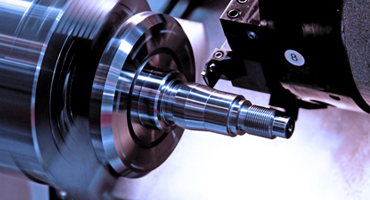
The future is being shaped by innovations in materials like thermoplastic composites and smart materials, and by transformative processes such as additive manufacturing and advanced hydroforming. These technologies, combined with a focus on customization and rapid prototyping, allow manufacturers to deliver solutions that not only meet but exceed the industry's highest expectations. At SOMI Custom Parts, we leverage a wide array of advanced techniques—including CNC machining, 3D printing, injection molding, die casting, stamping, and sheet metal fabrication—to meet the aerospace industry's insatiable demand for high-quality, high-performance precision parts. We encourage you to share your thoughts on these advancements and join the conversation on shaping the future of aerospace manufacturing.