The Essential Guide to Custom Metal Stamping Parts in SPCC Material
Welcome to our essential guide, where we delve into the world of custom metal stamping parts. We'll explore how these critical components are precision-crafted and why they are indispensable across various industries. Specifically, we’ll focus on the robust and versatile SPCC material, a popular choice for many custom metal stamping projects. We aim to equip you with a comprehensive understanding of the processes, design considerations, and quality standards involved in bringing these parts to life.
The Foundation of Custom Metal Stamping Parts: What You Need to Know
Understanding the fundamentals of metal stamping is the first step toward leveraging this powerful manufacturing technology. It’s a process that has shaped the modern world, from the cars we drive to the electronics we use daily. This section lays the groundwork, explaining what custom metal stamping is, its historical evolution, and how it can be integrated into your production strategy.
What is Custom Metal Stamping, and Why Does It Matter?
Custom metal stamping is a cold-forming manufacturing process that uses dies and presses to transform flat sheet metal into specific, predetermined shapes. Unlike standard stamping, which might use pre-existing tools for generic parts, custom stamping involves creating specialized tooling (dies) based on a customer's unique design specifications. This "tailor-made" approach is essential for producing components that must fit perfectly into a larger assembly. The process begins with advanced CAD/CAM software to design the complex tooling, which is then precision-machined. Once the tool is ready, a sheet of metal, either in blank or coil form, is fed into a stamping press where the tool and die apply immense pressure to cut, bend, and form it into the final part.
The importance of this process in modern manufacturing cannot be overstated. Here’s why it matters:
- Precision and Consistency: For industries like automotive, aerospace, and medical devices, components must be identical down to the micron. Custom metal stamping excels at producing millions of parts with negligible variation, ensuring consistent quality and reliability.
- Cost-Effectiveness at Scale: While there's an initial investment in custom tooling, the per-part cost becomes incredibly low in high-volume production runs. Automation allows for high-speed operation, making it one of the most economical methods for mass production.
- Strength and Durability: The cold-forming process work-hardens the metal, resulting in a final component that is stronger and more durable than the original sheet. This is critical for parts subjected to stress and wear.
- Design Flexibility: A wide range of operations can be performed, including blanking (cutting the part's outline), piercing (creating holes), forming, coining, and embossing. This allows for the creation of highly complex geometries that would be difficult or impossible with other methods.
Ultimately, Custom Metal Stamping Parts serve as the backbone for countless products, from the life-saving components in medical devices to the structural brackets in construction. Their production is a key driver of the U.S. industrial economy, supporting millions of jobs and contributing significantly to the national GDP.
How Custom Metal Stamping Parts Evolved and Where We Use Them Today
The history of metal stamping is long and fascinating, evolving from simple manual techniques to a highly automated, computer-controlled process. Its origins can be traced back to ancient civilizations that used hammers and simple dies to mint coins, creating some of the earliest mass-produced metal objects with consistent markings. The process was significantly advanced in the 16th century with the invention of the screw press for coining in Germany, which introduced a level of mechanical automation.
The true industrial revolution for metal stamping, however, occurred in the late 1800s. The mass production of bicycles created a huge demand for low-cost, interchangeable parts, and stamping quickly replaced more expensive methods like die forging and machining. This trend accelerated with the rise of the automotive industry. Though initially hesitant, manufacturers like Henry Ford soon realized that they couldn't meet consumer demand without the speed and efficiency of metal stamping, cementing its role as a cornerstone of modern manufacturing.
Today, the applications of custom metal stamping are virtually limitless, touching almost every aspect of modern life. Advances in press technology, automation, and materials have made it an indispensable process across numerous sectors.
Here are some key industries where custom metal stamped parts are critical:
- Automotive: This is arguably the largest user of stamped parts. Components range from large body panels, doors, and hoods to smaller, high-strength chassis parts, brackets, engine components, and intricate electrical connectors.
- Electronics: The miniaturization of electronics relies heavily on precision stamping. It is used to produce tiny, complex parts like terminals, contact springs, connectors, EMI/RFI shields, and housings for everything from smartphones to servers.
- Aerospace: The aerospace industry demands lightweight, high-strength parts that meet incredibly strict safety and quality standards. Stamped components are used for structural brackets, fasteners, engine parts, and interior elements.
- Medical Devices: Precision and sterility are paramount in the medical field. Custom metal stamping is used to create components for surgical instruments, implantable devices, diagnostic equipment, and medical enclosures, often from specialized materials like titanium and stainless steel.
- Appliances: From your washing machine and refrigerator to your oven and microwave, home and commercial appliances are filled with stamped metal parts. These include internal frames, functional components, housings, and decorative trim.
- Construction: The construction industry relies on durable, strong hardware. Metal stamping produces everything from structural connectors, brackets, and plates to components for power tools and electrical systems that must withstand harsh job site conditions.
Fitting Custom Metal Stamping Parts into Your Manufacturing Plan
Integrating custom metal stamping into your manufacturing plan is a strategic decision that hinges on several key factors: production volume, part complexity, material choice, and long-term cost goals. Deciding when to opt for stamping over other methods like CNC machining, fabrication, or casting is crucial for optimizing your production line.
When to Choose Custom Metal Stamping:
The primary driver for choosing metal stamping is high production volume. While the upfront cost for creating custom dies can be substantial—ranging from thousands to hundreds of thousands of dollars depending on complexity—this investment is amortized over the production run. For runs of 10,000 pieces or more, the per-part cost drops dramatically, often to mere cents, making it far more economical than other methods. In fact, some analyses show that for large volumes, stamping can reduce ongoing production costs by over 90% compared to fabrication.
Consider the following scenarios where metal stamping is the ideal choice:
- High Volume, High Speed: When you need tens of thousands or millions of identical parts quickly, the high speed of progressive die stamping (which can run at thousands of strokes per minute) is unmatched.
- High Repeatability and Tight Tolerances: If your product requires components with consistent dimensions and tight tolerances for proper fit and function, custom tooling ensures that every part is a perfect replica of the last.
- Complex Geometries in Sheet Metal: For parts with intricate bends, forms, and pierced features that can be made from sheet metal, stamping is often more efficient than machining them from a solid block.
- Material Efficiency: Stamping processes can be optimized to maximize material utilization, with modern nesting software achieving yields as high as 85-95%, which significantly reduces scrap and material costs.
Comparing Stamping to Other Processes:
| Manufacturing Process | Best For | Key Advantage | Key Disadvantage |
|---|---|---|---|
| Custom Metal Stamping | High-volume production (10,000+ units) | Extremely low cost-per-part at scale, high speed | High initial tooling cost and lead time |
| CNC Machining | Low-to-mid volume, high complexity, prototypes | High precision, no tooling cost, design flexibility | High cost-per-part, slower production speed |
| Sheet Metal Fabrication | Low volume, prototypes, large and simple parts | Low setup cost, quick turnaround for small batches | Higher labor cost per part, slower for volume |
| Metal Injection Molding (MIM) | Very complex, small metal parts in high volume | Excellent for intricate 3D shapes | Very high tooling cost, limited to smaller parts |
| 3D Printing (DMLS) | Prototypes, highly complex one-off parts | Unmatched geometric freedom, no tooling | Very high cost-per-part, extremely slow |
Integrating Stamping into Your Workflow:
Successful integration requires a "turnkey" or partnership approach with your stamping supplier. The process doesn't start at the press; it begins much earlier:
- Design Phase Collaboration: Engage with your stamping partner during the product design phase. They can provide critical Design for Manufacturability (DFM) feedback to ensure the part is optimized for stamping, preventing costly redesigns later.
- Prototyping: Before committing to expensive production tooling, use lower-cost prototype methods (like laser cutting, fabrication, or soft tooling) to test the part's form, fit, and function.
- Tool and Die Development: Once the design is finalized, your partner will design and build the production die. This is a critical step that requires significant expertise to ensure tool longevity and part quality.
- Production and Quality Control: High-speed stamping begins, supported by rigorous quality control processes like statistical process control (SPC) and in-process inspections to maintain consistency.
- Secondary Operations and Assembly: A full-service stamping partner can also manage secondary processes like deburring, plating, powder coating, heat treating, and even final assembly, streamlining your entire supply chain.
By understanding the economic break-even point and collaborating closely with an experienced supplier, you can effectively fit custom metal stamping into your manufacturing plan to achieve significant cost savings, superior quality, and production efficiency.
Mastering the Methods: Processes for Custom Metal Stamping Parts
The world of metal stamping is diverse, with a range of techniques available to transform a flat sheet of metal into a complex, functional component. These processes can be grouped into basic operations that form the foundation of most parts and advanced techniques used for more intricate designs. Understanding these methods is key to collaborating with a stamping partner and designing parts that are both functional and manufacturable.
The Basics: Blanking, Piercing, Bending, and Forming Custom Metal Parts
The fundamental operations in metal stamping are the building blocks for nearly every component produced. They are all cold-forming processes, meaning no heat is added, though friction can generate some heat. These four processes—blanking, piercing, bending, and forming—are often used in combination to create a finished part.
Blanking
Blanking is the process of cutting a specific shape out of a larger sheet of metal. Think of it like using a cookie cutter on a sheet of dough. A punch and die are used to shear the material, and the piece that is cut out, known as the "blank," is the desired workpiece. The remaining material around it is scrap. Blanking is typically the very first step in the stamping process, creating the initial profile of the part that will then undergo further operations. Precision in blanking is crucial as it defines the part's final outline and dimensions.
Piercing (or Punching)
Piercing is functionally the opposite of blanking. While both use a punch and die to cut metal, the purpose of piercing is to create holes, slots, or other internal features within the part. In this case, the part is the material that remains after the operation, and the small pieces of metal that are removed (called "slugs") are the scrap. Piercing and punching are often used interchangeably, though "punching" can sometimes refer to creating simple round holes, while "piercing" can imply more complex shapes. This process is essential for creating mounting points, ventilation, or access holes in a component.
Key Difference: Blanking vs. Piercing
- Blanking: The sheared piece is the workpiece.
- Piercing: The sheared piece is scrap (a slug), and the remaining sheet is the workpiece.

Bending
Bending is the process of deforming a flat metal part along a straight axis to create an angle or curve. This operation reshapes the part without removing any material. It is performed in a press using a punch and a die. For example, V-bending uses a V-shaped punch and die to create a sharp angle, while U-bending is used to form channels. Bending is what gives stamped parts their three-dimensional structure, turning a flat blank into a functional bracket, enclosure, or channel. The process relies on the metal's ductility to deform without fracturing.
Forming
Forming is a more general term that encompasses processes that reshape metal beyond simple, straight-line bends. It involves stretching and deforming the material to create more complex 3D geometries, such as ribs for stiffness, louvers for ventilation, or embossed logos. While bending creates angles, forming creates contours and features. It's a critical process for parts that need to fit over other components or require specific surface features for functional or aesthetic purposes.
These four basic processes can be performed in single-station dies or, more commonly for complex parts, within a multi-station progressive die where the part is methodically cut, pierced, bent, and formed as it moves through the press.
Advanced Techniques: Deep Drawing and Progressive Die Stamping for Complex Custom Metal Stamping Parts
While basic stamping operations can produce a wide variety of parts, creating components with significant depth or high complexity requires more advanced techniques. Deep drawing and progressive die stamping are two of the most powerful and efficient methods used to manufacture sophisticated custom metal stamped parts.
Deep Drawing
Deep drawing is a specialized forming process used to transform a flat metal blank into a hollow, three-dimensional part that is deeper than its diameter, such as a cup, can, or seamless housing. The process involves placing a metal blank over a die cavity and then using a punch to push the material into the cavity. As the punch descends, it "draws" the material from the blank holder area into the die, causing it to take the shape of the punch and die.
The key to successful deep drawing is controlling the flow of material to prevent defects like wrinkling, tearing, or excessive thinning. This is managed by applying precise pressure with a blank holder, which clamps the outer edge of the blank against the die surface. For very deep parts, the process may need to be done in several stages (re-drawing) with annealing (heat treatment) in between to restore the metal's ductility.
Common Applications for Deep Drawing:
- Automotive components like oil pans, fuel tanks, and airbag housings.
- Kitchenware such as stainless steel sinks, pots, and pans.
- Aerospace and defense parts, including ammunition casings and enclosures.
- Battery casings and electronic enclosures.
Progressive Die Stamping
Progressive die stamping is the gold standard for high-volume production of complex parts. It is a highly efficient, automated process that combines multiple stamping operations into a single tool, known as a progressive die. A coil of sheet metal is fed into the press, and it "progresses" through a series of stations with each stroke of the press.
Here's how it works:
- Feeding: A metal strip from a coil is automatically fed into the progressive die at a precise interval.
- Stations: The die contains multiple stations arranged in sequence. Each station performs a specific operation—such as piercing, blanking, bending, coining, or drawing—on the metal strip.
- Progression: The strip, which remains connected as a single piece (the "carrier strip"), moves from one station to the next with each press cycle. The part is gradually formed as it advances through the die.
- Cutoff: At the final station, the completed part is cut free from the carrier strip and ejected from the press.
Advantages of Progressive Die Stamping:
- High Speed and Efficiency: It is one of the fastest manufacturing methods, capable of producing hundreds or even thousands of parts per hour.
- Low Per-Part Cost: After the initial tooling investment, the automated nature of the process results in very low labor costs and a minimal cost per piece, making it ideal for large production runs.
- Exceptional Consistency: Since all operations occur within a single, fixed die, part-to-part repeatability is extremely high, and tight tolerances can be consistently maintained.
- Complex Geometries: Progressive dies can create highly intricate parts with multiple bends, holes, and forms in one continuous operation, eliminating the need for secondary operations.
- Reduced Scrap: The process is designed to optimize material usage, nesting parts closely on the carrier strip to minimize waste.
These advanced techniques empower manufacturers to create custom metal stamped parts for the most demanding applications, delivering precision, complexity, and cost-effectiveness at scale.
Deciding on the Best Process for Your Custom Metal Stamping Parts
Choosing the right metal stamping process is a critical decision that directly impacts production speed, cost, part quality, and design feasibility. There isn't a single "best" method; the optimal choice depends on a careful evaluation of your project's specific requirements. Key factors include part complexity, production volume, desired precision, and material choice.
Here are the primary factors to consider when selecting a stamping process:
- Part Complexity and Geometry: How intricate is your part? Does it have simple bends or complex, multi-axis forms? A flat washer has very different needs than a deep, seamless canister or a clip with multiple bends.
- Production Volume: How many parts do you need? 1,000? 100,000? A million? The economics of stamping change dramatically with volume, as high upfront tooling costs are offset by a low per-part price in mass production.
- Precision and Tolerance Requirements: How tight are your dimensional tolerances? Parts for medical devices or aerospace applications may require extremely high precision, influencing the choice of process.
- Material and Part Size: Is your part large and made of thick material, or is it small and made from thin, flexible metal? The size and material properties will dictate which presses and tooling can be used.
To help guide your decision, here is a comparison of the most common stamping processes tailored for different needs:
| Process | Best For | Production Volume | Part Complexity | Tooling Cost | Speed/Cost per Part |
|---|---|---|---|---|---|
| Single-Stage / Compound Die | Simple, flat parts like washers, gaskets, or parts requiring high flatness. | Medium to High | Low | Low to Moderate | Moderate |
| Progressive Die Stamping | Small to medium-sized parts with intricate features (bends, holes, forms). | High (100,000+) | Moderate to High | High | Very Fast / Very Low |
| Transfer Die Stamping | Larger parts or parts requiring deep draws that can't stay on a carrier strip. | Medium to High | High | Very High | Fast / Low |
| Fourslide / Multislide Stamping | Small, complex parts with bends on multiple planes (e.g., clips, wire forms). | Low to Medium | Very High | Moderate | Moderate |
| Fine Blanking | Parts requiring extremely tight tolerances, smooth edges, and high flatness. | Medium to High | Low to Moderate | Very High | Slow / High |
| Short-Run Stamping | Prototypes and initial production runs. | Low (< 5,000) | Varies | Very Low | Slow / High |
Making the Final Decision:
- For high-volume production of small to medium, complex parts, Progressive Die Stamping is almost always the most cost-effective and efficient choice. Its speed and consistency are unmatched for runs into the millions.
- For larger parts or those with very deep draws, Transfer Die Stamping is superior. By separating the part from the metal strip, it allows for more complex forming operations that are impossible in a progressive die.
- If your part is a small wire form or a flat part with complicated bends in multiple directions, Fourslide Stamping offers unique capabilities. Its horizontal tool slides can create geometries that are difficult for traditional vertical presses.
- When absolute precision and perfectly smooth, square edges are non-negotiable (eliminating the need for secondary finishing), Fine Blanking is the go-to process, despite its higher cost.
- For prototypes or low-volume needs, Short-Run Stamping using less-expensive "soft" tooling is the right call to validate a design before committing to expensive production dies.
Ultimately, the best approach is to consult with an experienced custom metal stamping provider early in the design process. An expert can analyze your part's geometry, volume requirements, and functional needs to recommend the most efficient and economical manufacturing path.
Smart Design for Superior Custom Metal Stamping Parts
The quality, cost, and manufacturability of a custom metal stamped part are largely determined long before any metal is cut. Intelligent and informed design is the foundation of a successful stamping project. By adhering to established Design for Manufacturability (DFM) principles and avoiding common pitfalls, you can create parts that are not only functional but also efficient to produce, leading to lower costs and higher quality.
Avoiding Common Mistakes When Designing Custom Metal Stamping Parts
Even the most advanced stamping press cannot fix a poorly designed part. Many common production issues, such as defects, high costs, and tool damage, originate from correctable mistakes in the design phase. By being aware of these pitfalls, you can design parts that are robust, cost-effective, and optimized for high-volume manufacturing.
Here are some of the most common design mistakes to avoid:
Overly Tight or Unnecessary Tolerances: While precision is important, specifying tolerances that are tighter than functionally required is a frequent and costly error. Every tightened tolerance increases tooling complexity, may slow down production speeds, and raises the risk of part rejection. This leads to higher tooling costs, more frequent die maintenance, and increased inspection time.
- How to Avoid: Clearly identify the critical functional dimensions of your part and apply tight tolerances only where necessary for fit or function. Use standard, more achievable tolerances for non-critical features.
Sharp Internal Corners and Bends: In CAD models, sharp corners are easy to draw, but in reality, they are a major source of failure in stamped parts. Bending or forming metal around a sharp corner creates a high-stress concentration point, which can lead to cracks, fractures, and reduced part fatigue life. Sharper bends also cause accelerated wear on the tooling.
- How to Avoid: Always design with a generous internal bend radius. A general rule of thumb is to make the inside bend radius at least equal to the material's thickness (a 1:1 ratio). For harder materials, an even larger radius may be needed.
Holes and Features Too Close to Bends or Edges: Placing a hole, slot, or other feature too close to a bend line will cause it to deform during the bending process. The hole can become stretched, oval-shaped, or distorted, preventing proper alignment with fasteners or mating parts. Similarly, placing features too close to the outer edge of the part can cause the material to bulge or tear.
- How to Avoid: A good practice is to keep the edge of any feature at a distance of at least three to four times the material thickness from the a bend.
Incorrect Material Selection: Choosing a material based solely on its end-use properties (like strength or corrosion resistance) without considering its formability is a common mistake. A high-strength steel might be perfect for the application but too brittle to be bent or drawn to the desired shape without cracking.
- How to Avoid: Select a material that balances both functional requirements and manufacturability. Consult with your stamping partner about the material's temper, ductility, and grain direction to ensure it can withstand the forming process.
Designing in a "Silo": Perhaps the biggest mistake is finalizing a design without consulting the manufacturer. A design that looks perfect in a 3D model may contain features that are extremely difficult, expensive, or impossible to produce with standard stamping methods.
- How to Avoid: Engage with your custom metal stamping supplier early in the design phase. Their expertise can help you simplify features, optimize strip layout to reduce material waste, and adjust the design to work with the stamping process, not against it. This collaboration is the single most effective way to prevent costly redesigns and production delays.
Avoiding these common errors will not only improve the quality and consistency of your custom metal stamped parts but will also lead to a more efficient and cost-effective manufacturing process from start to finish.
Design for Manufacturability (DFM): Making Your Custom Metal Stamping Parts Perfect
Design for Manufacturability (DFM) is a proactive engineering philosophy focused on designing products to be as easy and cost-effective to manufacture as possible, without compromising quality or functionality. In the context of custom metal stamping, applying DFM principles is the most powerful way to reduce costs, accelerate time-to-market, and ensure the final part performs flawlessly. It is estimated that decisions made during the design phase account for up to 70% of a product's final manufacturing cost.
DFM is not a checklist but a collaborative process between the product designer and the manufacturing partner. The goal is to anticipate and solve potential production problems before they ever happen.
The Core Principles of DFM for Metal Stamping:
Simplify the Design: Complexity adds cost. The first rule of DFM is to simplify the part wherever possible without sacrificing its function.
- Action: Can multiple parts be consolidated into a single stamped component? Can a complex curve be replaced with a series of simpler bends? Reducing the number of operations, bends, and unique features directly lowers tooling complexity and production time.
Standardize Components and Materials: Using standard materials, thicknesses, and hardware drastically reduces costs and lead times.
- Action: Design around commonly available gauges and grades of metal. When possible, use standard hole sizes that correspond to off-the-shelf punches. This avoids the cost and delay of ordering custom materials or fabricating non-standard tooling.
Optimize for the Stamping Process: Design features that align with how stamping works. This means respecting the physical limitations of forming metal.
- Action: Incorporate appropriate bend radii (e.g., ≥1x material thickness), ensure holes and slots are correctly spaced from bends and edges, and design features that can be created in a progressive die sequence to maximize speed.
Design with Tooling in Mind: The stamping die is a major investment. Designing a part that is "tool-friendly" ensures the die will last longer and produce parts more consistently.
- Action: Avoid features that create fragile or high-wear areas in the die, such as extremely narrow slots or sharp internal corners. A robust tool design leads to less downtime and lower maintenance costs over the life of the project.
Benefits of Implementing DFM:
| Benefit | Description |
|---|---|
| Reduced Production Costs | By simplifying the design and minimizing operations, DFM directly cuts down on tooling complexity, labor, and machine time. Optimizing material usage also reduces scrap waste. |
| Improved Part Quality | Designing to avoid high-stress features (like sharp corners) and material deformation leads to stronger, more reliable parts with fewer defects like cracks or warping. |
| Faster Time-to-Market | A manufacturable design moves through prototyping, tooling, and production much faster. It eliminates the need for costly and time-consuming redesigns and re-tooling efforts. |
| Enhanced Product Performance | DFM often results in a more robust part. By considering the stresses of both manufacturing and end-use, the final product is stronger and more durable. |
| Increased Profitability | The combination of lower costs, higher quality, and faster production directly translates to improved profitability over the product's lifecycle. |
Implementing DFM is a collaborative effort. The most successful projects involve bringing a stamping expert into the design process early. Their insights into material behavior, tooling capabilities, and production realities are invaluable for creating a part that is truly "perfect" for manufacturing.
Important Rules for Part Geometry, Holes, and Bends in Custom Metal Stamping
To ensure a stamped part is robust, cost-effective, and easy to manufacture, designers must adhere to a set of fundamental rules governing the part's geometry. These rules are based on the physical behavior of metal during the stamping process. Ignoring them often leads to defects like cracking, distortion, and excessive tool wear.
Below is a table summarizing the most critical design rules for geometry, holes, and bends. Adhering to these guidelines is a key step in successful DFM.
General Design Rules for Custom Metal Stamping
| Feature Type | Design Rule | Guideline (T = Material Thickness) | Why It's Important |
|---|---|---|---|
| Bends | Minimum Inside Bend Radius | Should be ≥ 1x T for ductile materials (e.g., mild steel, aluminum 5052). For harder materials like high-strength steel or stainless steel, use ≥ 1.5x to 2x T. | Prevents cracking on the outer surface of the bend and reduces stress on both the part and the tool. A radius that is too sharp concentrates stress and leads to material failure. |
| Minimum Flange Height | The height of a bent flange should be at least 2.5x T + the bend radius. | A flange that is too short lacks sufficient material for the die to grip and form properly, leading to instability, inconsistency, and inaccurate angles. | |
| Bend Relief | Add relief notches at the end of bends that terminate near an edge. The relief cut should have a width of ≥ 1.5x T and a depth slightly greater than the bend radius. | Prevents material from tearing or bulging at the ends of a bend, relieving the stress that builds up during forming. | |
| Holes & Slots | Minimum Hole Diameter | The diameter should be at least 1.2x T. For high-strength materials, increase to ≥ 2x T. | Punches for holes smaller than the material thickness are fragile and prone to breaking under the immense pressure of stamping. This rule ensures punch longevity and clean shearing. |
| Distance from Hole to Edge | The distance from the edge of a hole to the part's outer edge should be ≥ 2x T. | Placing a hole too close to the edge can cause the material between the hole and the edge to bulge outwards or even fracture. | |
| Distance Between Holes | The minimum distance between the edges of two holes should be ≥ 2x T. | If holes are too close, the thin web of material between them can deform or break during the punching operation. | |
| Distance from Hole to Bend | The distance from the edge of a hole to the start of a bend should be ≥ 2.5x T + the bend radius. | Holes placed too near a bend will be stretched and distorted into an oval shape during the forming process, affecting assembly and function. | |
| General Geometry | Minimum Part Features | The width of any tab, notch, or narrow section of the part should be at least 1.5x T. | Small, narrow features require fragile tooling components that can easily break, increasing maintenance costs and production downtime. |
| Corner Radii | External and internal corners on the flat pattern should have a radius of at least 0.5x T. | Sharp corners in the die are susceptible to wear and chipping. Adding a small radius improves tool life and reduces the formation of burrs on the part. | |
| Grain Direction | Bends should be oriented perpendicular to the material's grain direction whenever possible. | Metal is stronger and more ductile when bent across the grain. Bending parallel to the grain significantly increases the risk of cracking, especially with tight radii. |
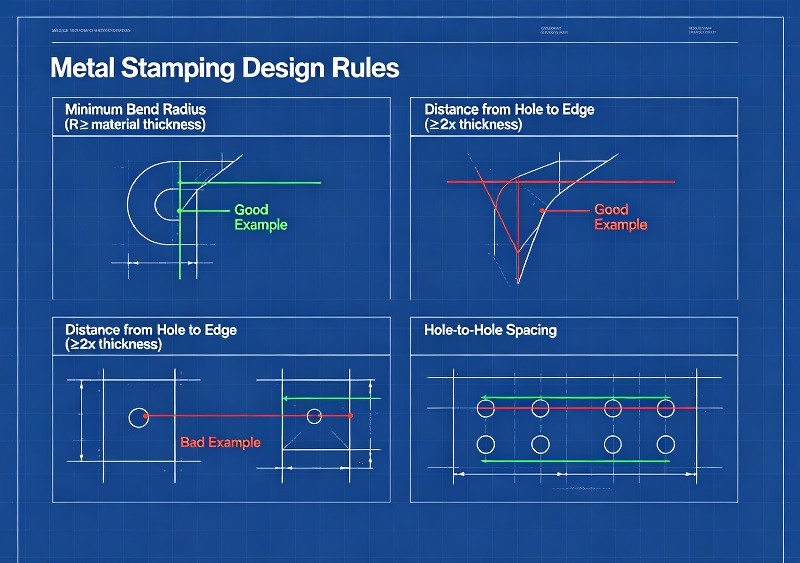
By integrating these rules into your design process, you can avoid the most common manufacturing headaches and create superior Custom Metal Stamping Parts that are optimized for quality, performance, and cost.
Choosing the Right Material for Your Custom Metal Stamping Parts, with a Focus on SPCC
The choice of material is one of the most critical decisions in a custom metal stamping project. It directly influences the part's strength, weight, corrosion resistance, conductivity, appearance, and, crucially, its manufacturability and cost. While many metals can be stamped, a select few are favored for their excellent balance of properties. This section explores these popular materials, delves into key properties to consider, and highlights the specific advantages of SPCC steel.
Popular Metals: Steel (Including SPCC), Aluminum, Copper, and Brass for Custom Metal Stamping
The choice of raw material is a cornerstone of any successful metal stamping project. Four materials dominate the industry due to their favorable properties and cost-effectiveness: steel, aluminum, copper, and brass. Each offers a unique profile of strength, formability, conductivity, and corrosion resistance.
Steel
Steel is the undisputed workhorse of the metal stamping industry. It offers an excellent combination of strength, durability, and low cost, making it the default choice for a vast range of applications.
- Low-Carbon Steel (Mild Steel): This is the most common type used in stamping. It is highly formable, weldable, and relatively inexpensive. This category includes grades like SPCC, which is prized for its smooth finish and excellent drawability.
- High-Strength Steels (HSLA): These alloys provide significantly more strength without a proportional increase in weight, making them ideal for automotive structural components where safety and fuel efficiency are paramount.
- Stainless Steel: Containing chromium, stainless steel offers superior corrosion resistance and a clean, aesthetic finish. It is harder and less formable than mild steel but is essential for medical, food-grade, and harsh-environment applications.
Aluminum
Aluminum is favored for applications where light weight is a critical requirement. It has an excellent strength-to-weight ratio and is naturally resistant to corrosion.
- Common Alloys: Grades like 3003, 5052, and 6061 are frequently stamped. 5052 is known for its high strength and good formability, making it popular for marine and transportation parts. 6061 offers even greater strength and can be heat-treated, but is less formable.
Copper
Copper is the material of choice when electrical or thermal conductivity is the primary concern. Its excellent conductivity is second only to silver.
- Properties: Highly ductile and malleable, copper is easy to form into complex shapes. Its inherent corrosion resistance and antimicrobial properties also make it useful in plumbing and medical applications.
- Applications: It is essential for electrical connectors, terminals, busbars, and heat sinks in the electronics and power distribution industries.
Brass
Brass is an alloy of copper and zinc, offering a balanced combination of properties that make it highly versatile.
- Properties: It is stronger and more durable than pure copper but retains good conductivity and formability. It also has excellent corrosion resistance and an attractive golden appearance.
- Applications: Brass is widely used for decorative hardware, plumbing fittings, ammunition casings, and intricate electronic components where a mix of strength and conductivity is needed.
Here is a comparative overview of these popular materials:
| Material | Key Properties | Common Applications | Relative Cost |
|---|---|---|---|
| Steel (e.g., SPCC) | High strength, durability, excellent formability, weldability. | Automotive panels, appliance bodies, structural brackets, general hardware. | Low |
| Aluminum | Lightweight, high strength-to-weight ratio, high corrosion resistance. | Aerospace components, automotive parts, electronic enclosures, heat sinks. | Medium |
| Copper | Excellent electrical and thermal conductivity, high ductility, corrosion resistance. | Electrical connectors, terminals, busbars, heat exchangers. | High |
| Brass | Good strength and conductivity, excellent machinability, corrosion resistance. | Plumbing fittings, decorative hardware, musical instruments, ammunition casings. | Medium-High |
Ultimately, the best material depends on the specific demands of your part. Balancing performance requirements with budget and manufacturability is key to making the right selection.
Understanding Material Properties: Thickness, Hardness, and Finishes
Beyond the type of metal, several intrinsic properties play a crucial role in the design and execution of a metal stamping project. Understanding how thickness, hardness, and finishes affect the process is essential for creating a high-quality, functional part.
Material Thickness (Gauge)
The thickness of the sheet metal is a foundational parameter in stamping design. It dictates not only the final part's strength and weight but also nearly every aspect of the manufacturing process.
- Impact on Stamping Force: Thicker materials require significantly more force to cut and form. This means a higher-tonnage press is needed, which can affect production costs.
- Influence on Tooling: Dies used for thicker materials must be more robust and are subject to accelerated wear due to increased friction and force. Clearances between the punch and die must be adjusted based on thickness to ensure a clean shear.
- Design Rule Implications: Most DFM rules, such as minimum bend radius and hole-to-edge distance, are defined as a multiple of the material thickness (T). A thicker material requires larger bend radii to prevent cracking and greater distances between features.
- Consistency: Variations in material thickness, even within industry tolerance, can lead to inconsistencies in forming and springback, affecting the part's final dimensions.
Material Hardness (Temper)
Hardness refers to a material's resistance to localized deformation, such as scratching or indentation. In stamping, it is a key indicator of the material's formability.
- Formability vs. Strength: There is a direct trade-off between hardness and formability. Harder materials (higher temper) are stronger and more resistant to wear, but they are also more brittle and less ductile. This makes them difficult to bend or draw without cracking.
- Work Hardening: The cold-forming process of stamping naturally increases the material's hardness, an effect known as work hardening. This makes the finished part stronger than the raw material it was made from.
- Springback: Harder materials exhibit more springback—the tendency of the material to partially return to its original shape after being bent. This must be compensated for in the tool design by "overbending" the part.
- Tool Wear: Stamping harder materials puts more stress on the tooling, leading to faster wear and the need for more frequent maintenance.
Surface Finishes
A surface finish is a treatment applied to the part either before or after stamping to enhance its properties. The choice of finish depends on the part's application and environment.
- Pre-plated/Coated Materials: Some raw materials come with a finish already applied, such as galvanized steel (zinc-coated) or pre-painted stock. This can be cost-effective as it eliminates a secondary finishing step, but care must be taken during stamping to avoid damaging the coating.
- Post-Stamping Finishes: More commonly, finishes are applied after the part is formed. This provides better and more complete coverage, especially on cut edges. Common post-stamping finishes include:
- Plating (Zinc, Nickel, Tin, Chrome, Gold, Silver): A thin layer of another metal is electrochemically deposited onto the part's surface. Plating is used to improve corrosion resistance, enhance electrical conductivity, increase wear resistance, or for decorative purposes.
- Powder Coating & E-Coating: These processes apply a durable, protective layer of paint. E-coating (electrophoretic deposition) provides an excellent corrosion-resistant primer, while powder coating offers a thick, durable, and aesthetic topcoat available in many colors.
- Anodizing (for Aluminum): An electrochemical process that creates a hard, durable, and corrosion-resistant oxide layer on the surface of aluminum parts. It can also be dyed in various colors.
- Passivation (for Stainless Steel): A chemical treatment that removes free iron from the surface of stainless steel and enhances the natural chromium-oxide layer, improving its corrosion resistance.
Understanding these three properties is crucial for a holistic design approach, ensuring that the selected material can be efficiently transformed into a finished part that meets all performance and aesthetic requirements.
The Advantages of Using SPCC Material for Your Custom Metal Stamping Parts
While many materials are suitable for metal stamping, SPCC stands out as a premier choice for a vast array of projects, particularly when formability, surface quality, and cost are key drivers. SPCC is the Japanese Industrial Standard (JIS G3141) designation for "Steel Plate Cold Rolled Commercial," a type of low-carbon steel that has been processed to achieve superior properties for forming.
The production of SPCC involves taking a hot-rolled steel coil, pickling it to remove surface scale, and then cold-rolling it at room temperature. This process reduces the steel's thickness while improving its dimensional accuracy and surface finish. It is typically followed by an annealing process, which softens the steel and restores its ductility, making it ideal for stamping.
Here are the primary advantages of using SPCC material for your custom metal stamping projects:
Excellent Formability and Ductility: SPCC is engineered for superior formability. Its low carbon content and annealed state give it high ductility, allowing it to be bent, drawn, and stretched into complex shapes with a very low risk of cracking or tearing. This makes it an ideal candidate for parts requiring deep draws or intricate geometries, such as automotive inner panels and appliance housings.
Superior Surface Finish: The cold-rolling process gives SPCC a smooth, clean, and uniform surface. This high-quality finish is crucial for applications where appearance is important. It provides an excellent substrate for painting, powder coating, and plating, ensuring a flawless and durable aesthetic result with minimal surface preparation.
High Dimensional Accuracy: Cold rolling allows for very tight control over the material's thickness and overall dimensions. This consistency is critical in precision metal stamping, as it ensures that every part produced will meet tight tolerance specifications, leading to better fit and function in the final assembly.
Cost-Effectiveness: As a commercial-grade low-carbon steel, SPCC is one of the most economical materials available for stamping. Its wide availability and relatively low raw material cost make it the go-to choice for high-volume production where keeping the per-part price low is a primary objective.
Good Weldability: SPCC's low carbon content makes it easy to weld using common methods like spot welding, MIG, and TIG. This simplifies assembly processes where stamped parts need to be joined to other components.
Typical Applications of SPCC Steel:
- Automotive Industry: Used extensively for non-critical structural parts, inner body panels, brackets, and enclosures.
- Home Appliances: The go-to material for the outer shells and internal components of refrigerators, washing machines, microwaves, and air conditioners.
- Furniture and Hardware: Ideal for manufacturing furniture frames, brackets, hinges, and other hardware.
- Electronics: Used for computer cases, chassis, and internal mounting brackets.
While SPCC is not inherently corrosion-resistant and requires a protective coating for use in humid or harsh environments, its combination of outstanding formability, superior surface quality, and low cost makes it an unbeatable choice for a wide range of custom metal stamping applications.
Quality Assurance for Your Custom Metal Stamping Parts
In the world of precision manufacturing, speed and cost-efficiency are meaningless without quality. A finished part is only as good as its ability to meet exact specifications consistently, from the first piece to the millionth. A robust quality assurance (QA) program is not just a final inspection step; it is an integral part of the entire metal stamping process, from initial design review to final packaging. It ensures dimensional accuracy, prevents defects, and ultimately guarantees the reliability of your final product.
How We Ensure Dimensional Accuracy and Meet Tolerance Standards
Achieving dimensional accuracy and adhering to specified tolerances are the cornerstones of quality in custom metal stamping. A part that is out of tolerance can cause assembly problems, functional failures, and costly recalls. A robust quality system employs a multi-faceted approach, integrating checks and advanced metrology tools throughout the production process to guarantee that every part conforms to the design blueprint.
The Foundation: Proactive Quality Planning
Accuracy begins long before the first part is stamped. It starts with a comprehensive quality plan:
- Material Certification and Inspection: Quality control starts with the raw material. We verify that all incoming metal coils or sheets meet the specified grade, thickness, and hardness standards through material certification reviews and incoming inspections.
- Tool and Die Validation: The stamping die is the heart of the process. Before production, the die itself is meticulously inspected to ensure all cutting edges, forming surfaces, and clearances match the design specifications. Regular die maintenance and calibration are crucial for maintaining accuracy over long production runs.
- Statistical Process Control (SPC): SPC is a methodology that uses statistical analysis to monitor and control the manufacturing process in real-time. By tracking key process variables, we can identify and correct potential deviations before they result in out-of-tolerance parts, ensuring process stability.
Advanced Inspection and Measurement Techniques
To verify the dimensions of complex stamped parts, we utilize a suite of high-precision metrology instruments. Standard tools like calipers and micrometers are used for basic checks, but for comprehensive analysis, more advanced technology is required.
Coordinate Measuring Machine (CMM): A CMM is the gold standard for full 3D dimensional verification. It uses a highly sensitive probe to touch points on the part's surface, creating a precise 3D map of its geometry. This data is then compared directly to the original CAD model to check for any deviations in dimensions, hole positions, and complex contours. CMM inspection is essential for first-article inspection (FAI) to validate the tooling and for ongoing batch checks to ensure continued accuracy.
Optical Comparator: An optical comparator, or profile projector, is a non-contact measurement tool ideal for 2D inspection. It magnifies a part's silhouette and projects it onto a screen, where it can be compared against a scaled drawing overlay. This method is excellent for quickly verifying profiles, edge features, hole diameters, and angles on small or delicate parts that could be damaged or deformed by a contact probe.
3D Laser Scanning: For rapid, full-surface inspection, 3D laser scanners capture millions of data points to create a detailed digital model of the part. This "point cloud" is then compared to the CAD file, generating a color-coded map that visually highlights any areas of deviation. This is highly effective for inspecting free-form surfaces, identifying warpage, and ensuring overall geometric conformity.
By combining proactive process controls with advanced measurement technologies, we can confidently ensure that every custom metal stamped part we produce meets the most stringent dimensional accuracy and tolerance standards required by our customers. This commitment to quality minimizes waste, improves assembly efficiency, and guarantees the performance and reliability of the final product.