The Custom Metal Stamping Manufacturer's Guide to Material Properties and Selection
As custom metal stamping manufacturers, we know that selecting the right material is crucial for the success of any project. The properties of the material directly impact the performance, durability, and cost-effectiveness of your finished components. Choosing the wrong material can lead to part failure, increased costs, and production delays, which is why a deep understanding of material science is foundational to quality manufacturing.
This guide will walk you through the key material properties and selection considerations that we, as your manufacturing partner, take into account to ensure your custom metal stamped parts meet your exact specifications and application needs. We'll explore how material choice affects everything from the stamping process itself to the final product's longevity, helping you make more informed decisions for your projects.
Understanding Material Properties: A Custom Metal Stamping Manufacturer's Perspective
The selection of a material is a foundational decision that influences every stage of production and the ultimate performance of the final part. From a manufacturer's standpoint, we must balance the material's behavior under the stress of stamping with its long-term performance in its intended environment. This requires a comprehensive evaluation of its mechanical, physical, and chemical characteristics.
Key Properties We Consider for Your Custom Metal Stamping Projects
Every project has a unique set of demands. Our role is to translate your application requirements into a specific material profile, ensuring the final component is not only manufacturable but also perfectly suited for its job. Here are some of the primary properties we assess.
Strength and Durability for Optimal Performance
Strength determines a material's capacity to resist external forces without deforming or breaking. We analyze several aspects of strength:
- Tensile Strength: The maximum stress a material can withstand while being stretched or pulled before necking, which is when the specimen's cross-section starts to significantly contract.
- Yield Strength: The point at which a material begins to deform plastically (permanently). For a stamped part that must maintain its shape under load, a high yield strength is critical.
- Fatigue Resistance: For components subjected to repeated cycles of loading and unloading, such as those in automotive or aerospace applications, fatigue resistance is paramount to prevent failure over time.
Durability is the measure of a product's lifespan under operational stress. A material with the right balance of hardness, toughness, and strength will ensure the longevity and reliability of the final assembly.
Formability and Bend Rating
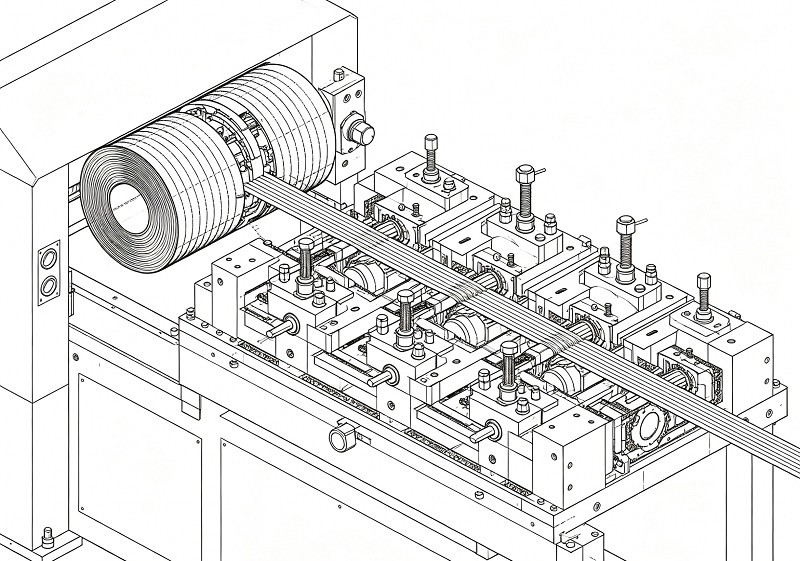
Formability, or ductility, is a material's ability to undergo plastic deformation—like being bent, stretched, or drawn—without cracking or breaking. This property is fundamental to the stamping process.
- Elongation: This measures how much a material can be stretched before it fractures. A higher elongation percentage generally indicates better formability, which is crucial for parts with deep draws or complex geometries.
- Bend Radius: The minimum radius a material can be bent to without cracking. This is heavily influenced by the material's thickness, ductility, and grain direction. Attempting to form a part with a radius smaller than the material's limit will lead to fractures and high scrap rates.
Materials with good formability, like certain aluminum alloys and low-carbon steels, reduce the risk of defects during stamping, leading to more efficient production.
Corrosion Resistance and Environmental Suitability
The operating environment of a part is a major factor in material selection. Exposure to moisture, chemicals, salt, or extreme temperatures can degrade materials over time.
We often recommend materials with inherent corrosion resistance, such as:
- Stainless Steel: Contains chromium, which forms a passive, self-healing oxide layer that protects against rust and corrosion. It is a favored choice for medical, food processing, and marine applications.
- Aluminum: Naturally generates a protective oxide coating, making it highly resistant to corrosion in many environments.
- Copper and Brass: Offer good corrosion resistance, particularly in marine environments.
For other materials, we can enhance their durability through secondary processes like plating, painting, or specialized coatings that create a protective barrier.
Electrical Conductivity for Specific Applications
For components used in electronics, telecommunications, and power distribution, electrical properties are the primary consideration. How a material conducts or resists electrical current is critical to the function and safety of the final product.
- High Conductivity: Materials like copper and its alloys (such as brass and bronze) are chosen for their excellent ability to conduct electricity, making them ideal for terminals, connectors, and bus bars.
- Lower Conductivity: In some cases, a material might be chosen for its ability to resist electrical flow or to provide structural support without interfering with electrical signals.
The material's thermal conductivity is also important in these applications, as it determines how effectively the component can dissipate heat generated by electrical resistance.
Dimensional Stability in Custom Metal Stamping: Maintaining Precision
Dimensional stability refers to a material's ability to retain its original size and shape when exposed to environmental changes like temperature and humidity. Materials expand when heated and contract when cooled, a property known as thermal expansion.
In precision metal stamping, where tolerances can be as tight as ±0.05 mm, managing thermal expansion is crucial. If a component is part of an assembly with different materials, a mismatch in thermal expansion rates can cause stress, warping, or failure. We select materials with thermal characteristics that match the application's operating range to ensure components fit and function correctly throughout their lifecycle.
Non-Metallic Options for Custom Metal Stamping
While "metal stamping" is in our name, the process can also be adapted for a variety of non-metallic materials. These are chosen when specific properties like electrical insulation, flexibility, or a lightweight nature are required where metals would be unsuitable.
Commonly stamped non-metallic materials include:
- Plastics and Polymers (e.g., Polycarbonate, ABS, Nylon)
- Composites
- Fiber and vulcanized materials
- Phenolics
Stamping these materials requires specialized tooling and handling to prevent cracking, delamination, or deformation. They are frequently used for gaskets, insulators, washers, and structural components in electronics and consumer goods.
Choosing the Right Material: How a Custom Metal Stamping Manufacturer Guides You
The process of selecting the right material is a collaborative effort. As your manufacturing partner, our goal is to align your design vision, performance requirements, and budget constraints with the ideal material solution. This involves a careful analysis of your application and a deep understanding of how material choice impacts manufacturability and cost.
Matching Materials to Your Application and Budget
Balancing performance with cost is often the most challenging aspect of material selection. Our engineering team works with you to identify the "must-have" properties for your application, helping to avoid over-engineering, which can lead to unnecessary expense.
Cost-Effectiveness and Project Requirements
The total cost of a stamped part is influenced by more than just the raw material price. It includes tooling, production speed, and scrap rates. A seemingly cheaper material that is difficult to form can increase production time and waste, ultimately raising the total cost.
We help you analyze the total cost of ownership by considering:
- Raw Material Cost: Prices for metals like steel, aluminum, and copper fluctuate based on market availability.
- Manufacturability: Materials with good formability and machinability reduce processing time and tool wear.
- Production Volume: For high-volume runs, investing in more durable tooling to handle a tougher material may be cost-effective. For lower volumes, a more formable material that works with less expensive tooling might be a better choice.
By evaluating these factors, we can recommend a material that provides the best value without compromising on quality or performance.
Specific Industry Needs (Automotive, Aerospace, Medical)
Different industries operate under distinct regulatory and performance standards. Materials for these sectors must meet stringent requirements for safety, reliability, and compliance.
- Automotive: This industry often requires high-strength, low-alloy (HSLA) steels and aluminum alloys to create parts that are both strong and lightweight for improved fuel efficiency and safety.
- Aerospace: Materials must withstand extreme temperatures, pressures, and stresses. Specialty alloys like titanium, Inconel, and specific grades of stainless steel are common choices for their high strength-to-weight ratio and resilience.
- Medical: Biocompatibility and corrosion resistance are non-negotiable. Medical-grade stainless steel, titanium, and certain polymers are used for surgical instruments and implantable devices because they do not react with the human body.
Our expertise across these industries ensures that the material selected will meet all required specifications and certifications.
The Role of Finishes and Coatings in Custom Metal Stamping
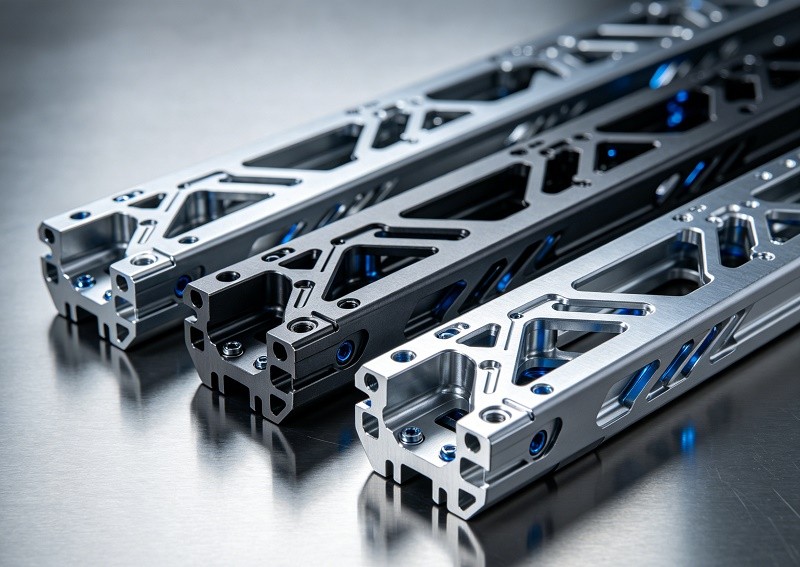
A surface finish is often more than just a cosmetic touch; it's a functional element that can drastically improve a part's performance and longevity. Finishes and coatings are applied after the stamping process to add or enhance properties that the base material may not possess.
Surface Treatments for Enhanced Function and Aesthetics
Surface treatments can be tailored to meet a wide range of needs:
| Treatment Type | Description | Common Applications |
|---|---|---|
| Plating | A thin layer of another metal (e.g., zinc, nickel, chrome, tin) is electrochemically bonded to the surface. | Enhances corrosion resistance, improves solderability, increases hardness, and provides a decorative finish. |
| Anodizing | An electrochemical process that converts the metal surface into a durable, corrosion-resistant, anodic oxide finish. | Commonly used on aluminum for corrosion protection and to allow for durable coloring (dyeing). |
| Powder Coating | A dry powder is applied electrostatically and then cured under heat to form a hard finish that is tougher than conventional paint. | Provides excellent resistance to scratches, chemicals, and weather. Available in a wide range of colors and textures. |
| Passivation | A chemical process, typically for stainless steel, that removes free iron from the surface and forms a passive oxide layer to enhance corrosion resistance. | Used in medical and food-grade applications to ensure a clean, non-reactive surface. |
Compatibility with Chosen Materials
The selection of a finish is not independent of the material choice; they must be compatible. For instance, certain coatings adhere better to steel than to aluminum. The pre-treatment process, such as cleaning and etching the surface, is critical to ensure proper adhesion and prevent issues like flaking or peeling. We consider the synergy between the material and the desired finish early in the design phase to guarantee a durable and effective final product.
Advanced Materials and Specialty Alloys for Unique Custom Metal Stamping Needs
When standard metals cannot meet the demands of an application, we turn to advanced materials and specialty alloys. These materials are engineered to perform in extreme environments, offering superior properties like ultra-high strength, heat resistance, or chemical inertness.
Examples include:
- High-Strength Steels (HSS/AHSS): Offer exceptional strength-to-weight ratios, essential for modern automotive safety structures.
- Inconel, Monel, and Hastelloy: Nickel-based superalloys that maintain their strength and corrosion resistance at very high temperatures, making them suitable for aerospace and chemical processing industries.
- Titanium: Provides an unmatched combination of high strength, low weight, and biocompatibility, used in aerospace and medical implants.
Working with these materials requires specialized expertise, as they can be more challenging to stamp and process. Our experience with advanced alloys allows us to tackle unique challenges and produce components for the most demanding applications.
The Custom Metal Stamping Manufacturer's Approach to Material Processes
A material's properties dictate not only its suitability for an end-use application but also how it must be handled during manufacturing. Our process is built around understanding this relationship to optimize efficiency, precision, and quality for every part we produce.
What is Sheet Metal Stamping and How We Define Our Process
Sheet metal stamping is a cold-forming manufacturing process that uses a die and a stamping press to transform a flat sheet of metal into a specific shape. The process can include a variety of techniques to cut, bend, and form the material into a net-shape or near-net-shape part.
Cold Forming Techniques (e.g., Blanking, Drawing, Piercing, Forming)
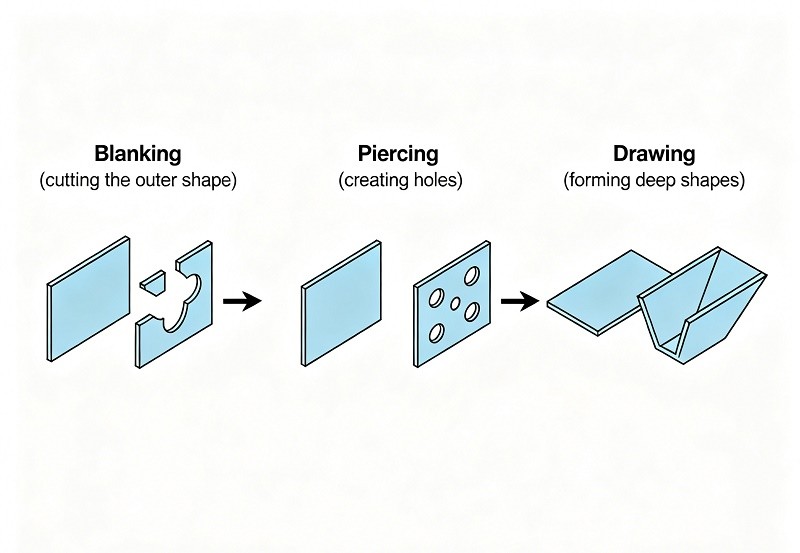
Our stamping operations utilize several cold-forming techniques, often in combination within a single progressive die:
- Blanking: Cutting the outer shape of the part from a metal sheet, separating it from the larger coil.
- Piercing: Punching holes, slots, or other cutouts within the part.
- Drawing: Stretching the metal over a form to create deep, cup-like shapes. The material's formability is critical here to prevent tearing or wrinkling.
- Forming/Bending: Creating bends and angles in the part along a straight axis. Managing springback—the tendency of a material to return to its original shape after bending—is key to achieving accurate angles.
Precision and High-Volume Production
Stamping is an ideal process for precision and high-volume production. By using progressive dies, where a series of stamping operations are performed sequentially as a coil of material feeds through the press, we can produce thousands or even millions of identical parts with exceptional speed and consistency. This high degree of automation ensures tight tolerances are maintained throughout the production run, making it a highly cost-effective method for large quantities.
Material Characteristics and Impact on Production Efficiency
The inherent characteristics of a material directly influence the efficiency and success of the stamping process. A failure to account for these properties can lead to tool damage, high scrap rates, and production delays.
Weldability, Machinability, and Ductility
- Ductility: As previously mentioned, this is a material's ability to be formed without breaking. Materials with low ductility are prone to cracking during drawing or bending operations.
- Machinability: This refers to the ease with which a material can be cut or machined. While stamping is a forming process, some features may require secondary machining. Materials with poor machinability increase tool wear and cycle times.
- Weldability: If the stamped component is to be welded into a larger assembly, its weldability is a key consideration. Some materials and coatings can be difficult to weld, requiring special techniques or preparation.
By understanding these properties, we can design our tooling and processes to accommodate the material's behavior, ensuring a smooth and efficient production flow.
Examples of Materials We Work With for Custom Metal Stamping
Our extensive experience allows us to work with a diverse range of materials, each selected for its unique advantages.
| Material | Key Properties | Common Applications |
|---|---|---|
| Carbon Steel | Strong, durable, cost-effective. Available in various grades (low, medium, high carbon) to tune properties. | Automotive frames, brackets, appliances, industrial hardware. |
| Stainless Steel | Excellent corrosion resistance, hygienic, high strength, aesthetic appeal. | Medical devices, food processing equipment, automotive exhaust, architectural components. |
| Aluminum | Lightweight, high strength-to-weight ratio, excellent corrosion resistance, high thermal and electrical conductivity. | Aerospace components, electronics enclosures, automotive body panels, heat sinks. |
| Copper | Superior electrical and thermal conductivity, excellent formability. | Electrical contacts, terminals, bus bars, connectors. |
| Brass/Bronze | Good corrosion resistance, good conductivity, durable, attractive appearance. | Plumbing fittings, decorative hardware, musical instruments, electrical connectors. |
This is just a sample of the materials we can stamp. We are equipped to handle everything from common alloys to specialized, high-performance metals.
Choosing the right material is a critical decision that impacts cost, performance, and manufacturability. At our facility, we pride ourselves on our deep expertise in material science and our ability to guide you through the complexities of material selection. From initial design consultation to final production, our team is dedicated to finding the perfect material that meets your functional needs and budgetary goals.
By understanding the critical factors outlined in this guide—from mechanical strength and formability to corrosion resistance and cost-effectiveness—we ensure that every custom metal stamped component we produce performs flawlessly in its intended application. To discuss your project's specific material needs and discover how our expertise can bring your design to life, feel free to contact us and speak with one of our engineers. We encourage you to share this guide with your team and colleagues to foster a better understanding of the foundation of quality manufacturing.