The 5 Key Electroless Nickel Plating Processes Explained for Suppliers
As suppliers, we know the critical role that surface finishing plays in product performance and longevity. Electroless nickel plating (ENP) stands out as a versatile and widely adopted method, offering superior protection and enhanced functionality for various components. It's a chemical deposition method that applies a nickel-phosphorus or nickel-boron alloy on a substrate without using an electric current, unlike traditional electroplating. This autocatalytic process ensures a perfectly uniform coating, even on the most complex parts.
This blog post is designed to guide electroless nickel plating suppliers through the five key processes, characteristics, and benefits of ENP, ensuring you're equipped to offer the best solutions to your clients. We'll delve into the nuances of different phosphorus content levels, post-plating treatments, and specialized formulations that can improve performance. The properties of the ENP deposit can be tailored to meet specific service conditions by adjusting the amount of phosphorus in the alloy.
Understanding these processes helps us as electroless nickel plating suppliers to provide tailored, high-quality finishes that meet the specific demands of diverse industries, from automotive and aerospace to oil and gas. By leveraging the unique qualities of ENP, we can help our clients enhance product durability, extend component lifespan, and ensure reliability in the most demanding environments.
Understanding the Fundamentals of Electroless Nickel Plating for Suppliers
Before diving into the specific types and applications, it's crucial for suppliers to grasp the core principles that make electroless nickel plating a preferred choice in surface engineering. The process is defined as the deposition of a metallic coating by a controlled chemical reduction that is catalyzed by the metal or alloy being deposited. Unlike electroplating, which relies on an external electrical current, ENP is a purely chemical process. This fundamental difference is the source of its most significant advantages and governs how we, as suppliers, should approach its application.
The Autocatalytic Process: A Key Advantage for Electroless Nickel Plating Suppliers
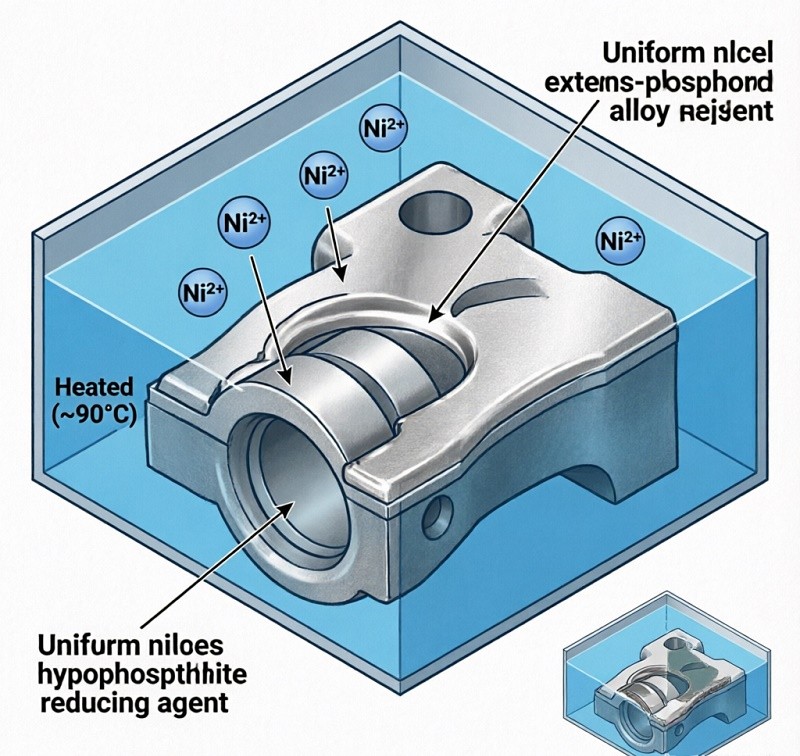
The term "autocatalytic" is central to understanding electroless nickel plating. It means the process is self-sustaining; once a layer of nickel is deposited on the substrate, that nickel layer itself acts as a catalyst for the ongoing reaction. This chemical reaction involves a reducing agent, typically sodium hypophosphite, which reduces nickel ions in the solution to metallic nickel, depositing them onto the part's surface. This continuous, controlled chemical reaction is what allows for the creation of a highly uniform and consistent coating.
Uniformity on Complex Geometries
One of the most significant advantages of the autocatalytic process is its ability to create a perfectly uniform coating, regardless of the part's geometry. Unlike electroplating, which suffers from current density variations (leading to thicker deposits on edges and corners, and thinner coatings in recesses), electroless plating deposits an even layer on any surface the solution can reach. This is invaluable for components with intricate designs, deep cavities, threads, blind holes, and internal passages. For suppliers, this means we can confidently offer a high-quality, protective finish on complex parts for industries like aerospace, medical device manufacturing, and high-precision tooling, where even slight variations in thickness are unacceptable. This uniformity often eliminates the need for costly post-plating grinding or polishing.
Substrate Compatibility
The versatility of ENP extends to its wide range of compatible substrates. The process is suitable for numerous metals, including:
- Alloy steels and stainless steels
- Aluminum and its alloys
- Copper, brass, and other copper alloys
- Titanium and beryllium alloys
Furthermore, because the process is chemical rather than electrical, it can be adapted to coat non-conductive materials, such as plastics, after they undergo a special activation or metallization step. This involves applying a catalytic surface, often with palladium, to initiate the nickel deposition. This broad compatibility allows suppliers to offer ENP solutions across a vast spectrum of industries and product types.
The Basic Steps of Electroless Nickel Plating
A successful ENP application relies on a meticulous, multi-stage process. As suppliers, ensuring precision at each step is critical to delivering a high-quality, adherent, and defect-free coating. The process can generally be broken down into four main phases:
| Step | Description | Purpose |
|---|---|---|
| 1. Pre-treatment | This is the most critical phase and involves a series of cleaning and rinsing steps. It includes alkaline cleaning to remove oils and grease, acid etching to remove scale and oxides, and multiple rinses. | To ensure the substrate surface is perfectly clean and free of any contaminants that could interfere with adhesion. A pristine surface is paramount for a strong bond. |
| 2. Activation | After cleaning, the substrate surface is activated. For many metals, this is a continuation of the acid etch. For others, like aluminum, a specific zincate treatment is used. For non-conductive surfaces, a palladium catalyst is applied. | To prepare the surface to be catalytically active, which is necessary to initiate the plating reaction. |
| 3. Plating Bath Immersion | The prepared component is immersed in the electroless nickel plating bath, which is heated to a specific operating temperature, typically between 85-95°C (185-203°F). The solution contains nickel salts, reducing agents (like sodium hypophosphite), pH buffers, and stabilizers. | This is where the autocatalytic reaction occurs. The reducing agent provides electrons to the nickel ions, causing them to deposit as a nickel-phosphorus alloy onto the part's surface. The thickness is controlled by the immersion time. |
| 4. Post-treatment | After the desired thickness is achieved, the part is removed and thoroughly rinsed. Depending on the application's requirements, the part may then undergo baking or heat treatment. | Rinsing removes residual bath chemicals. Heat treatment can be used to improve adhesion, increase hardness, or relieve hydrogen embrittlement. |
Adhering strictly to these steps ensures the final coating meets the required specifications for thickness, adhesion, and performance, reinforcing the supplier's reputation for quality and reliability.
Exploring the Three Main Types of Electroless Nickel Plating for Suppliers
The properties of an electroless nickel coating are primarily determined by its phosphorus content. As suppliers, understanding the distinctions between low, medium, and high phosphorus formulations allows us to tailor the finish to the specific demands of our clients' applications, whether they prioritize hardness, corrosion resistance, or a balance of properties.
Low Phosphorus Electroless Nickel Plating
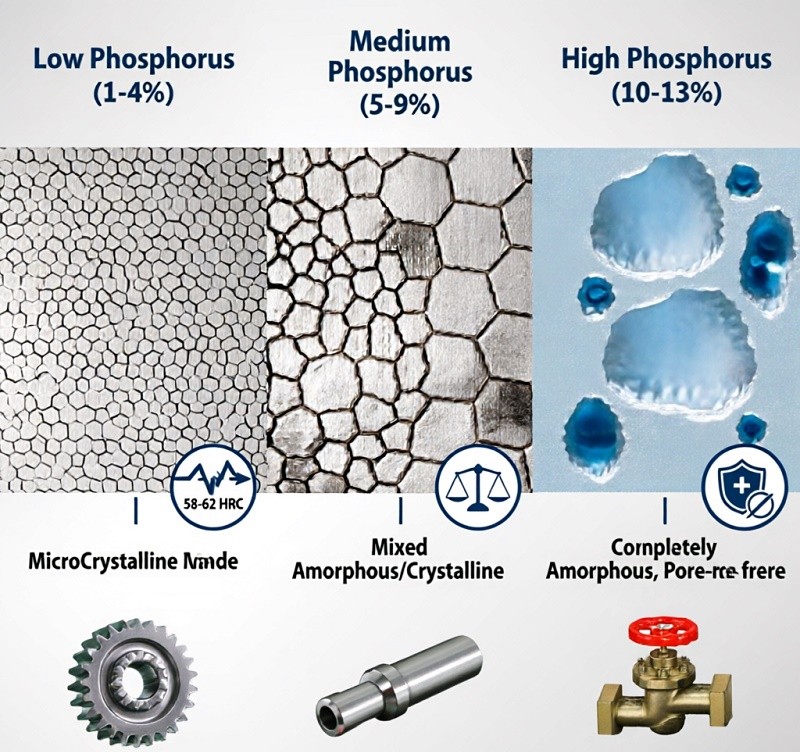
Low phosphorus (Low-P) electroless nickel typically contains 1-4% phosphorus by weight. Its structure is more microcrystalline, which contributes to its primary characteristic: high hardness.
Properties:
- High Hardness and Wear Resistance: Low-P ENP is the hardest of the three types as-plated, with hardness values often ranging from 58 to 62 Rc. This makes it exceptionally resistant to wear and abrasion.
- Uniform, Compressive Stress: The deposit is compressively stressed, which can improve fatigue life in some applications.
- Corrosion Resistance: It offers good corrosion resistance in alkaline or high pH environments. However, its corrosion protection is generally less than medium or high phosphorus types in acidic environments.
- Conductivity and Solderability: It provides increased electrical conductivity and is easily soldered.
Common Applications: Due to its exceptional hardness, it is ideal for components subject to high friction and wear, particularly in industrial settings. It is also specified for certain electronic applications where solderability is key.
Medium Phosphorus Electroless Nickel Plating
Often called the "workhorse" of the industry, medium phosphorus (Mid-P) electroless nickel is the most common type used. It typically contains 5-9% phosphorus, although this range can vary slightly. It strikes a balance between hardness, wear resistance, and corrosion protection.
Properties:
- Balanced Performance: Mid-P offers a good combination of hardness (as-plated hardness of 45-57 Rc) and wear resistance, coupled with good corrosion resistance in both alkaline and some acidic conditions.
- Appearance: The finish is typically bright or semi-bright, making it suitable for applications where aesthetics are a consideration.
- Heat Treatable: Its hardness can be significantly increased through post-plating heat treatment, often reaching 65-70 Rc.
- Magnetic Properties: Mid-P deposits are slightly magnetic.
Common Applications: Its versatility makes it suitable for a vast array of general-purpose industrial applications, including automotive components, machinery parts, and decorative finishes where durability is required.
High Phosphorus Electroless Nickel Plating
High phosphorus (High-P) electroless nickel contains 10% or more phosphorus by weight, typically in the 10-13% range. Its structure is amorphous, meaning it lacks grain boundaries, which is the key to its superior performance in corrosive environments.
Properties:
- Superior Corrosion Resistance: This is the primary advantage of High-P ENP. Its non-crystalline, pore-free structure provides an excellent barrier against moisture and aggressive chemicals, especially in acidic environments. It can often withstand over 1,000 hours of salt spray testing.
- Non-Magnetic: As-plated, High-P is completely non-magnetic, a critical requirement for sensitive electronics, military applications, and components used in magnetic resonance imaging (MRI).
- Ductility: It is more ductile than low or medium phosphorus varieties, making it suitable for applications that may involve some flexing or for building up thicker deposits.
- Hardness: It is the softest of the three in its as-plated state but can be hardened through heat treatment.
Common Applications: It is the preferred choice for industries facing harsh and corrosive conditions, such as oil and gas (valves, pumps), marine applications, chemical processing, and aerospace.
Here is a comparative summary:
| Feature | Low Phosphorus (1-4% P) | Medium Phosphorus (5-9% P) | High Phosphorus (10-13% P) |
|---|---|---|---|
| Corrosion Resistance | Good in alkaline environments | Good, general purpose | Excellent, especially in acidic environments |
| As-Plated Hardness | Very High (58-62 Rc) | Medium (45-57 Rc) | Lower (~48 Rc) |
| Wear Resistance | Excellent | Good | Good, but typically lower than Low-P |
| Magnetic Property | Magnetic | Slightly Magnetic | Non-Magnetic (as-plated) |
| Structure | Crystalline | Amorphous/Crystalline mix | Amorphous |
| Primary Advantage | Maximum Hardness & Wear | Balanced Properties | Maximum Corrosion Protection |
Enhancing Properties Through Post-Plating Treatments for Electroless Nickel Plating Suppliers
For suppliers, the electroless nickel plating process doesn't just end after the component leaves the bath. Post-plating treatments, particularly heat treatment, are powerful tools that allow us to further customize and enhance the properties of the coating to meet highly specific engineering requirements. These treatments can significantly increase hardness, improve adhesion, and mitigate potential material failures like hydrogen embrittlement.
The Role of Heat Treatment in Electroless Nickel Plating
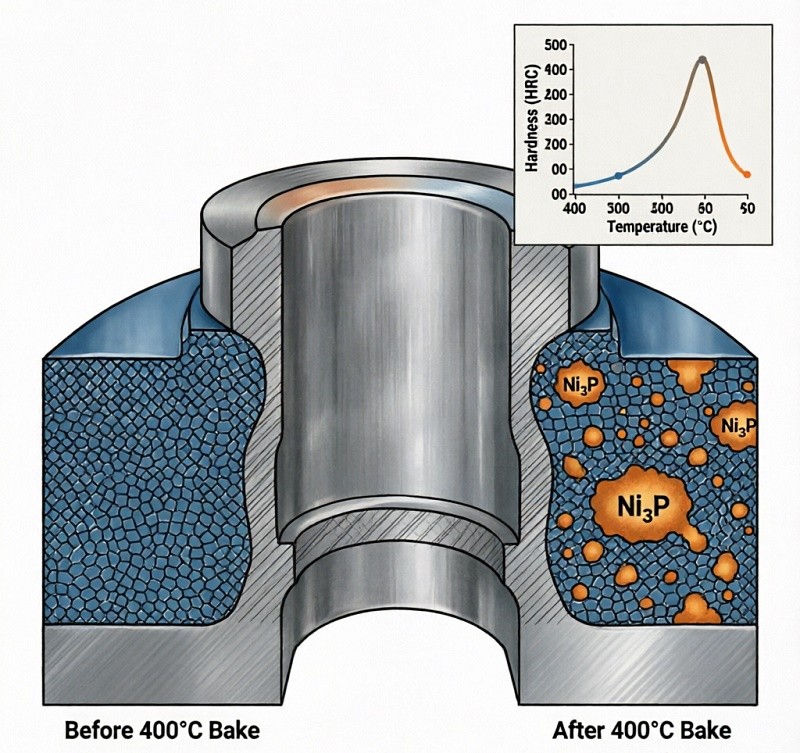
Heat treatment, or baking, at different temperatures and for varying durations can fundamentally alter the microstructure and, consequently, the mechanical properties of the ENP deposit. When as-plated ENP (especially mid and high phosphorus types) is heated, its amorphous or mixed structure transforms into a more crystalline one. This transformation involves the precipitation of hard nickel phosphide (Ni₃P) particles within the nickel matrix.
- Hardening: This precipitation is the primary mechanism for hardening the coating. An as-plated High-P deposit might have a hardness of around 48-52 Rc, but after heat treatment, this can increase to 68-70 Rc, rivaling the hardness of hard chrome. The peak hardness is typically achieved by baking at temperatures around 400°C (750°F) for one hour.
- Trade-offs: It is crucial for suppliers to understand and communicate the trade-offs. While heat treatment for maximum hardness drastically improves wear resistance, it can reduce the coating's corrosion resistance. This is because the crystalline structure created during hardening introduces grain boundaries that can become initiation sites for corrosion, especially in high-phosphorus coatings that were previously amorphous.
- Adhesion Improvement: A low-temperature bake, for example at 180-200°C (356-392°F) for 2-4 hours, is often used not for hardening but to significantly improve the adhesion of the coating to the substrate. This process promotes diffusion between the atoms of the coating and the substrate, creating a stronger metallurgical bond.
The following table summarizes common heat treatment classes and their purposes:
| Treatment Class/Type | Temperature Range | Duration | Primary Purpose |
|---|---|---|---|
| Adhesion Bake (Aluminum) | ~120-150°C (250-302°F) | 1-2 hours | Improve adhesion on aluminum alloys |
| Hydrogen Embrittlement Relief | ~150-190°C (302-375°F) | 1-4 hours | Remove hydrogen from high-strength steels |
| Adhesion Bake (Steel) | ~180-200°C (356-392°F) | 2-4 hours | Improve adhesion on steel substrates |
| Hardening Bake | ~260-400°C (500-750°F) | 1-8 hours | Achieve maximum hardness and wear resistance |
Preventing Hydrogen Embrittlement and Improving Adhesion
For certain substrates, post-plating baking is not just optional but mandatory for safety and performance.
Hydrogen Embrittlement: During the plating process, particularly the acid cleaning steps, atomic hydrogen can be absorbed by high-strength steels (typically those with a hardness over 40 HRC). This hydrogen can cause the steel to become brittle, leading to sudden, catastrophic failure under stress. A post-plating bake at a relatively low temperature, often around 190°C (375°F), allows the trapped hydrogen to diffuse out of the metal before it can cause damage. This "hydrogen embrittlement relief" bake is critical for aerospace, automotive, and defense components.
Adhesion: As mentioned, baking at low to moderate temperatures is a standard procedure to enhance the bond between the ENP coating and the substrate. This is especially important for challenging substrates like aluminum or titanium. The heat reduces internal stresses at the coating-substrate interface and encourages inter-diffusion, ensuring the plating will not flake or delaminate during service.
By mastering and correctly applying these post-plating treatments, suppliers can elevate their service from simply applying a coating to providing a comprehensive surface engineering solution.
Specialized Electroless Nickel Plating Formulations for Diverse Supplier Needs
Beyond the standard low, medium, and high phosphorus varieties, the world of electroless nickel plating offers advanced formulations designed for niche, high-performance applications. These specialized coatings, often referred to as composite or poly-alloy coatings, involve co-depositing other materials within the nickel-phosphorus matrix. As forward-thinking suppliers, offering these advanced solutions can open doors to new markets and solve complex engineering challenges for our clients.
Composite Electroless Nickel Coatings (e.g., PTFE, Boron Carbide)
Composite ENP involves introducing fine, inert particles into the plating bath, which become entrapped and evenly dispersed throughout the deposited nickel-phosphorus layer. This creates a new material with a unique combination of properties.
Electroless Nickel + PTFE (Teflon): By co-depositing particles of Polytetrafluoroethylene (PTFE), we can create a coating with extremely low friction and excellent release properties.
- Properties: The primary benefit is enhanced lubricity, creating a self-lubricating surface that reduces wear and prevents galling.
- Applications: Ideal for molds in the plastics industry, moving parts in machinery, and any application where reduced friction is critical.
Electroless Nickel + Silicon Carbide (SiC) or Boron Carbide (B₄C): Incorporating ultra-hard ceramic particles like silicon carbide or boron carbide results in a coating with exceptional wear and abrasion resistance.
- Properties: The hardness of these composites can far exceed that of standard heat-treated ENP, making them suitable for the most aggressive wear environments.
- Applications: Used in components for mining, textile manufacturing, and material handling systems where parts are exposed to highly abrasive materials.
Electroless Nickel + Diamond: For the ultimate in hardness and wear resistance, microscopic diamond particles can be co-deposited.
- Properties: Creates one of the hardest, most wear-resistant surfaces available, often used for grinding and cutting tools.
- Applications: High-precision grinding components, cutting tools, and other extreme-wear industrial applications.
Understanding Material Additives: Silicon and Boron
In addition to phosphorus, other elements can be used as the primary reducing agent or alloying element, creating entirely different families of electroless nickel coatings.
Electroless Nickel-Boron (ENB): In this process, a boron-based reducing agent (like sodium borohydride) is used instead of sodium hypophosphite. The resulting deposit is a nickel-boron alloy.
- Properties: ENB coatings are known for their exceptional as-plated hardness, often exceeding that of Low-P ENP, and superior wear resistance. They also have a very high melting point and excellent conductivity. They exhibit a columnar structure.
- Applications: Because of their high hardness without the need for heat treatment, they are used in high-wear applications, electronics, and as a potential replacement for hard chrome.
Ternary & Poly-Alloys: Advanced formulations can include additional metals co-deposited with the nickel-phosphorus or nickel-boron. For example, adding tungsten can increase the coating's stability at high temperatures. These alloys are highly specialized and developed for extreme application environments.
As suppliers, expanding into these specialized formulations requires significant investment in process control and bath chemistry management. However, it also positions a company as a leader in high-performance surface engineering, capable of providing solutions for the most demanding technological challenges.
Key Applications and Industries for Electroless Nickel Plating Suppliers
The unique and customizable properties of electroless nickel plating have made it an indispensable surface treatment across a multitude of industries. For suppliers, understanding these key application areas allows for targeted marketing and a deeper appreciation of the value ENP brings to end-products. The versatility of ENP ensures its relevance from heavy industry to high-tech electronics.
Corrosion and Wear Resistance in Harsh Environments
The ability of ENP to protect components from both chemical attack and mechanical wear is one of its most valued attributes. This dual protection is critical in sectors where equipment is exposed to extreme conditions.
- Oil & Gas Industry: This is a major market for high-phosphorus ENP. Components like valves, pumps, pipes, and downhole drilling equipment are constantly exposed to highly corrosive elements such as saltwater, hydrogen sulfide (H₂S), and carbon dioxide, often under high pressure and temperature. High-P ENP provides a robust, non-porous barrier that significantly extends the service life of these critical components, preventing costly downtime and failures.
- Marine Industry: Similar to oil & gas, marine applications involve constant exposure to saltwater, a highly corrosive agent. Propellers, shafts, and other hardware are coated with ENP to prevent corrosion and a buildup of marine organisms.
- Chemical Processing: Equipment used in chemical plants, such as reactors, valves, and mixers, must withstand a wide range of aggressive chemicals. Depending on the chemical environment (acidic or alkaline), high or low phosphorus ENP can be selected to provide optimal protection and dramatically increase the lifespan of steel components.
Precision and Uniformity in Critical Components
The perfectly uniform coating provided by the autocatalytic process is a non-negotiable requirement in industries where precision is paramount.
- Aerospace & Defense: In the aerospace industry, every component is critical. ENP is used on engine components (like turbine blades), hydraulic systems, fasteners, and landing gear parts. The uniform coating ensures that tight engineering tolerances are maintained, while also providing essential wear resistance and corrosion protection. In defense, it's used on firearms and other military hardware to improve reliability and durability.
- Electronics & Semiconductors: The electronics industry relies on ENP for several key functions. It provides a conductive and solderable surface on components like circuit boards and connectors. Its non-magnetic properties (High-P) are essential for hard drives and other data storage devices. The uniformity of the coating is critical for these microscopic and highly complex components.
- Automotive Industry: ENP is widely used in vehicles to improve the performance and longevity of parts. Applications include fuel injectors, brake pistons, gears, and cylinders. The coating provides wear resistance for moving parts, corrosion protection for fuel system components, and a combination of both for many other under-the-hood applications.
Cost-Effectiveness and Component Lifespan Extension
Beyond its technical performance, electroless nickel plating offers significant economic advantages, which suppliers should emphasize to their clients.
- Extending Component Life: By providing a hard, wear-resistant, and corrosion-proof barrier, ENP can dramatically extend the operational lifespan of a component. This leads to fewer replacements, reduced maintenance schedules, and less downtime, all of which translate to significant long-term savings.
- Use of Less Expensive Base Materials: ENP allows designers to use more cost-effective base materials like carbon steel and then apply a high-performance surface coating to achieve the desired properties. This can be much more economical than manufacturing the entire component from an expensive and difficult-to-machine exotic alloy or stainless steel.
- Salvage and Repair: Thicker deposits of ENP can be used to repair and restore worn or mismachined parts, bringing them back to their original dimensional specifications. This practice of salvaging expensive components is often far cheaper than manufacturing a new one.
By highlighting these application-specific benefits, suppliers can effectively demonstrate how electroless nickel plating is not just a cost, but a valuable investment in product quality, reliability, and longevity.
As electroless nickel plating suppliers, recognizing the distinctions and advantages of each ENP process empowers us to deliver superior surface finishing solutions. Whether it’s enhancing wear resistance with low phosphorus, balancing properties with medium phosphorus, or providing ultimate corrosion protection with high phosphorus, the right choice depends on the specific application. Heat treatments and specialized composite coatings further extend the utility and performance potential of electroless nickel plating.
By continuously expanding our knowledge and capabilities as electroless nickel plating suppliers, we can help our clients achieve optimal product performance, extend component lifespan, and ensure reliability in the most demanding environments. We are committed to offering comprehensive surface finishing solutions and OEM services. As a Surface Finishing manufacturer, we are dedicated to providing cutting-edge electroless nickel plating solutions tailored to your exact specifications, ensuring your products not only meet but exceed industry standards.