Protecting Your IP in CNC Outsourcing: NDAs, Documentation, and Secure Supply Chains
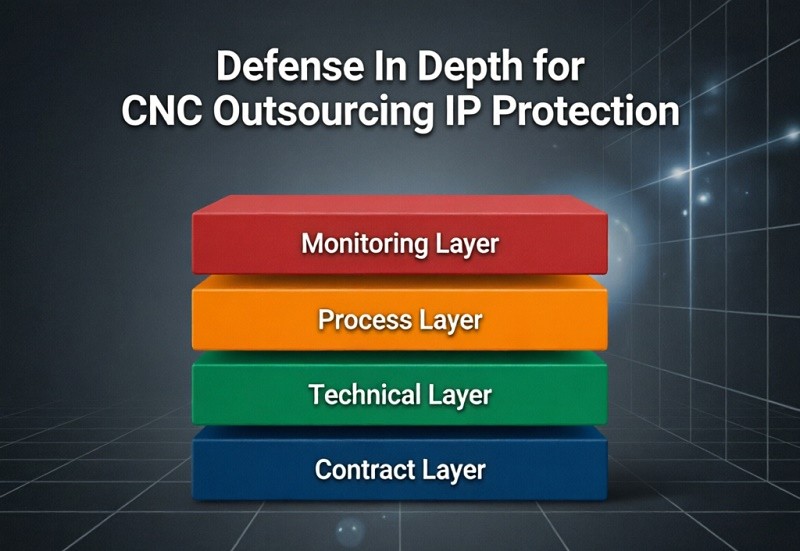
For most buyers, a product design represents years of engineering, testing, and investment - often worth far more than the machined parts themselves. Yet every RFQ requires sharing that design with an external CNC supplier. When that sharing happens without structure, a single leaked drawing can erase a market advantage, trigger imitation, and cost millions. This guide walks through the three pillars of IP protection in CNC outsourcing: the right agreements, disciplined documentation control, and a supply chain engineered to prevent exposure in the first place. Intellectual property (IP) protection in CNC outsourcing is the set of legal, technical, and operational measures that keep your confidential design information - CAD files, engineering drawings, bills of materials, material specifications, and process know-how - from being copied, disclosed, or used without authorization. In an outsourcing relationship, the supplier must see enough of your design to machine it, but ideally nothing more. The stakes are measurable. Industry studies report that 60% of companies that suffer a major IP loss close within six months, that supply-chain partners are linked to about 18% of reported IP leaks, and that the average loss per IP theft incident reaches roughly $3.1 million. Companies that put protection measures in place before manufacturing begins save an average of $2.7 million in potential losses. IP protection is not a legal formality - it is a financial control. Drawings reveal function, materials, and assembly logic. Keeping them confined to authorized personnel keeps competitors from accelerating their own development on your work. Restricted access, watermarks, and need-to-know sharing stop files from being forwarded, reused, or copied beyond the project scope. Properly drafted NDA/NNN agreements with local jurisdiction give you a real path to damages - including punitive damages - if a breach occurs. Clear, professional IP processes signal that you take your designs seriously, which attracts trustworthy suppliers and builds long-term trust. The Non-Disclosure Agreement (NDA) is the most common confidentiality tool in CNC manufacturing. It defines what information is confidential, how it may be used, who may access it, how long the obligation lasts, and what remedies exist if it is breached. Most RFQ-driven custom machining projects use a one-way NDA: you disclose, the supplier protects. When outsourcing to a supplier in China, most IP attorneys recommend upgrading to an NNN agreement - Non-Disclosure, Non-Use, and Non-Circumvention. A standard Western NDA is often difficult to enforce in Chinese courts, whereas an NNN drafted in Chinese and governed by Chinese law, with a China jurisdiction clause, carries real legal weight. The agreement should also state that all IP, tooling, and molds remain your property, with penalty clauses for unauthorized use. Practice notes: Sign the agreement before sending any drawing. A bilingual contract with a controlling Chinese-language version supports enforcement. Typical confidentiality terms run two to three years after the relationship ends. For high-value or safety-critical IP, involve an IP attorney before sharing anything. Legal protection means little if files are handled sloppily. Secure documentation control combines file-level technical measures with disciplined release practices. Modern CAD files carry more than geometry - parametric history, design intent, and manufacturing knowledge are embedded in them. Stripping parametric history and exporting only dumb geometry, as some Fortune 500 aerospace buyers do, lets the supplier machine the part while making reverse-engineering of design intent nearly impossible. Release only what each stage requires. An RFQ can be answered with a 2D PDF overview and envelope; full drawings follow once the NDA is signed; STEP/CAD models, BOMs, and fixture data ship only at the production stage. Each stage should carry watermarks naming the recipient. This keeps design intent out of early quotes and limits the damage any single leak can do. Trust is built on verifiable process, not promises. Before the first drawing goes out, verify that the supplier has a written IP-protection process, is willing to sign your NNN before receiving files, and has no public record of IP complaints. Check certifications, customer references, and project history - a supplier with a reputation to protect has far more to lose from stealing a design than from honoring it. For complex or highly sensitive products, consider splitting production so no single factory sees the complete design: Supplier A machines the housing, Supplier B the internal mechanism, Supplier C handles finishing - with final assembly done in-house or by a trusted partner. This adds supply-chain complexity but removes the single point of IP exposure. Apple's approach to iPhone manufacturing is the best-known example, and the principle scales down to any complex assembly. IP protection is not a one-time activity. Periodic factory audits - announced and unannounced - should check production records for extra runs beyond your order quantity. Watch e-commerce marketplaces for copies of your part or tooling. Register your IP with customs so border agents can block counterfeit goods at the port. Early detection dramatically improves outcomes: trade-secret recovery rates rise from about 15% overall to roughly 38% when a leak is detected within 30 days. Enforcement is genuinely strengthening. China operates a first-to-file system, so patents and trademarks must be registered with CNIPA before designs are shared - a US or EU filing gives no protection there. The revised Anti-Unfair Competition Law, effective October 2025, adds stronger penalties for trade-secret theft, confusion acts, and platform-assisted infringement. The Supreme People's Court's IP Court applied punitive damages in 58 cases worth RMB 2.05 billion combined through 2025 - including a CNC machine-tool trade-secret case ordered to pay roughly RMB 380 million in triple punitive damages. At the same time, the US Trade Representative's 2026 Special 301 Report keeps China on the Priority Watch List, so buyers should plan around both realities: stronger enforcement exists, and vigilance is still required. SOMI Custom Parts treats customer IP as a core part of our quality system. We are happy to review and sign your NDA or NNN agreement before any drawing is exchanged, and our documented IP Protection Policy governs how customer files are stored, accessed, and destroyed. Access to drawings is restricted to the engineers and operators working on your specific order, files are stored on controlled systems, and customer tooling is returned or destroyed at project close. As an ISO 9001:2015-certified precision manufacturer of CNC turned and milled parts, we serve customers across aerospace, medical, automation, and electronics - and we know the trust required to machine a design before its market launch. Learn more about our company or contact us to discuss your project, and send your drawings with confidence for a secure review and quotation. Yes. Professional CNC manufacturers routinely sign NDAs - and, for China-based suppliers, NNN agreements - before receiving customer drawings. Always confirm this before sending files, not after. Yes, when the supplier has proper confidentiality procedures: a signed agreement, restricted document access, secure file storage, and employee confidentiality policies. Send only what each stage requires, and use watermarked, revision-controlled files. An NDA covers non-disclosure. An NNN adds non-use and non-circumvention clauses, and when drafted in Chinese and governed by Chinese law it is typically enforceable in Chinese courts where a standard Western NDA may not be. Most IP attorneys recommend NNN agreements for CNC outsourcing to China. Act quickly: document the infringement, notify the supplier, consult an IP attorney, and consider filing with the relevant court or customs authorities. Detection within 30 days significantly improves recovery rates. Preventive measures - registration, contracts, audits, and market monitoring - remain the strongest defense. Protecting your IP in CNC outsourcing comes down to structure, not luck: the right NDA or NNN agreement signed before any file leaves your desk, disciplined documentation control that shares only what each stage needs, and a supply chain built on vetted suppliers, split production where appropriate, and ongoing monitoring. These measures cost a fraction of what a single leak can cost - in lost market position, recovery costs, and reputation. SOMI Custom Parts is ready to be the partner that treats your designs as carefully as you do. Request a quote today and let your next CNC project run on trust - not just on drawings.Protecting Your IP in CNC Outsourcing: NDAs, Documentation, and Secure Supply Chains
What Is IP Protection in CNC Outsourcing?
Key Benefits of a Structured IP Protection Strategy
Preserves Competitive Advantage
Prevents Unauthorized Disclosure
Enforceable Legal Remedies
Stronger Supplier Partnerships
The NDA and NNN Agreement: Your First Line of Defense
Documentation Control: Sharing CAD Files Without Giving Away the Farm
Technical measures that work
Share files gradually, not all at once
Building a Secure Supply Chain: Vetting, Splitting, and Monitoring
Split manufacturing for high-value designs
Monitor, audit, and enforce
The Enforcement Landscape in 2026
How SOMI Custom Parts Can Help
Frequently Asked Questions
Do CNC suppliers sign NDAs?
Is it safe to send CAD files to a CNC supplier?
What is the difference between an NDA and an NNN agreement?
What should I do if my design is copied?
Conclusion