Mastering Modern Manufacturing: The Ultimate Guide to Custom Metal Shielding Frame Stamping with Automation
In today's hyper-connected world, the reliability of electronic devices is paramount. From mission-critical aerospace systems to the smartphone in your pocket, performance hinges on protecting sensitive components from electromagnetic interference (EMI) and radio frequency interference (RFI). This is where custom metal shielding frames come in—small but mighty components that are crucial for device integrity. However, producing these intricate parts at scale requires more than just traditional metal stamping. It demands a fusion of precision engineering, advanced equipment, and strategic automation. This guide explores the sophisticated process of custom metal shielding frame stamping, detailing how modern technology is enabling manufacturers to meet the ever-increasing demands for precision, miniaturization, and quality.
What Exactly is a Custom Metal Shielding Frame?
A metal shielding frame is a specialized housing, typically stamped from conductive metals, designed to encapsulate and isolate electronic components on a printed circuit board (PCB). Its primary purpose is to act as a Faraday cage, blocking external EMI/RFI from disrupting the component's function and preventing the component itself from emitting interference that could affect other parts of the system. Given the rapid miniaturization of electronics, these frames are often complex, with intricate geometries, thin walls, and tight tolerances—making their manufacture a significant engineering challenge. The need for custom designs arises from the unique layout of every PCB, requiring shielding solutions that are tailored to specific shapes and sizes.
The Critical Role of Shielding in Modern Electronics
The density of electronic components in modern devices creates a noisy electrical environment. Without proper shielding, this "noise" can lead to a host of problems, including data corruption, signal degradation, and complete device failure. Key industries where EMI/RFI shielding is non-negotiable include:
- Telecommunications: Ensuring signal integrity in routers, switches, and 5G infrastructure.
- Automotive: Protecting critical systems like engine control units (ECUs), infotainment systems, and advanced driver-assistance systems (ADAS) from interference.
- Aerospace & Defense: Guaranteeing the reliability of avionics, radar, and communication systems in harsh environments.
- Medical Devices: Shielding sensitive diagnostic and monitoring equipment to ensure patient safety and accuracy.
- Consumer Electronics: Maintaining the performance of smartphones, laptops, and IoT devices.
Effective shielding is a cornerstone of regulatory compliance and product reliability, making the quality of the shielding frame a critical design consideration.
Progressive Die Stamping: The Engine of High-Volume Production
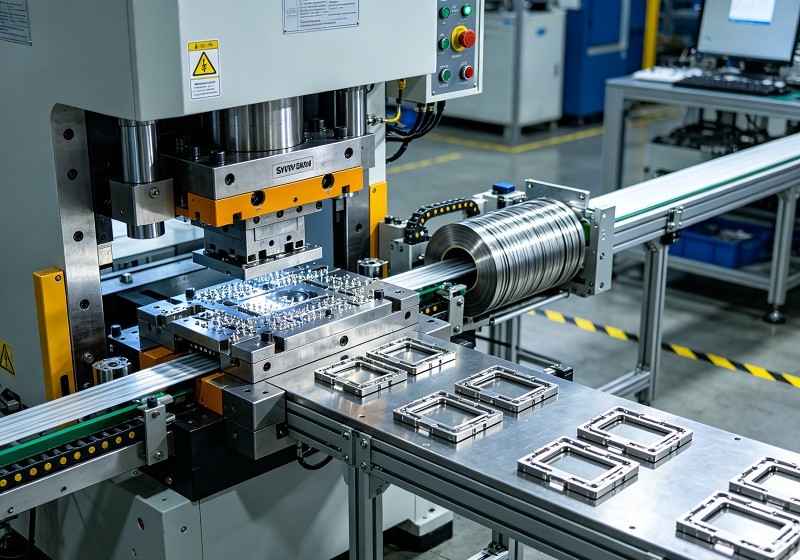
For high-volume production of complex parts like shielding frames, progressive die stamping is the most efficient and cost-effective method. In this process, a coil of flat metal stock is fed through a multi-station die. At each station, the die performs a specific operation—punching, coining, bending, or forming—as the material "progresses" through the tool.
- How it Works for Shielding: A single stroke of the press can perform dozens of operations, gradually forming the flat metal strip into a complex 3D shield. By the final station, the finished part is cut from the strip.
- Key Advantages: This method delivers exceptional speed, consistency, and repeatability, which are essential for producing millions of identical parts with tight tolerances. It eliminates the need for multiple setups and reduces material handling, drastically lowering the cost per part compared to other fabrication methods.
Why Servo Press Technology is a Game-Changer
While progressive dies provide the roadmap for forming the part, the press itself provides the force. Here, advanced servo-driven presses offer significant advantages over traditional mechanical or hydraulic presses, especially for delicate and precise components like shielding frames.
A servo press uses a high-torque servo motor to drive the ram, allowing for complete and programmable control over the slide's position, velocity, and acceleration throughout the stroke. This is a revolutionary leap in precision.
| Feature | Traditional Mechanical Press | Servo Press | Benefit for Shielding Frames |
|---|---|---|---|
| Stroke Control | Fixed sine curve motion | Fully programmable profile | Allows for slower contact to prevent shock, and faster return to increase SPM. |
| Precision | Limited | Micron-level accuracy | Essential for forming thin materials (.003"-.005") and achieving tight tolerances. |
| Dwell Time | None | Programmable dwell at any point | Can be used to set material properly before forming, reducing stress and improving quality. |
| Energy Use | Continuous flywheel motion | Energy consumed only during forming | More energy-efficient and cost-effective operation. |
This precise control minimizes material stress, reduces tool wear, and allows for the creation of more complex geometries that would be impossible with a traditional press. The ability to perform a slow, gentle forming action is particularly crucial for preventing cracks or deformities in the thin walls of a shielding frame.
Leveraging Automation for Unmatched Efficiency and Quality
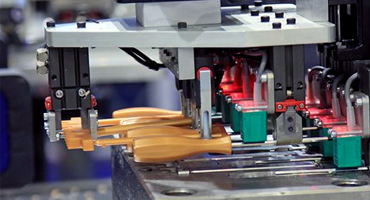
Automation is the thread that ties all elements of modern stamping together. It extends beyond the press to encompass the entire production line, creating a seamless, efficient, and safe manufacturing ecosystem.
Key automation components include:
- Coil Handling and Feeding Systems: Automated uncoilers, straighteners, and feeders ensure that material is fed into the press consistently and accurately, which is the first step to a quality part.
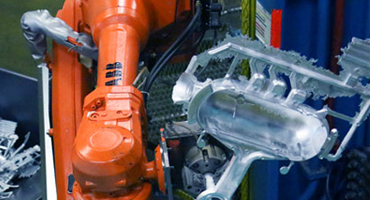
- Robotic Transfer Systems: For processes that require moving parts between presses or stations, robotic arms provide speed, precision, and flexibility that far surpasses manual handling.
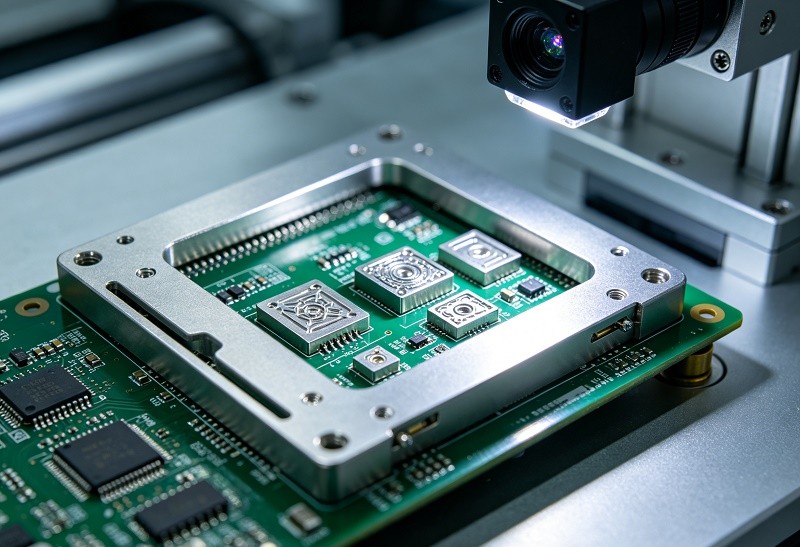
- In-Die Sensing and Vision Systems: Integrated sensors and high-speed cameras can monitor the process in real-time. They can detect a misfeed, verify that a hole has been properly punched, or inspect for quality defects, stopping the press before a major failure or run of bad parts occurs.
- Automated Packaging: At the end of the line, robots can handle the final inspection, sorting, and packaging of finished shielding frames, preparing them for shipment with minimal human intervention.
Real-Time Quality Control: The Path to Zero Defects
For EMI shielding to be effective, consistency is key. Even a small variation in a frame's dimensions can compromise its fit and function. Advanced stamping operations integrate quality control directly into the process. Vision inspection systems embedded within the production line can measure critical dimensions on every single part as it's being made. This 100% inspection model is a stark contrast to traditional batch sampling, ensuring that any deviation is caught and corrected immediately. This proactive approach is fundamental to achieving a zero-defect manufacturing standard, a critical requirement for automotive, medical, and aerospace applications.
Selecting the Right Material for Optimal Shielding
Material choice is crucial for both manufacturability and shielding effectiveness. The material must be formable enough for the stamping process but also have the right conductive properties to block EMI/RFI. Common materials include:
- Tin-Plated Steel: Offers a great balance of cost, formability, and shielding performance. The tin plating provides excellent solderability and corrosion resistance.
- Nickel Silver: An alloy of copper, nickel, and zinc, it provides excellent corrosion resistance and good shielding properties without the need for plating, although it is more expensive.
- Stainless Steel: Used when higher strength or specific environmental resistance is required.
The choice of material often depends on the specific frequency range being shielded, the environmental conditions, and cost targets.
The Importance of Design for Manufacturability (DFM)
Collaboration between product designers and stamping experts from the very beginning is essential. Design for Manufacturability (DFM) is a proactive process where the design of the shielding frame is optimized for the progressive stamping process. Simple adjustments to corner radii, draw depths, and feature placement can have a huge impact on tooling complexity, production speed, and overall cost. A well-executed DFM review can prevent costly tool revisions, reduce material waste, and ensure a more robust and reliable manufacturing process.
The Rise of In-Die Assembly and Secondary Operations
Modern stamping automation doesn't stop when the part is formed. Advanced progressive dies can perform in-die assembly, where other components like plastic insulators or inserts are fed into the tool and integrated with the stamped part. Furthermore, automated cells can perform a wide range of secondary operations post-stamping:
- Tapping or threading holes
- Welding or riveting components
- Applying thermal interface materials
- Automated cleaning and packaging
Integrating these steps creates a streamlined production flow, reducing lead times, minimizing handling damage, and lowering the total cost of the finished assembly.
Choosing the Right Custom Stamping Partner
Given the complexity and capital investment involved, partnering with the right manufacturing expert is critical. When evaluating a potential supplier for custom shielding frames, look for:
- Engineering Expertise: Do they offer DFM support and have experience with complex electronic components?
- Advanced Equipment: Do they invest in modern servo presses and automation technology?
- In-House Tooling: A partner who designs, builds, and maintains their own progressive dies has greater control over quality and lead times.
- Robust Quality Systems: Look for certifications (like IATF 16949 for automotive) and evidence of integrated, real-time quality control.
- Proven Track Record: Ask for case studies and examples of similar complex components they have produced for demanding industries.
The Future: Smarter, Faster, More Integrated Stamping
The future of metal stamping is intelligent. The integration of AI and machine learning will lead to even smarter production lines that can predict maintenance needs, self-optimize for performance, and provide even more granular quality data. As electronics continue to shrink and grow in complexity, the demand for highly advanced, automated, and precise custom metal shielding frames will only increase. By embracing the technologies and principles outlined here, manufacturers can turn a simple piece of metal into a critical component that enables the technology of tomorrow.