Low Volume CNC Machining: The Ultimate Guide to Agile, On-Demand Manufacturing
In today's fast-paced product development landscape, speed, precision, and flexibility are paramount. Manufacturers are increasingly moving away from the rigid constraints of mass production, seeking agile solutions that reduce financial risk and accelerate time-to-market. Low volume CNC machining has emerged as a critical strategy, offering a powerful bridge between initial prototyping and full-scale production. This on-demand manufacturing approach is perfect for producing high-quality, end-use parts in quantities that typically range from 10 to 10,000 units, providing a strategic advantage for businesses of all sizes.
What Exactly is Low Volume CNC Machining?
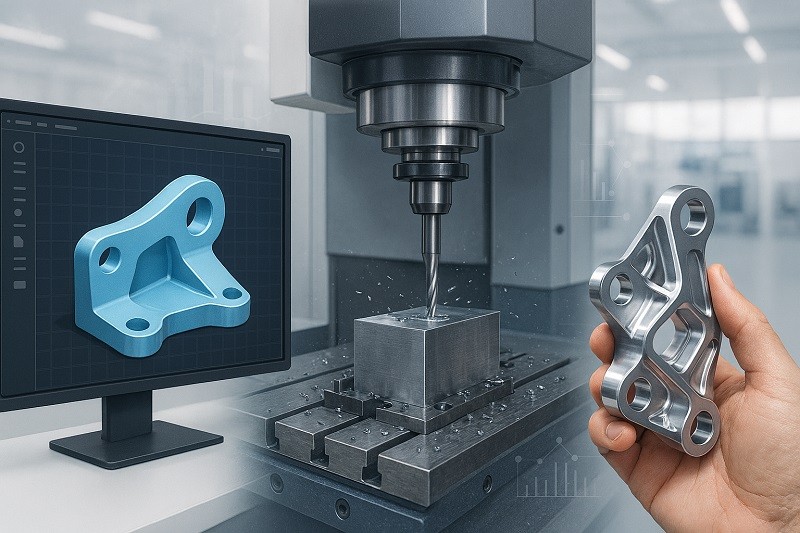
Low volume CNC (Computer Numerical Control) machining is a subtractive manufacturing process that uses computer-guided machines to create precise parts from solid blocks of material in small to moderate quantities. Unlike mass production methods that rely on expensive, permanent tooling (like injection molds), low volume CNC is designed for agility. It's the ideal solution when you need more than a few prototypes but aren't ready to commit to the massive investment of a full production run. This makes it a cost-effective choice for market testing, custom parts, and bridge production.
The Strategic Sweet Spot: Bridging Prototyping and Mass Production
Low volume manufacturing occupies a crucial space in the product lifecycle. After a design is validated with a handful of prototypes (often made via 3D printing or single CNC parts), the next step isn't always a 100,000-unit order. Companies need to test the market, fulfill early orders, and gather user feedback. Low volume CNC machining facilitates this by allowing the production of hundreds or thousands of high-quality, production-grade parts without the long lead times or high costs of traditional tooling. This approach mitigates risk and enables data-driven decisions before scaling up.
Key Advantages of a Low Volume Production Strategy
Opting for small batch CNC production provides a wealth of benefits that align with modern business needs for speed and efficiency.
- Significant Cost Savings on Tooling: Traditional methods like injection molding require upfront tooling costs that can run into tens of thousands of dollars. Low volume CNC machining eliminates this expense, drastically reducing the initial financial barrier.
- Faster Time-to-Market: Without the need to create and validate molds, production can begin almost immediately. This allows companies to get their products into customers' hands faster, gaining a crucial competitive edge.
- Design Flexibility and Iteration: Low volume production enables engineers to make design changes between batches with minimal cost or delay. This iterative approach is perfect for refining products based on real-world performance and market feedback.
- Reduced Inventory and Financial Risk: Manufacturing on-demand means you produce parts as needed, aligning production closely with actual demand. This minimizes the costs and risks associated with warehousing large quantities of unsold inventory.
On-Demand Manufacturing: The Power of Agility
On-demand manufacturing is the core principle behind low volume CNC's success. It provides the flexibility to scale production up or down in response to market demand without the overhead of maintaining your own equipment or staff. Whether fulfilling an emergency order, producing custom parts for a niche market, or launching a limited-edition product, on-demand services offer a streamlined, efficient, and cost-effective solution.
Cost Analysis: When Does Low Volume CNC Make Sense?
Higher per-unit costs are an inherent trait of low-volume production because setup costs are spread across fewer parts. However, the total project cost is often far lower than mass production due to the absence of steep tooling investments. Low volume CNC machining is most cost-effective for quantities that are too large for prototyping but too small to justify the expense of creating molds for injection molding. As production volumes increase into the thousands, the cost per part in CNC machining decreases, but methods like injection molding eventually become more economical at very high volumes.
| Feature | Low Volume CNC Machining | High Volume (e.g., Injection Molding) |
|---|---|---|
| Upfront Tooling Cost | None to very low | Very High |
| Cost Per Unit | Higher (decreases with volume) | Very Low (at scale) |
| Lead Time | Days to a few weeks | Months (for tooling & setup) |
| Design Flexibility | High (easy to change) | Low (expensive to change mold) |
| Ideal Quantity | 10 - 10,000 units | 10,000+ units |
Ideal Applications Across Industries
Low volume CNC machining is not confined to a single sector. Its versatility makes it vital for numerous high-tech industries where precision and customization are critical.
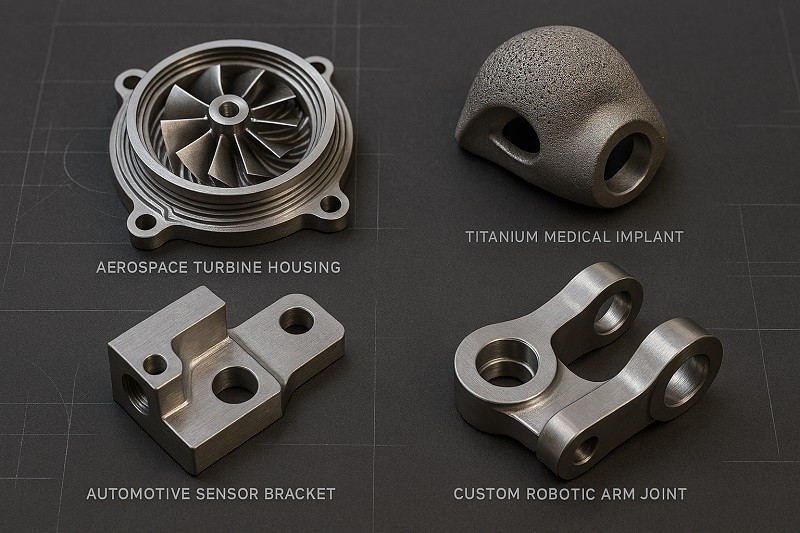
- Aerospace & Defense: For producing specialized components with tight tolerances and complex geometries that don't warrant mass production.
- Medical Devices: Creating custom surgical instruments, orthopedic implants, and housings for diagnostic equipment where precision and biocompatible materials are non-negotiable.
- Automotive: Manufacturing parts for concept cars, performance vehicle upgrades, and prototype testing before committing to full-scale production.
- Robotics & Automation: Building custom brackets, enclosures, and functional components for specialized robotic systems where designs evolve rapidly.
Choosing the Right Materials for Your Project
Material selection is a balance of application requirements, machinability, and cost. CNC machining supports a vast range of production-grade metals and plastics.
- Metals: Aluminum (like 6061 and 7075) is popular for its excellent strength-to-weight ratio and machinability. Stainless steel offers durability and corrosion resistance, while harder metals like titanium are used for high-performance applications.
- Plastics: Materials like ABS, Polycarbonate (PC), PEEK, and Nylon offer a wide array of properties, from high impact strength to chemical resistance. Softer plastics are generally easier and cheaper to machine.
Choosing a cost-effective material that still meets the functional needs of the part is a key strategy for optimizing budget in low volume production.
The Low Volume CNC Process: From CAD to Part
The journey from a digital idea to a physical part follows a clear, efficient workflow:
- CAD Model: It all starts with a 3D Computer-Aided Design (CAD) file, which serves as the digital blueprint for the part.
- CAM Programming: The CAD file is loaded into CAM (Computer-Aided Manufacturing) software, which generates the toolpaths and G-code that will direct the CNC machine.
- Machine Setup: A skilled technician secures the block of raw material (the workpiece) in the machine and loads the appropriate cutting tools.
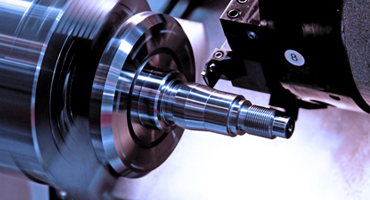
- Machining: The CNC machine executes the program, precisely cutting away material through milling, turning, or drilling to create the final shape.
- Finishing & Inspection: After machining, parts are deburred, cleaned, and inspected for quality. If required, they can undergo secondary processes like anodizing or plating.
Comparing Low Volume CNC to Other Methods
While CNC machining is highly versatile, it's important to know its place alongside other manufacturing processes.
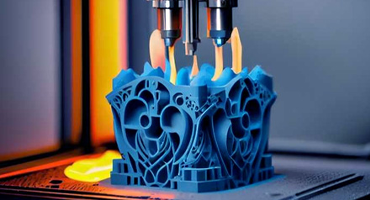
- 3D Printing: Ideal for very early-stage prototypes and highly complex geometries, 3D printing is typically faster for single parts but may lack the material strength and surface finish of a CNC-machined component.
- Injection Molding: Unbeatable for mass-producing plastic parts at a low per-unit cost, but requires a massive upfront investment in tooling, making it unsuitable for low volumes.
- Sheet Metal Fabrication: Efficient for enclosures, brackets, and structural components but is limited to parts formed from metal sheets.
Getting Started with Your First Low Volume Project
To ensure a successful low volume production run, focus on design for manufacturability (DFM). Simple strategies can significantly reduce costs and turnaround times:
- Simplify Geometry: Complex shapes require more machine time.
- Avoid Deep Pockets and Thin Walls: These features are challenging and time-consuming to machine.
- Use Standard Tolerances and Radii: Tighter tolerances increase inspection time and cost. Opt for standard fillets on internal corners.
- Consult Your Manufacturing Partner: Engage with your service provider early. Their expertise can help optimize your design for efficiency and cost-effectiveness.
The Future of Manufacturing Is Agile and On-Demand
Low volume CNC machining is more than just a production method; it's a strategic approach that empowers innovation. By enabling businesses to produce high-quality parts with speed, flexibility, and minimal financial risk, it levels the playing field and accelerates the entire product development cycle. For any company looking to stay competitive in a rapidly changing market, mastering the art of low volume, on-demand manufacturing is no longer an option—it's a necessity.