How to Choose the Right Manufacturer for Your Custom Plastic Injection Molding Parts
It's an exciting journey to bring a product idea to life, and for many innovations, custom plastic injection molding parts are an essential component. Choosing the right manufacturing partner for your custom plastic injection molding parts is a critical decision that can truly make or break your product's success and efficiency. This guide will walk you through the key factors to consider, helping you navigate the options and secure a partner who aligns with your vision for quality, cost, and innovation.
Decoding the Core Benefits of Custom Plastic Injection Molding Parts
Plastic injection molding is a versatile and efficient manufacturing process for producing parts. It has become a cornerstone of modern manufacturing, trusted by industries from automotive and medical to consumer electronics. The process involves injecting molten plastic into a precisely engineered mold under high pressure. This method ensures remarkable accuracy, repeatability, and minimal material waste, which directly contributes to its cost-effectiveness. Understanding the fundamental advantages of this technology is the first step in appreciating why your choice of manufacturer is so critical.
Achieving Precise Design Freedom and Material Optimization
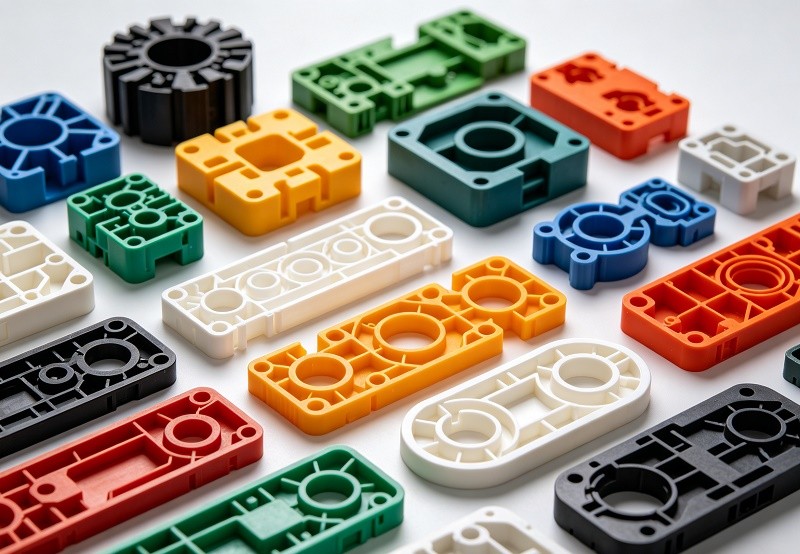
One of the most significant advantages of plastic injection molding is the immense design flexibility it offers. The process is capable of producing highly complex and detailed parts with a level of uniformity that allows for the creation of millions of virtually identical components. Because the molten plastic is forced into the mold under extremely high pressure, it presses firmly against every surface, allowing for the creation of intricate features and complex geometries that would be difficult or prohibitively expensive to produce with other methods.
This design freedom extends to advanced techniques that can integrate multiple functions into a single piece:
- Insert Molding: This technique involves placing a non-plastic component, such as a metal threaded insert or an electronic sensor, into the mold before injecting the plastic. The molten resin then flows around the insert, creating a single, integrated part.
- Overmolding: Often used to improve ergonomics or aesthetics, overmolding involves molding a layer of a second plastic (frequently a soft-touch material like TPE) over an existing molded part. This is common on tool handles and toothbrush grips.
- Complex Internal and External Features: The process allows for the design of parts with features like support ribs, bosses for mounting, and living hinges, which can reduce the need for secondary assembly operations.
Equally important is the vast selection of materials available. There are over 25,000 engineered materials available for injection molding applications, ranging from common commodity resins to high-performance engineering-grade polymers. This allows for precise material optimization based on the part's end-use requirements. A manufacturer can help select materials for:
- Mechanical Strength: Using fillers can increase the strength of a part while reducing the density of the plastic. Engineering-grade resins can be selected to withstand extreme temperatures, friction, and corrosion.
- Thermal Resistance: For applications in high-heat environments, such as automotive or industrial settings, materials like PEEK, PPS, or glass-filled polycarbonates (PC-GF) can be chosen for their high heat deflection temperature (HDT).
- Chemical Compatibility: When parts will be exposed to chemicals or harsh cleaning agents, specific polymers can be selected for their resistance, a critical factor in medical devices and food-grade containers.
- Aesthetics: Plastic injection molding offers excellent control over color and surface finish. Masterbatch colorants can be added to the raw material for consistent color throughout the part, and the mold surface itself can be polished or textured to create a variety of finishes, from high gloss to matte.
Maximizing Scalability and Cost-Efficiency for Your Product Line
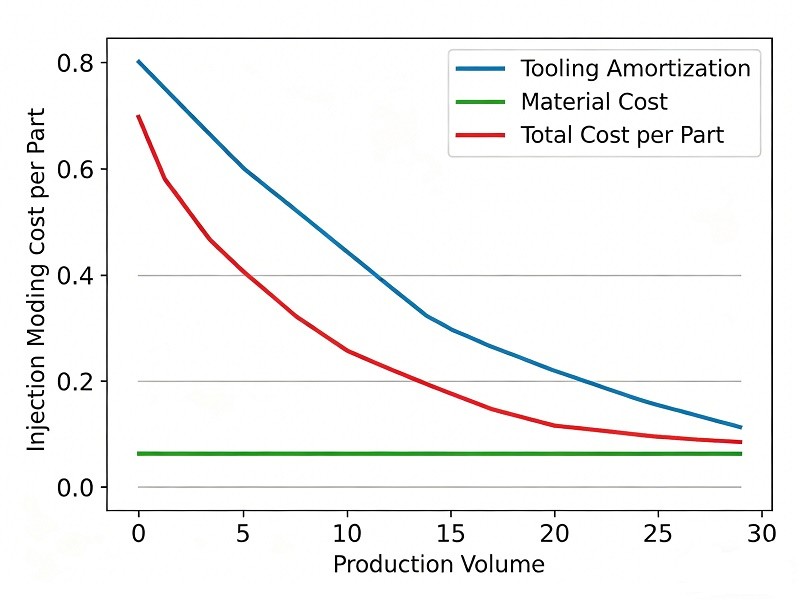
While the initial investment in creating a high-quality mold can be significant, plastic injection molding is exceptionally cost-effective for medium to high-volume production runs. Once the mold is created and the process is dialed in, parts can be produced at an incredibly high rate with cycle times as short as 10 to 30 seconds. This efficiency leads to a dramatic reduction in the cost-per-part as production volume increases.
The primary reasons for this cost-efficiency include:
- High-Speed, Automated Production: Modern injection molding machines are highly automated, often running 24/7 with minimal operator supervision. This reduces labor costs significantly compared to other manufacturing processes.
- Economies of Scale: The high initial tooling cost is spread across a large number of parts. As production scales up, the per-unit cost drops significantly, making it ideal for mass production.
- Minimal Waste: Injection molding is a very low-waste process. Any scrap material, such as the runners that channel plastic to the mold cavities, can often be reground, melted, and reused, which optimizes material usage and reduces costs.
- Repeatability and Consistency: The process produces highly consistent and repeatable parts, which minimizes the costs associated with defects, rejects, and rework. A well-made steel production mold can last for over 100,000 cycles, ensuring uniformity across massive production runs.
To illustrate the principle of economies of scale, consider the following table which shows how the cost-per-part changes with increasing production volume.
| Production Volume | Tooling Cost Amortization per Part | Material & Production Cost per Part | Total Cost Per Part |
|---|---|---|---|
| 1,000 Parts | $10.00 | $1.50 | $11.50 |
| 10,000 Parts | $1.00 | $1.20 | $2.20 |
| 100,000 Parts | $0.10 | $1.00 | $1.10 |
| 1,000,000 Parts | $0.01 | $0.90 | $0.91 |
(Note: The costs above are for illustrative purposes and based on a hypothetical $10,000 tooling cost.)
This scalability is a critical advantage for businesses planning to grow. It allows a company to meet surging market demand quickly and efficiently without sacrificing the quality and consistency that customers expect.
Navigating Manufacturer Capabilities for Your Custom Plastic Injection Molding Parts
Not all injection molders are created equal. When your product's success hinges on the quality and performance of its plastic components, you need a partner whose capabilities align perfectly with your project's demands. This involves looking beyond a simple price quote and delving into the manufacturer's technical expertise, their investment in technology, their production capacity, and their communication practices. A top-tier manufacturer offers more than just machines; they bring process knowledge and design insight to the table.
The Critical Role of Experience, Expertise, and Advanced Technology
A manufacturer's experience and deep-seated expertise are invaluable assets. Look for a partner with a proven track record across multiple industries and materials. Companies that serve diverse markets, such as medical, automotive, and electronics, often possess a broader range of creative solutions and are more financially stable. Their experience with various regulatory requirements, material specifications, and quality standards can be a significant advantage.
A key indicator of a manufacturer's expertise is their adoption of Scientific Molding. This isn't just a buzzword; it's a data-driven methodology for developing a highly stable, repeatable, and optimized injection molding process. Unlike traditional molding, which can involve a lot of trial and error, scientific molding treats the process like a science. It decouples the process into distinct stages—filling, packing, and cooling—and uses in-mold sensors to collect real-time data on pressure, temperature, and flow rate. This data-centric approach results in:
- Improved Part Quality: By minimizing variations from shot to shot, scientific molding ensures higher precision and consistency.
- Reduced Waste: The process is optimized to reduce scrap and defects, leading to significant cost savings.
- Greater Efficiency: It can lead to faster cycle times and less downtime for troubleshooting.
- Process Portability: A scientifically documented process can be easily transferred to other qualified machines, ensuring consistent production.
Equally important is a manufacturer's investment in Advanced Technology. The industry is constantly evolving, and a forward-thinking partner will leverage innovations to enhance efficiency, precision, and sustainability. Some technologies to look for include:
- Automation and Robotics: Automated systems for material handling, part removal, and secondary operations reduce cycle times, minimize human error, and increase overall productivity. Collaborative robots (cobots) can work alongside human operators on intricate tasks like assembly and inspection.
- Advanced Mold Technology: Innovations like Direct Metal Laser Sintering (DMLS), a form of 3D printing for metal, allow for the creation of molds with highly complex geometries, including conformal cooling channels. These channels follow the contour of the part, providing much more efficient and uniform cooling, which can drastically reduce cycle times and improve part quality.
- Process Control Software: Modern injection molding machines are equipped with sophisticated software that allows for real-time monitoring and adjustment of process parameters. Systems like iMFLUX operate at a low, constant pressure, which can save energy and enable the use of a wider range of materials, including higher percentages of recycled content.
- Simulation Software: Mold-flow simulation has revolutionized the design phase. By creating virtual prototypes, engineers can predict how plastic will fill the mold, identify potential problem areas like weld lines or air traps, and optimize the part and mold design before any steel is cut.
Capacity, Communication, and the "Melt Quality" Factor
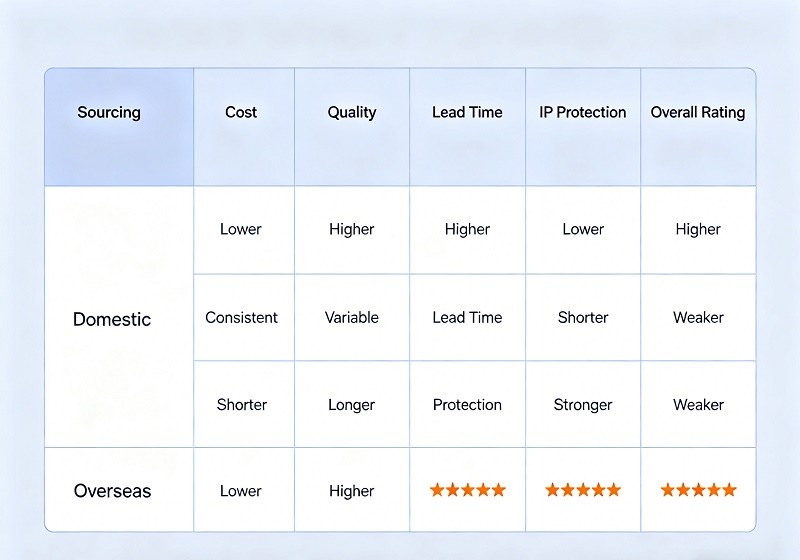
A manufacturer’s practical capabilities are just as crucial as their technical expertise. You must ensure they have the bandwidth to meet your production needs, both now and in the future.
Production Capacity and Scalability: Evaluate the manufacturer's operational capacity. This isn't just about the number of machines they have; it's about the right fit for your project. Key questions to ask include:
- What is the range of your machine clamp forces (tonnage)? Your part size and mold dimensions must be a good fit for their equipment to ensure efficient and stable production.
- What is your shot size capacity? This determines the maximum amount of plastic that can be injected in a single cycle and should be appropriately matched to your part's weight.
- Can you handle our projected production volume, from prototypes to high-volume runs?
- Do you have the infrastructure and labor force to scale production up or down to meet fluctuating market demand? Your ideal partner should be able to support your growth.
Communication is Key: The interaction between you and your manufacturing partner is a highly iterative process that is fraught with opportunities for delay and misinterpretation. Clear, consistent, and proactive communication is the bedrock of a successful partnership and is critical for keeping projects on schedule and within budget. Inefficient communication can lead to project failure, even with a perfect design. Look for a partner who:
- Establishes clear points of contact and provides regular project updates.
- Asks clarifying questions early in the process rather than making assumptions. For complex parts, a manufacturer should act as a "material application" expert, not just a "drawing follower," by seeking to understand the part's end-use and potential failure modes.
- Uses modern communication tools and is responsive, respecting time zones for global projects.
- Has a collaborative approach, working with you to optimize part design for manufacturability (DFM) to prevent costly issues down the line.
The "Melt Quality" Factor: At the heart of injection molding is the transformation of solid plastic pellets into a homogeneous molten fluid—the "melt." The quality of this melt is a critical, yet often overlooked, factor that directly influences part quality. Melt quality refers to the consistency of the molten plastic's temperature and viscosity before it is injected into the mold.
- Why it Matters: An inconsistent melt can lead to a host of problems. If the temperature is too low, the plastic may be too viscous to fill the mold completely, resulting in short shots. If it's too high, the material can degrade, compromising its mechanical properties and appearance. Variations in viscosity lead to inconsistent packing of the mold, causing dimensional instability, warpage, and shrinkage variations.
- Achieving Good Melt Quality: The quality of the melt is determined by several factors within the injection molding machine, including the barrel temperatures, the design of the screw, the screw's rotation speed (RPM), and the back pressure applied during screw recovery. A knowledgeable manufacturer precisely controls these parameters to ensure the material is melted uniformly without being subjected to excessive shear or thermal degradation. The temperature must be high enough to melt the granules but not so high that it damages the plastic.
Ultimately, a manufacturer who demonstrates a deep understanding of these core competencies—from adopting scientific principles and advanced technology to managing capacity and ensuring melt quality—is one you can trust to turn your vision into a high-quality, reliable product.
Upholding Quality Standards and Certifications for Your Custom Plastic Injection Molding Parts
In the world of manufacturing, particularly for industries where precision and reliability are non-negotiable, quality is paramount. A manufacturer's commitment to upholding rigorous quality standards is a direct reflection of their professionalism and their ability to be a trusted partner. This commitment is most clearly demonstrated through their quality management systems, industry-specific certifications, and a comprehensive quality control process.
The Assurance of Industry-Specific Certifications and Rigorous Quality Control
Industry certifications are more than just pieces of paper; they are proof that a manufacturer has undergone rigorous independent audits and has demonstrated a commitment to excellence, consistency, and continuous improvement. When evaluating a potential partner, their certifications should be a key part of your decision-making process.
Here are some of the most important certifications to look for:
ISO 9001:2015: This is the internationally recognized standard for a Quality Management System (QMS). It serves as a foundational certification, indicating that a company has well-documented processes for everything from material handling and mold maintenance to process control and customer satisfaction. An ISO 9001 certified molder operates on a framework of risk-based thinking, evidence-based decisions, and continuous improvement.
IATF 16949:2016: This is the non-negotiable global quality standard for the automotive industry. Built upon ISO 9001, it includes additional, more stringent requirements focused on defect prevention, process efficiency, and the reduction of variation and waste throughout the supply chain. For any company supplying parts to Tier 1 or Tier 2 automotive manufacturers, this certification is a prerequisite.
ISO 13485:2016: This certification is specific to the medical device industry. It outlines the QMS requirements for organizations involved in the design, production, and servicing of medical devices. ISO 13485 compliance ensures strict process validation (IQ/OQ/PQ), complete lot traceability for materials and processes, risk management, and manufacturing in controlled environments like cleanrooms, which are critical for patient safety.
Beyond certifications, a manufacturer's internal Quality Control (QC) process provides insight into their daily commitment to excellence. A robust QC strategy is a multi-stage approach:
- Material Inspection: It starts with verifying that all incoming raw materials meet the required specifications and are free from contamination.
- First Article Inspection (FAI): Before full production begins, the first parts produced from a new or modified mold are meticulously inspected against all dimensional and cosmetic specifications to ensure the process is correct.
- In-Process Control: During production, key process parameters like temperature, pressure, and cycle time are continuously monitored using Statistical Process Control (SPC) to detect any deviations in real-time. This allows for immediate corrections before a large number of defective parts can be made.
- Final Inspection: The last line of defense is a final inspection of finished products before they are shipped. This can involve visual checks, dimensional measurements using tools like Coordinate Measuring Machines (CMMs), and functional testing to ensure every part meets the customer's standards.
Domestic vs. Overseas Sourcing: Balancing Cost, Quality, and Ethics
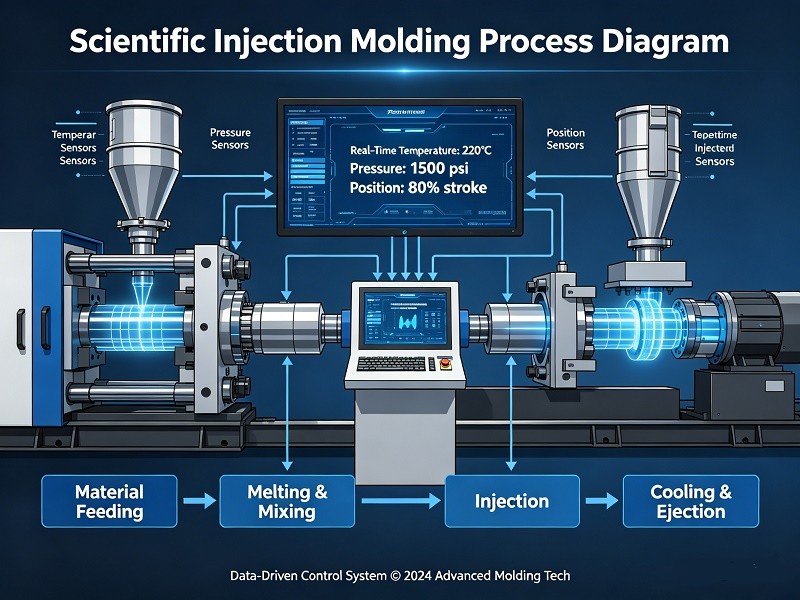
The decision of whether to source your custom plastic parts domestically (onshoring) or from an overseas manufacturer is a critical strategic choice with significant implications for cost, quality, logistics, and intellectual property (IP) protection. While lower labor costs have historically driven companies to offshore production, a shift is occurring as businesses re-evaluate the total cost and risk involved.
Here is a comparison to help you weigh the options:
| Aspect | Domestic (U.S.) Sourcing | Overseas Sourcing (e.g., China) |
|---|---|---|
| Cost | Higher initial labor and tooling costs. However, lower shipping costs, no tariffs, and potentially lower total cost of ownership (TCO) when all factors are considered. | Lower upfront labor and tooling costs are major draws. However, costs can be driven up by tariffs, high shipping fees, and unexpected expenses from quality issues or delays. |
| Quality Control | Easier to oversee production and ensure high quality. Stringent U.S. regulatory standards and quicker response to quality issues. Face-to-face visits are simple. | Quality control can be challenging due to distance and communication barriers. There's a risk of "quality fade," where quality is gradually reduced to cut costs. |
| Lead Times & Logistics | Significantly faster lead times and simplified logistics. Enables quicker responses to market changes and agile inventory management. | Long and unpredictable lead times due to ocean freight and customs clearance. Vulnerable to global supply chain disruptions. |
| Communication | Real-time, clear communication is straightforward, with no language or major time zone barriers. This greatly simplifies collaboration and problem-solving. | Communication can be challenging due to language differences, cultural nuances, and significant time zone gaps, often leading to misunderstandings and delays. |
| Intellectual Property (IP) Protection | Strong legal frameworks provide robust protection for your designs, molds, and technology. | IP theft is a significant risk. Legal recourse for IP infringement is often difficult, time-consuming, and expensive. Your molds can be copied or held "hostage." |
| Ethical & Environmental Standards | Adherence to strict labor laws and environmental regulations. "Made in America" can enhance brand reputation. Lower carbon footprint due to reduced transportation. | A less regulated environment can pose risks related to labor practices and environmental standards. |
For decades, the lure of lower piece-part prices made overseas manufacturing seem like the obvious choice. However, many businesses are now "reshoring" their production to domestic suppliers. They've found that the hidden costs of offshoring—including IP theft, quality-related recalls, tariffs, and supply chain disruptions—can quickly erase any initial savings. Choosing a U.S.-based manufacturer often provides greater security, more reliable supply chains, and a stronger partnership built on clear communication and shared quality standards.
Strategic Cost Management and Sustainable Practices for Custom Plastic Injection Molding Parts
Selecting a manufacturing partner goes beyond technical capabilities and quality assurance; it also involves smart financial planning and a commitment to responsible, long-term practices. A truly strategic partnership requires a holistic view of costs and an increasing focus on environmental sustainability, which can provide both economic and brand-related benefits.
Mastering Total Cost of Ownership (TCO) for Custom Plastic Injection Molding Parts
When evaluating quotes from different manufacturers, it's a common mistake to focus solely on the initial tooling price and the per-part cost. While these figures are important, they don't tell the whole story. A smarter approach is to analyze the Total Cost of Ownership (TCO), which is the cumulative cost of producing a part over its entire lifecycle.
TCO encompasses all direct and indirect expenses, providing a much more accurate picture of the true financial impact of your sourcing decision. Many companies that offshore production discover they have underestimated their costs by 20% or more because they failed to account for the full range of TCO factors. The equation for TCO is more than just tooling + parts; it includes:
TCO = Tooling Cost + (Part Cost × Volume) + Maintenance + Downtime + Scrap/Reject Costs + Logistics (Shipping & Tariffs) + IP Risk
Here are the key hidden costs to consider that are captured by a TCO analysis:
- Mold Maintenance and Repairs: A lower-cost mold may be made from softer steel or have a less robust design, leading to more frequent maintenance and unexpected repairs. A high-quality mold, while more expensive upfront, pays for itself over time through a longer production life, minimized downtime, and fewer costly repairs.
- High Scrap Rates: Defects in production aren't just wasted plastic; they represent lost time, labor, and energy. A poorly designed mold or an unstable process can lead to high scrap rates, significantly increasing the effective cost per good part.
- Inefficient Cycle Times: A cheaper tool may not be optimized for efficient cooling or ejection, leading to longer cycle times. Even a few extra seconds per part can add up to substantial cost increases over a high-volume production run.
- Secondary Operations: If a part is not designed for manufacturability, it may require additional labor for assembly, finishing, or other post-production processes that add to the total cost.
- Logistics and Supply Chain Costs: For overseas manufacturing, you must factor in shipping, tariffs, customs fees, and the cost of carrying larger inventories to buffer against long lead times.
- Intellectual Property Risk: The financial impact of a stolen design or counterfeit products can be catastrophic and is a major risk associated with some overseas manufacturing regions.
By evaluating suppliers based on TCO, you shift the focus from short-term savings to long-term value, leading to more reliable production and stronger overall margins.
Integrating Sustainability into Your Custom Plastic Injection Molding Parts Supply Chain
Sustainability is no longer a niche concern but a core component of modern, responsible manufacturing. As consumers and regulators demand more eco-friendly products, partnering with a manufacturer that prioritizes sustainable practices is not only good for the planet but also a smart business decision that can enhance your brand reputation and provide a competitive advantage.
Key strategies for sustainable injection molding include:
Sustainable Material Selection: One of the most impactful strategies is the choice of materials. This can involve:
- Recycled Plastics: Using post-consumer recycled (PCR) or post-industrial recycled (PIR) materials reduces the demand for virgin plastics, conserves resources, and lowers the carbon footprint. While there can be challenges with consistency and material degradation, many manufacturers successfully use blends of virgin and recycled content to balance performance and sustainability.
- Bio-based Plastics: These polymers are made from renewable resources like corn starch, sugarcane, or cellulose instead of fossil fuels. Materials like Polylactic Acid (PLA) and Polyhydroxyalkanoates (PHA) reduce reliance on petroleum and can have lower greenhouse gas emissions during production.
- Biodegradable Plastics: These materials are designed to decompose naturally under specific conditions (like industrial composting), reducing long-term waste in landfills.
Improving Energy Efficiency: Injection molding is an energy-intensive process, but modern manufacturers can significantly reduce their consumption by:
- Upgrading to all-electric injection molding machines, which are more energy-efficient than older hydraulic models.
- Optimizing processes to reduce cycle times and implementing smart monitoring systems to prevent energy waste.
- Utilizing renewable energy sources like solar or wind power to run their facilities.
Reducing Material Waste: A core principle of sustainable manufacturing is minimizing waste. This is achieved through:
- Lean Manufacturing: Implementing principles that focus on efficiency and eliminating wasteful steps in the production process.
- Optimized Mold Design: Using technologies like hot runner systems and conformal cooling to reduce the amount of scrap plastic (from runners and sprues) generated with each shot.
- Closed-Loop Recycling: Establishing systems where scrap plastic is immediately reground and reintroduced into the production process, minimizing what goes to landfill.
Choosing a manufacturer that has integrated these sustainable practices demonstrates a forward-thinking approach that aligns with the growing expectations of consumers and regulators. It signals a commitment not just to making your parts, but to making them responsibly.
Conclusion
Ultimately, selecting the right manufacturer for your custom plastic injection molding parts is a strategic decision that extends far beyond just the initial cost. It’s about finding a true partner. By carefully evaluating factors like expertise, technology, quality controls, capacity, and commitment to sustainability, you can secure a manufacturing partner who will truly transform your product vision into a high-quality reality. My advice is to seek a partner who not only understands your technical specifications but also aligns with your long-term business goals, ensuring the consistent delivery of exceptional custom plastic injection molding parts. Don't be afraid to ask the tough questions and dig deeper than the surface of a price quote. The success of your product depends on it.
What has been your biggest challenge when selecting a manufacturing partner? Share your experiences or questions in the comments below