


How to Choose the Best 3D Printing SLA Parts Supplier for Custom Projects
Are you embarking on a custom project that demands meticulously crafted 3D printed components? You've come to the right place. I'm here to guide you through the process of selecting the ideal supplier for your 3D Printing SLA parts. Stereolithography (SLA) 3D printing is renowned for its ability to produce parts with incredible detail, smooth surface finishes, and high accuracy. However, the success of your complex designs hinges on choosing the right manufacturing partner. A mismatched supplier can lead to delays, budget overruns, and components that fail to meet your quality standards.
The marketplace for 3D printing services is vast and varied, making it challenging to identify a provider that truly aligns with your needs. This guide will serve as your comprehensive roadmap. We will walk through the essential steps, from defining your project's technical specifications to evaluating a supplier's capabilities and finalizing your partnership. By following these structured recommendations, you can confidently navigate the selection process and secure a reliable partner for your specific requirements.
Let's begin the journey to find the best 3D Printing SLA Parts Supplier that will not only meet but exceed your expectations, transforming your innovative ideas into high-quality, tangible realities.
Pinpointing Your Project Requirements for a 3D Printing SLA Parts Supplier
Before you can even begin to search for a supplier, you must first achieve a crystal-clear understanding of your own project. A detailed and well-documented set of requirements is the foundation of a successful manufacturing partnership. It allows potential suppliers to provide accurate quotes, foresee potential challenges, and ultimately deliver parts that align perfectly with your vision. Without this crucial first step, you risk miscommunication, wasted resources, and unsatisfactory results. This initial phase is about introspection and documentation, ensuring you can articulate exactly what you need to achieve.
Defining Materials, Accuracy, and Production Volume
The three pillars of any 3D printing project specification are material, accuracy, and volume. Defining these elements with precision is non-negotiable.
Materials: SLA technology utilizes a variety of photopolymer resins, each with unique properties. Your choice will depend entirely on the application of the final part. Do you need a standard resin for a visual prototype, a tough or durable resin for functional testing, a flexible resin to simulate rubber-like materials, or a high-temperature resin for parts exposed to heat? A supplier’s material data sheets are a critical resource for comparing properties like tensile strength, heat deflection temperature (HDT), and elongation at break. Clearly specifying the desired material, or at least the required mechanical and thermal properties, is essential.
Accuracy and Tolerances: SLA is known for its high precision, but "high precision" is a relative term. You must define the specific dimensional tolerances your project requires. Tolerances are the acceptable limits of variation in a part's dimensions. For example, you might specify a general tolerance of ±0.1mm for features under 100mm. This is influenced by the supplier's machine calibration, the material used, and the part's geometry. Clearly communicate critical dimensions and their required tolerances on your CAD drawings to ensure the supplier focuses on what matters most.
Production Volume: Are you creating a single, one-off prototype for a design review, a small batch of 10-50 units for functional testing, or moving into low-volume production of several hundred or thousand parts? The required volume significantly impacts the supplier's suitability. Some suppliers specialize in rapid prototyping with quick turnarounds on single parts, while others are optimized for scalable production and can offer better per-part pricing on larger quantities. Your production volume will dictate the type of partner you should seek, whether it's a small boutique shop or a larger manufacturing service.
| Aspect | Considerations for Your Project | Why It Matters to a Supplier |
|---|---|---|
| Material | Mechanical strength, flexibility, thermal resistance, biocompatibility, color, clarity. | Determines which resins and machines are suitable. Affects print time and cost. |
| Accuracy | Critical dimensions, acceptable deviations (e.g., ±0.05mm), surface finish requirements. | Informs machine choice, print orientation, and post-processing needs. Manages quality expectations. |
| Volume | One-off prototype, small batch (1-100), low-volume production (100-1000+). | Dictates quoting structure, production scheduling, and suitability for scalable manufacturing. |
The Importance of Clear Project Specifications
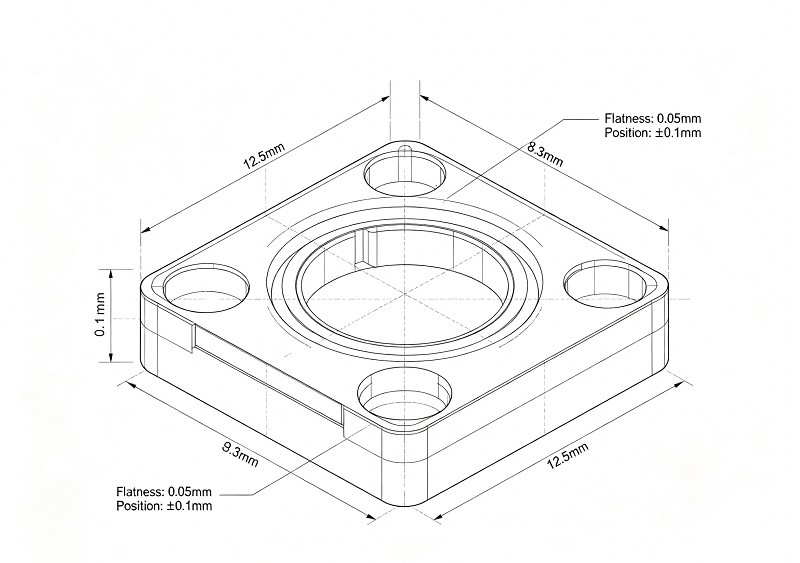
A comprehensive project specification document, often part of a Request for Quotation (RFQ), is your primary tool for communicating with potential suppliers. This document should leave no room for ambiguity. The more detailed it is, the more accurate your quotes will be, and the smoother the production process will run. Vague requests lead to endless back-and-forth emails, incorrect quotes, and potentially flawed parts. A clear RFQ demonstrates professionalism and helps suppliers quickly assess if they are a good fit for your project.
Your specification document should serve as a single source of truth for the project. At a minimum, it must include:
- 3D CAD Files: Provide files in a standard format like .STL, .STEP, or .OBJ. Ensure your models are watertight (manifold) and free of errors.
- Technical Drawings: For projects with critical tolerances, a 2D drawing that calls out specific dimensions, tolerances, and surface finish requirements is invaluable.
- Material Specification: Name the specific resin type (e.g., "Standard Clear Resin," "Tough 2000 Resin") or list the required performance characteristics.
- Quantity and Batch Size: Specify the total number of parts needed and if they should be delivered in separate batches.
- Post-Processing & Finishing: Detail any required secondary operations, such as support removal level, sanding, painting (with color codes), vapor smoothing, or assembly.
- Inspection and Quality Requirements: Mention if you require a certificate of conformance, first article inspection (FAI) reports, or specific measurement data.
- Desired Lead Time: Communicate your project timeline and deadline to ensure the supplier can meet your schedule.
By investing time upfront to create a thorough project brief, you streamline the entire procurement process and lay the groundwork for a successful partnership.
What Capabilities to Seek in a Reliable Supplier
Once your own requirements are clearly defined, you can begin evaluating suppliers based on the capabilities they offer. A top-tier 3D Printing SLA Parts Supplier is more than just a print farm; they are a manufacturing partner that adds value throughout the production lifecycle. Look for a supplier that demonstrates a wide range of technical capabilities and a commitment to quality.
Key capabilities to look for include:
- Design for Additive Manufacturing (DFAM) Support: The best suppliers have engineers on staff who can review your design and offer suggestions for optimization. This could involve modifying geometry to improve printability, reducing material usage, or orienting the part to achieve the best surface finish and accuracy, ultimately lowering costs and improving part performance.
- Diverse Material Inventory: A reliable supplier should offer a broad portfolio of SLA resins from different manufacturers. This indicates they understand various application needs and aren't locked into a single material ecosystem. They should be able to provide detailed material data sheets for everything they stock.
- Advanced Printing Technology: Ask about their fleet of SLA machines. Are they using modern, well-maintained equipment from reputable brands? The quality of the machinery directly impacts the quality of the final parts. A supplier invested in high-end technology is more likely to be invested in high-end results.
- Comprehensive Post-Processing Services: Raw SLA parts require several post-processing steps. A supplier that offers a full suite of in-house finishing services—from basic support removal and curing to advanced painting, texturing, and assembly—can act as a one-stop-shop, saving you time and ensuring consistency.
- Scalable Production Infrastructure: Assess their ability to scale. Do they have the capacity—both in terms of machines and personnel—to handle your project if it moves from prototyping to low-volume production? A supplier with scalable infrastructure can grow with your needs, ensuring a long-term partnership.
Choosing a supplier with these capabilities ensures you are not just buying a part, but gaining a partner with the expertise to help make your project a success.
Key Evaluation Criteria for a Top 3D Printing SLA Parts Supplier
With your project requirements defined, you can now move on to the critical evaluation phase. Choosing the right supplier is a multi-faceted decision that goes far beyond the initial price quote. A cheap supplier that delivers poor quality or misses deadlines will cost you more in the long run. To ensure a successful and lasting partnership, you must conduct a thorough assessment of potential suppliers against a set of key criteria that reflect quality, reliability, and overall value. This due diligence is essential for mitigating risk and building confidence in your chosen partner.
Quality Standards, Certifications, and Material Expertise
Quality is paramount in manufacturing. A top-tier supplier will have a robust quality management system (QMS) in place, often validated by third-party certifications. Look for suppliers who hold certifications like ISO 9001, which demonstrates a commitment to consistent processes, continuous improvement, and customer satisfaction. While not always mandatory for every project, an ISO 9001 certification is a strong indicator of a mature and reliable operation.
Beyond general quality systems, their material expertise is a critical differentiator. An expert supplier won't just ask you what material you want; they will engage in a conversation about your part's application. They should be able to discuss the nuances between different resin types and recommend the optimal material based on your specific needs for strength, temperature resistance, or flexibility. Their ability to provide detailed technical data sheets and even suggest alternative materials for better performance or cost-effectiveness is a sign of a true partner.
Understanding Resin Types and Properties
The heart of SLA technology is its diverse range of photopolymer resins. A deep understanding of these materials is crucial for making the right choice for your custom project. A knowledgeable supplier will guide you through this, but it's important for you to have a foundational understanding as well. Resins are not one-size-fits-all; they are engineered with specific characteristics to meet different application demands.
Here is a breakdown of common SLA resin categories and their typical applications to help you in your discussions with suppliers:
| Resin Category | Key Properties | Common Applications |
|---|---|---|
| Standard Resins | High detail, smooth surface, moderate strength, brittle. | Visual prototypes, concept models, non-functional parts. |
| Tough / Durable Resins | High impact strength, shatter-resistant, simulates ABS plastic. | Functional prototypes, jigs, fixtures, snap-fit enclosures. |
| Flexible / Elastic Resins | Rubber-like feel, high elongation, good tear resistance, simulates TPU/silicone. | Gaskets, seals, soft-touch grips, wearables, anatomical models. |
| High-Temperature Resins | High Heat Deflection Temp (HDT), high stiffness, resists deformation under heat. | Molds for short-run injection molding, hot air/fluid flow fixtures, heat-resistant components. |
| Castable Resins | Burns out cleanly with no ash, extremely high detail. Used for investment casting. | Jewelry patterns, dental applications, metal part prototyping. |
| Medical / Biocompatible Resins | Certified for skin contact or other medical classifications (e.g., Class I or II). | Surgical guides, medical devices, patient-specific models. |
When evaluating a supplier, ask about the range of resins they offer and their experience with each. A supplier with deep expertise can help you avoid costly mistakes, like choosing a brittle standard resin for a part that needs to withstand impact.
Assessing Surface Finish and Post-Processing
One of the primary reasons for choosing SLA is its superior surface finish. However, the "out-of-the-printer" finish is only the beginning. Post-processing is a critical stage that transforms a raw print into a finished product. A supplier's skill and capabilities in this area will have a massive impact on the final look, feel, and function of your parts.
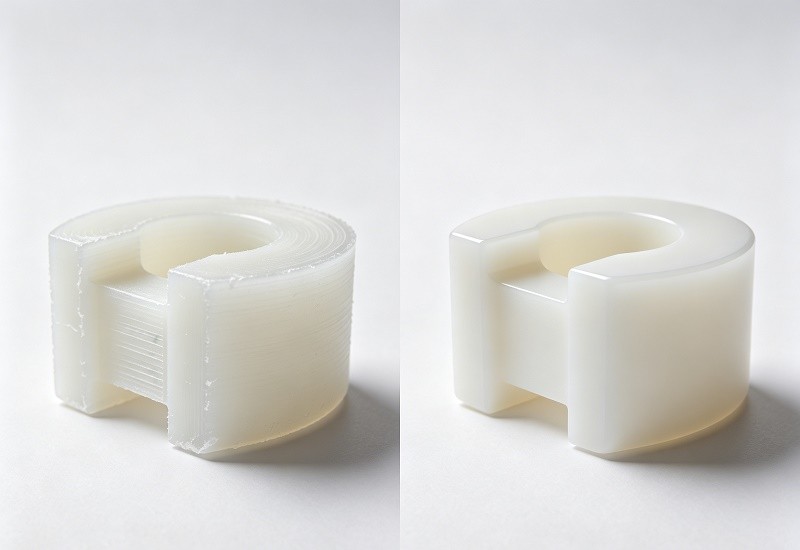
A raw SLA part will have small nubs where support structures were attached and may have visible layer lines, albeit very fine ones. Your assessment should focus on the supplier's ability to refine this raw state to meet your specifications. Key post-processing steps include:
- Support Removal: How cleanly are supports removed? Are the contact points carefully sanded to be flush with the part surface, or are they left rough?
- UV Curing: All SLA parts require post-curing in a UV chamber to achieve their final material properties. Ensure the supplier has a repeatable, controlled curing process.
- Sanding and Polishing: For parts requiring an exceptionally smooth, glass-like finish, sanding and polishing are necessary. A skilled technician can sand through progressively finer grits to eliminate all layer lines.
- Bead or Vapor Blasting: These methods can create a uniform matte finish across the entire part surface, which is often desirable for aesthetic and functional components.
- Painting and Coating: A full-service supplier can offer painting (including color matching to Pantone or RAL standards), clear coating (matte or gloss), and even EMI/RFI shielding for electronic housings.
Request to see samples of their different finish levels. This is the best way to gauge the quality of their workmanship and understand exactly what you will receive.
Production Capacity and Lead Time Efficiency
For any project with a deadline, time is money. A supplier's ability to deliver high-quality parts on schedule is a crucial evaluation criterion. You need to assess both their production capacity and their typical lead times.
- Production Capacity: This is determined by the number of machines they operate, their hours of operation (some run 24/7), and the efficiency of their workflow. A supplier with a large fleet of SLA printers is better equipped to handle urgent requests and larger volume orders without creating a bottleneck. They are also more resilient; if one machine goes down for maintenance, they have others to pick up the slack, minimizing delays.
- Lead Time Efficiency: Ask for their standard lead time for a project of your scope. Many online services offer instant quotes with estimated lead times, which is a good baseline. However, for complex projects, it's worth having a direct conversation. A truly efficient supplier will have a streamlined digital workflow, from quote generation and file processing to production scheduling and shipping. Be wary of suppliers who are consistently unable to provide clear lead time estimates. Also, inquire about expedited service options and their associated costs if speed is your top priority.
Robust Quality Control and Part Traceability
A supplier's promise of quality is meaningless without a robust Quality Control (QC) process to back it up. A comprehensive QC plan should encompass every stage of production. When vetting a supplier, ask them to describe their quality procedures.
A thorough QC process in an SLA printing service includes:
- Incoming Material Inspection: Verifying that each batch of resin is from a trusted source, is not expired, and meets specifications.
- Pre-Production Check: A technical review of your CAD file to identify any potential issues that could affect quality before the print begins.
- In-Process Monitoring: Regular calibration of machines and monitoring of the printing environment (e.g., temperature) to ensure consistency.
- Post-Print Inspection: All parts should undergo a final inspection. For standard parts, this may be a visual check and measurement of critical features with digital calipers. For high-precision projects, this could involve using advanced metrology equipment like 3D scanners or Coordinate Measuring Machines (CMMs) to generate a detailed inspection report comparing the final part to the original CAD data.
Part Traceability is another hallmark of a mature supplier. This is the ability to track a part through the entire production process, from the specific batch of resin used to the machine it was printed on and the technician who performed the post-processing. For industries like medical, aerospace, and automotive, this is often a strict requirement. A supplier with a good traceability system can quickly investigate any issues and ensure accountability and consistency across batches.
Effective Communication and Customer Support
Technical capabilities are only one part of the equation. The "human" element—communication and customer support—is equally important, especially for custom projects. A project can be easily derailed by poor communication, unresponsiveness, or a lack of access to technical experts.
Evaluate a potential supplier on the following communication-related factors:
- Responsiveness: How quickly do they respond to your initial RFQ and subsequent questions? A prompt and professional response is a good sign.
- Clarity and Transparency: Is their communication clear, concise, and honest? They should be upfront about potential challenges, limitations, and any necessary design adjustments.
- Access to Expertise: Can you speak directly with an engineer or a technical project manager who understands the nuances of SLA printing? Or are you firewalled by a generic customer service representative? Direct access to technical staff is invaluable for resolving issues quickly.
- Proactive Updates: A great partner will keep you informed about the status of your project, from order confirmation to production commencement and shipping, without you having to constantly ask for updates.
The quality of customer support often reflects the overall culture of the company. A supplier who invests in excellent, knowledgeable support is likely a supplier who cares about the success of their customers' projects.
Transparent Pricing and Cost-Effectiveness
While cost should not be the only factor, it is undeniably an important one. The goal is to find a supplier that offers the best overall value, not just the lowest price. To do this, you need to understand their pricing structure and look for transparency.
The cost of an SLA part is typically influenced by several factors:
- Material Volume: The amount of resin required to build the part and its support structures.
- Machine Time: The total time the printer is occupied, which is affected by the part's volume and height (Z-axis).
- Labor: The manual labor involved in setup, post-processing (sanding, painting, etc.), and quality inspection.
A trustworthy supplier will provide a detailed, itemized quote that breaks down these costs where possible. Be cautious of quotes that are just a single number with no explanation. This can hide inefficiencies or allow for unexpected upcharges later.
When comparing quotes from different suppliers, ensure you are comparing "apples to apples." Does one quote include a higher level of surface finish or a more detailed inspection report? The cheapest quote may be for a part with a raw finish that will require you to do additional work, ultimately costing more in time and effort. Seek cost-effectiveness, which is the optimal balance of quality, reliability, and price.
Finalizing Your Selection of a 3D Printing SLA Parts Supplier
After thoroughly evaluating potential suppliers against the key criteria, you should have a shortlist of one or two promising candidates. The final step is to make your decision and formalize the partnership. This stage involves tangible verification and setting clear expectations to ensure a smooth and successful collaboration from the very first order. Rushing this final phase can undermine all the careful research you've done. Taking these last few steps with diligence will solidify your choice and lay the groundwork for a strong, long-term manufacturing relationship.
Requesting Samples and Prototypes for Review
Reading about quality and seeing pictures is one thing; holding a physical part in your hands is another. Before committing to a large or critical order, it is absolutely essential to request a sample part or a prototype of your own design. This is the ultimate test of a supplier's capabilities and is a non-negotiable step in the vetting process.
When you receive the sample, evaluate it methodically:
- Dimensional Accuracy: Use digital calipers or more advanced measurement tools to check critical dimensions against your CAD file. Does the part meet the tolerances you specified?
- Surface Finish: Examine the part's surface under good lighting. Are the layer lines as fine as you expected? How well have the support marks been removed and blended? If you requested a specific finish (e.g., matte or gloss), does it meet your aesthetic standards?
- Feature Detail: Scrutinize small features, sharp edges, and intricate details. SLA is known for its high resolution, and the sample part should reflect this. Are the details crisp and well-defined?
- Material Integrity: Assess the feel and properties of the material. Does it match the datasheet? For functional parts, you might perform some informal stress tests to check for brittleness or other undesirable characteristics.
Ordering a small, inexpensive part that is representative of the complexity of your larger project is often the most effective approach. The quality of this test piece is a direct reflection of the quality you can expect on all future orders.
Examining Testimonials and Past Project Successes
Social proof is a powerful indicator of a supplier's reliability and reputation. Go beyond the curated testimonials on their own website and look for independent reviews and case studies that demonstrate their track record.
- Case Studies: The most valuable form of social proof is a detailed case study. Look for case studies that are relevant to your industry (e.g., medical, automotive, consumer electronics) or application (e.g., functional prototyping, master patterns for casting). A well-written case study will describe the customer's initial problem, the supplier's proposed solution, and the final outcome, often with quantitative results like "reduced lead time by 50%" or "cut costs by 30%."
- Independent Reviews: Check third-party platforms like Google Reviews, industry forums, or manufacturing network portals. These reviews can provide candid feedback about the customer experience, communication, and overall quality. Pay attention to both positive and negative reviews. A single bad review isn't a dealbreaker, but a pattern of complaints about missed deadlines or poor quality is a major red flag.
- Client References: For a significant, long-term partnership, don't hesitate to ask the supplier for client references. Speaking directly with a current or past customer can provide invaluable, firsthand insights into what it’s like to work with the supplier day-to-day. Prepare a few specific questions to ask the reference about communication, quality, and their overall satisfaction.
Establishing Clear Agreements and Expectations
Once you are confident in your choice, the final step is to formalize the relationship and establish crystal-clear expectations. This prevents future misunderstandings and ensures both parties are aligned on the terms of the engagement. This is typically done through a formal agreement or a detailed purchase order.
Your agreement should clearly define:
- Scope of Work: A reference to the specific parts to be produced, including quantities and technical specifications.
- Quality Standards: Explicitly state the agreed-upon quality requirements, such as acceptable finish levels, dimensional tolerances, and any required inspection documentation (e.g., Certificate of Conformance).
- Lead Times and Delivery: Confirm the production lead time and the expected delivery date. Specify shipping terms and responsibilities.
- Pricing and Payment Terms: Lock in the final pricing, including any taxes or shipping costs. The payment schedule (e.g., 50% upfront, 50% on delivery; Net 30) should be clearly stated.
- Intellectual Property (IP) Protection: Especially for sensitive projects, it may be wise to have a Non-Disclosure Agreement (NDA) in place to protect your design files and proprietary information. Ensure the supplier has a clear policy on IP security.
- Process for Handling Issues: Establish a clear procedure for handling non-conforming parts. What is the process for rejection, rework, or replacement? A professional supplier will have a straightforward and fair process for resolving these issues.
By establishing these terms in writing, you create a framework for accountability and a shared understanding of success, setting the stage for a productive and trusting partnership.
Choosing the right partner for your 3D Printing SLA parts is a critical business decision that will significantly impact your project's quality, budget, and timeline. It's a process that requires diligence, technical understanding, and a clear vision of your own requirements. As we've explored, the selection journey goes far beyond simply finding the lowest price; it's about identifying a true manufacturing partner who brings expertise, reliability, and quality to the table.
By diligently following the steps outlined in this guide—from meticulously defining your project needs to rigorously evaluating suppliers on their technical capabilities, quality systems, and communication—you can arm yourself with the confidence to make an informed choice. Investing your time in this crucial due diligence, including reviewing sample parts and formalizing agreements, is an investment in the success of your project. It helps mitigate risks and builds a foundation for a strong, long-term partnership.
This careful approach will enable you to find a reliable supplier who not only meets your specifications but also helps you innovate and bring your custom projects to life with exceptional quality. If you are ready to partner with an expert supplier who embodies these principles of quality, expertise, and customer focus, we encourage you to start the conversation. For a team that is committed to turning your complex designs into reality, Contact SOMI today. We invite you to share this guide with colleagues who might find it valuable and to continue the discussion on achieving excellence in additive manufacturing.