Guide to the Best CNC Custom Parts Service for Beginners
As a beginner exploring the world of manufacturing, understanding CNC custom parts services can seem daunting. I'm here to guide you through the essentials of choosing the right service, what to expect, and how to make the most of this versatile technology for your projects.
CNC machining is a core manufacturing process that creates precise parts from various materials. Learning about the best CNC custom parts service for beginners will equip you with the knowledge to bring your designs to life, whether for a hobby or a burgeoning business.
Demystifying CNC Custom Parts Service: What It Is and Why It Matters for Beginners
Venturing into manufacturing can be complex, but CNC (Computer Numerical Control) machining is a technology that has revolutionized how we create everything from simple brackets to complex aerospace components. For a beginner, understanding what a CNC custom parts service offers is the first step toward turning a digital idea into a physical reality. It’s a bridge between your design and a tangible, high-quality product.
The Fundamentals of CNC Machining
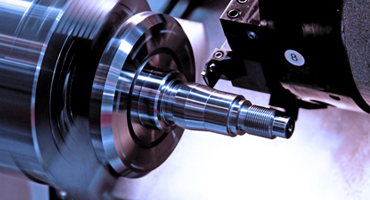
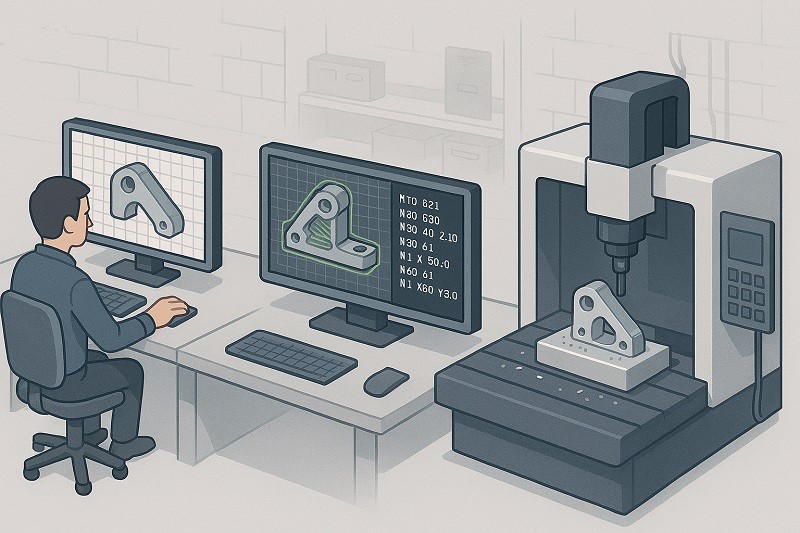
At its core, CNC machining is a subtractive manufacturing process. This means it starts with a solid block of material (a workpiece) and systematically removes material from it using computer-controlled cutting tools to create a final part. Think of it like a highly precise, automated sculptor. The entire operation is directed by pre-programmed computer software, which ensures incredible accuracy and repeatability that would be impossible to achieve by hand.
The process generally follows these key steps:
- Computer-Aided Design (CAD): First, a 2D or 3D model of the part is created using CAD software. This digital file is the blueprint, containing every dimension, curve, and feature of the final product.
- Computer-Aided Manufacturing (CAM): The CAD file is then processed by CAM software. This software converts the design into a set of instructions, called G-code, that the CNC machine can understand. The G-code dictates the exact movements of the cutting tools, the speed of the cuts, and the rotation of the workpiece.
- Machine Execution: The G-code is loaded into the CNC machine. After setting up the workpiece and the appropriate cutting tools, the machine executes the program, automatically cutting and shaping the material to match the design specifications.
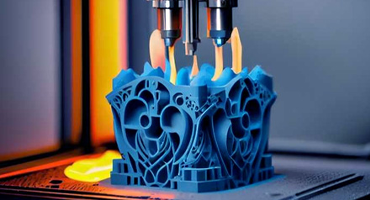
Unlike additive manufacturing (like 3D printing), which builds objects layer by layer, CNC machining's subtractive nature allows for parts made from solid blocks of metal or plastic, often resulting in superior strength and surface finish.
The Benefits of Using a CNC Custom Parts Service
For beginners, hobbyists, and even small businesses, investing in CNC machinery can be prohibitively expensive and requires significant expertise. This is where a CNC custom parts service becomes invaluable. Partnering with a service provider offers numerous advantages:
- Precision and Repeatability: CNC machines are known for their ability to produce parts with extremely tight tolerances. This means every copy of a part will be virtually identical to the last, which is critical for components that need to fit together perfectly.
- Speed and Efficiency: Once programmed, a CNC machine can run with minimal supervision, producing parts much faster than manual methods. This translates to quicker turnaround times for your projects, from initial prototypes to small-batch production runs.
- Material Versatility: Custom CNC services offer a vast library of materials to choose from. Whether you need the lightweight strength of aluminum, the durability of stainless steel, or the specific properties of an engineered plastic, a service provider will have the right option available.
- Cost-Effectiveness for Prototyping and Low-Volume Production: While setting up a CNC job has initial costs, it is often more economical for producing high-quality prototypes and small batches compared to other manufacturing methods like injection molding, which requires expensive custom molds.
- Access to Expertise: Reputable services employ experienced machinists and engineers who can provide feedback on your design to optimize it for manufacturing. This guidance, known as Design for Manufacturability (DFM), can save you time, reduce costs, and result in a better final product.
Understanding Material Options for Your CNC Custom Parts Service Needs
The material you choose has a massive impact on your part's functionality, durability, appearance, and cost. A good CNC custom parts service will offer a wide array of options and provide guidance on the best choice for your application.
Here is a breakdown of common materials used in CNC machining:
| Material Category | Examples | Key Properties | Common Applications |
|---|---|---|---|
| Metals | Aluminum (e.g., 6061, 7075), Stainless Steel (e.g., 303, 304, 316L), Brass, Copper, Titanium | High strength, durability, thermal conductivity, corrosion resistance. | Prototypes, automotive parts, aerospace components, medical devices, consumer electronics. |
| Plastics | ABS, Polycarbonate (PC), Nylon (PA), Acrylic (PMMA), Delrin (POM) | Lightweight, good electrical insulation, chemical resistance, varying levels of flexibility and strength. | Enclosures, jigs and fixtures, consumer products, living hinges, gears and bearings. |
| Wood | Hardwoods (e.g., Oak, Maple), Softwoods (e.g., Pine), Plywood | Aesthetically pleasing, easy to machine, varying densities and grain patterns. | Custom furniture, decorative items, prototypes, architectural models. |
| Foam | High-Density Urethane (HDU), Polystyrene | Very lightweight, easy to shape, excellent for creating large, non-structural forms. | Molds for composites, visual prototypes, architectural and art installations. |
When selecting a material, consider factors like its mechanical strength, resistance to heat or chemicals, weight, and, of course, budget. Discussing your project's requirements with your chosen CNC service provider will ensure you select the perfect material for the job.
Navigating the Landscape: How to Choose the Best CNC Custom Parts Service Partner
Selecting the right partner is as crucial as the design of your part itself. A great CNC service provider acts as more than just a vendor; they become an extension of your team, offering guidance and ensuring your vision is realized to the highest standard. For a beginner, knowing what to look for can make all the difference between a successful project and a frustrating experience.
Expertise and Experience: The Cornerstone of a Reliable CNC Custom Parts Service
A service's track record is a strong indicator of its capabilities. Look beyond the marketing slogans and dig into their actual experience.
- Industry Specialization: Does the company have a portfolio of projects similar to yours? A shop that specializes in aerospace components will have a different skill set and level of precision than one that primarily makes custom wood furniture. Find a partner whose experience aligns with your industry, whether it's automotive, medical, consumer electronics, or robotics.
- Case Studies and Galleries: Reputable services are proud of their work. They should have a gallery or a collection of case studies on their website showcasing the complexity, quality, and variety of parts they have produced. This is tangible proof of their capabilities.
- Years in Business: While not the only factor, a long-established business often indicates stability and a history of satisfied customers. It suggests they have weathered industry changes and have a deep understanding of the manufacturing process.
Equipment and Capabilities: What Your Ideal CNC Custom Parts Service Should Offer
The machinery a shop uses directly impacts the quality, complexity, and cost of your parts. A well-equipped partner can offer a wider range of solutions and produce more intricate designs.
- Types of CNC Machines: The most common machines are mills and lathes. However, the complexity they can handle is determined by the number of axes they operate on.
- 3-Axis CNC Machines: These machines move the cutting tool along the X, Y, and Z axes. They are perfect for simpler parts with features that can be accessed from the top.
- 5-Axis CNC Machines: These add two rotational axes, allowing the cutting tool to approach the workpiece from multiple directions in a single setup. This is essential for creating complex curves and geometries without needing to manually re-fixture the part, which improves accuracy and efficiency.
- Range of Services: A top-tier service will offer more than just basic milling. Look for capabilities like CNC turning (for cylindrical parts), Electrical Discharge Machining (EDM) (for intricate shapes in hard metals), and surface grinding (for ultra-flat surfaces).
- Technology and Maintenance: Modern, well-maintained equipment is a sign of a commitment to quality. Ask about the brands of machines they use and their maintenance schedule. State-of-the-art machinery often leads to better precision, faster cycle times, and a superior surface finish.
Quality Control and Certifications: Ensuring Excellence in Your CNC Custom Parts
How does a service guarantee that the part you receive matches your CAD model perfectly? The answer lies in a robust quality control process. For beginners, this is a critical area, as it provides assurance that your investment will yield a functional, high-quality product.
- Documented Quality Management System (QMS): A serious manufacturing partner will have a formal QMS in place. This system governs every step of their process, from initial quote to final inspection, to ensure consistency and quality.
- Certifications: Industry certifications are a third-party validation of a company's commitment to quality. The most recognized standard is ISO 9001, which signifies that the service has a well-defined and consistently followed quality control process. Other industry-specific certifications, like AS9100 for aerospace, are also strong indicators of high standards.
- Inspection Equipment: Ask what tools they use for inspection. At a minimum, they should use calibrated digital calipers and micrometers. For high-precision work, advanced equipment like a Coordinate Measuring Machine (CMM) is essential. A CMM uses a probe to measure the geometry of a part with incredible accuracy, generating a detailed report that can be compared directly to your original CAD file.
Communication and Project Management: Building a Strong Relationship with Your CNC Custom Parts Service
Excellent technical skills are useless if a company is difficult to work with. Clear, consistent, and proactive communication is the foundation of a successful partnership, especially for beginners who will likely have many questions.
- Dedicated Point of Contact: You shouldn't be passed around between different departments. A good service will assign you a dedicated project manager or engineer who understands your project and can answer your questions from start to finish.
- Transparent Quoting Process: The quote you receive should be detailed and easy to understand. It should break down costs related to materials, machine time, setup fees, and any secondary finishing operations. Be wary of quotes that are vague or leave room for surprise charges.
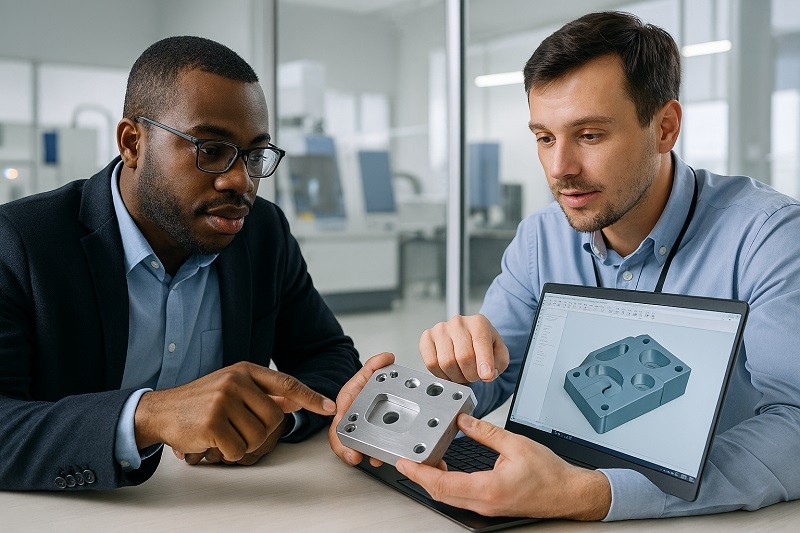
- Design for Manufacturability (DFM) Feedback: The best partners don't just blindly machine whatever file you send them. They will review your design and provide DFM feedback, suggesting small changes that could reduce machining time, lower costs, or improve the part's strength and functionality. This collaborative approach is a hallmark of a top-tier service.
From Concept to Creation: The Process of Getting Your CNC Custom Parts Made
Understanding the journey your part takes from a digital file to a physical object can help you make better design decisions and manage your project effectively. This process is a collaboration between you (the designer) and the CNC service provider (the manufacturer). As a beginner, familiarizing yourself with these steps will demystify the process and empower you to navigate it with confidence.
Designing for Manufacturability: Optimizing Your Project for CNC Custom Parts Service
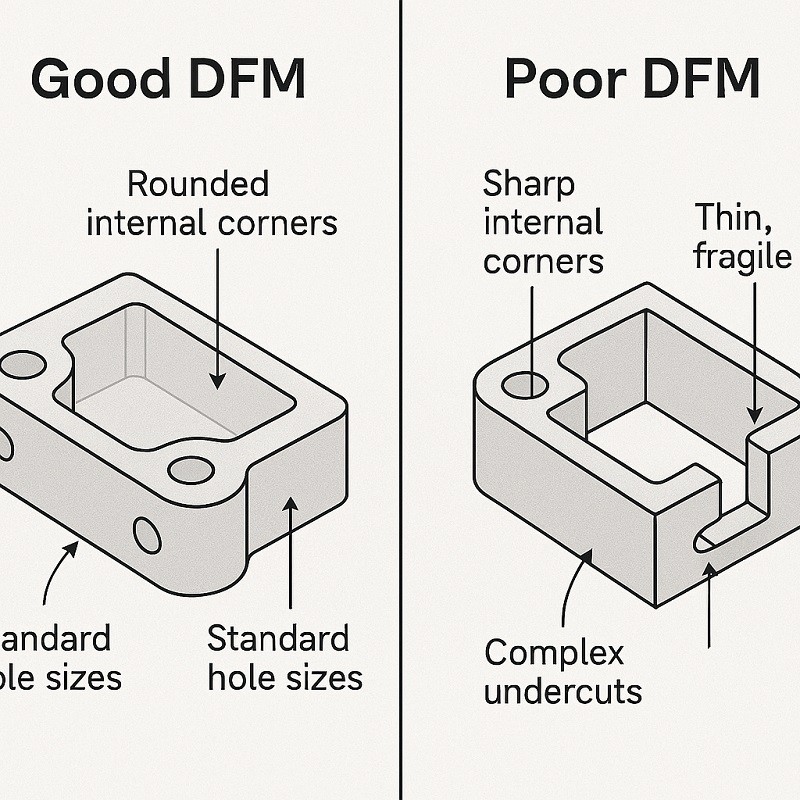
The most common mistake beginners make is designing a part that is difficult or unnecessarily expensive to machine. Design for Manufacturability (DFM) is the practice of designing parts in a way that makes them as easy and cost-effective to produce as possible, without compromising their function. A good CNC service will often provide DFM feedback, but incorporating these principles into your initial design will streamline the entire process.
Here are some key DFM tips for CNC machining:
- Simplify Internal Corners: CNC cutting tools are round, which means they cannot create perfectly sharp internal corners. They will always leave a radius. Designing your part with rounded internal corners (fillets) that are slightly larger than the cutting tool's radius will prevent the need for special, time-consuming operations.
- Avoid Thin Walls: Walls that are too thin can be prone to vibrating or warping during machining, leading to inaccuracies or even part failure. As a general rule, try to keep wall thicknesses for plastics above 1.5mm and for metals above 1mm.
- Use Standard Tool Sizes: Design holes and radii that correspond to standard drill bit and end mill sizes. If your design requires a custom-sized hole, the shop may need to use a more complex and expensive process to create it.
- Limit Complex Geometries: While 5-axis CNC machines can create incredibly complex shapes, these features add significant cost. If a simpler geometry can achieve the same function, opt for that. The more machine setups and special tools your part requires, the higher the price will be.
The Key Steps in CNC Milling for Custom Parts
CNC milling is one of the most common types of CNC machining, using a rotating multi-point cutting tool to remove material from the workpiece. While the specifics can vary, the general workflow remains consistent.
- CAD Model & Quote: The process starts when you submit your 3D CAD file to the CNC custom parts service for a quote. At this stage, you will specify the material, quantity, desired surface finish, and any special tolerances.
- CAM Programming (Toolpath Generation): Once you approve the quote, a machinist or programmer uses CAM software to generate the toolpaths for the machine. This involves selecting the right cutting tools, setting the cutting speeds and feed rates, and creating the G-code that will guide the machine.
- Machine Setup: A skilled operator then prepares the CNC mill. This includes securely fastening the workpiece to the machine's bed (a process called workholding), loading the correct cutting tools into the machine's tool changer, and calibrating the machine to ensure the starting point is accurate.
- Machining: The operator starts the G-code program. The CNC mill executes the commands, moving the cutting tool and/or the workpiece to precisely remove material. Coolant is often flooded over the cutting area to prevent overheating and to clear away chips.
- Post-Processing and Finishing: After the primary machining is complete, the part is removed from the machine. It may require several post-processing steps:
- Deburring: Removing small, sharp pieces of material (burrs) left on the edges of the part.
- Tumbling: Smoothing and polishing parts by placing them in a tumbler with abrasive media.
- Anodizing or Plating: Applying a surface coating to improve corrosion resistance or for cosmetic purposes.
- Assembly: If the final product consists of multiple machined parts, they are assembled.
- Quality Inspection: The finished part undergoes a final inspection to ensure all dimensions and features are within the specified tolerances before it is packaged and shipped to you.
Understanding Lead Times and Cost Factors in CNC Custom Parts Service
"How long will it take?" and "How much will it cost?" are two of the most important questions for any project. For CNC custom parts, the answers depend on a combination of factors.
Key Cost Drivers:
- Machining Time: The longer it takes to machine a part, the more it will cost. This is directly influenced by the part's complexity and size.
- Material: The raw material cost can vary dramatically. Common aluminum alloys are relatively inexpensive, while high-performance materials like titanium or PEEK are significantly more expensive.
- Part Complexity: A part that can be made on a 3-axis machine in a single setup will be much cheaper than a part with complex curves and undercuts that requires a 5-axis machine and multiple setups.
- Tolerances: Standard tolerances are included in the base price. If your design requires extremely tight tolerances, this will necessitate more careful programming, slower machining speeds, and more rigorous inspection, all of which add to the cost.
- Quantity: There is a setup cost for every job. Spreading that setup cost over a larger number of parts will reduce the per-part cost.
- Finishing: Secondary operations like anodizing, painting, or laser engraving will add to the final cost.
Factors Affecting Lead Time:
- Programming and Setup: Complex parts require more time for programming and machine setup.
- Machine Availability: The service provider's current workload and machine availability will influence how quickly they can start your job.
- Machining Time: As with cost, the actual time spent cutting the part is a major component of the lead time.
- Finishing and Inspection: Any required post-processing and quality control steps will add to the overall timeline.
By understanding these factors, you can make informed trade-offs in your design to balance functionality with your budget and timeline.
Beyond the Basics: Exploring Different Types of CNC Machines and Their Impact on Custom Parts Service
While CNC milling is a versatile workhorse, the world of Computer Numerical Control is vast and includes a variety of specialized machines. Each type offers unique capabilities that make it better suited for certain materials, applications, and levels of detail. As you grow beyond basic projects, understanding these different technologies will open up new possibilities for your custom parts.
CNC Routers: Versatile Tools for Various Custom Parts
A CNC router is similar in principle to a CNC mill, but it is typically built with a gantry-style frame where the head moves over a large, stationary table. This design makes them ideal for cutting large sheets of softer materials.
- How They Work: A router uses a high-speed rotating spindle to cut, carve, and shape materials. They excel at 2.5D cutting, which involves moving in the X and Y axes and then plunging to different depths along the Z-axis.
- Common Materials: CNC routers are the go-to machines for wood, plywood, MDF, plastics (like acrylic and PVC), and foam. Some more powerful models can also handle light-duty machining of soft metals like aluminum.
- Applications: Their ability to work with large sheets makes them perfect for creating signage, custom cabinetry, furniture, boat hulls, and large-scale artistic carvings. For a beginner looking to work with wood or plastics on a larger scale, a CNC router service is an excellent choice.
Fiber Laser Engravers for Custom Jewelry and Metal Parts
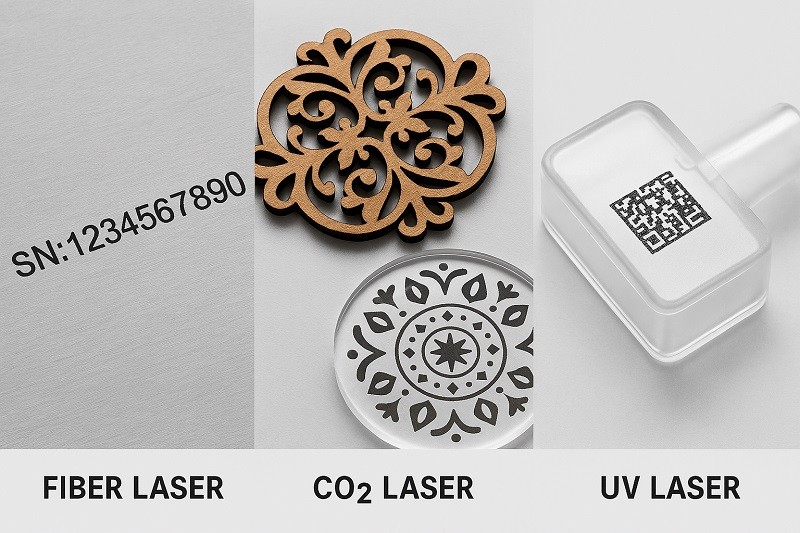
When your project demands a high level of detail, especially on metal, a fiber laser engraver is an incredibly powerful tool. Unlike CNC machines that use physical cutting tools, lasers use a focused beam of light to remove material.
- How They Work: A fiber laser generates a high-intensity laser beam that is precisely focused onto the material's surface. This energy vaporizes or melts the material, creating a permanent mark. By controlling the laser's power and speed, you can achieve different effects, from a light surface etch to a deeper engraving.
- Common Materials: Fiber lasers are optimized for marking and engraving metals, including stainless steel, aluminum, brass, titanium, and precious metals like gold and silver. They can also work on some plastics.
- Applications: The extreme precision of fiber lasers makes them ideal for adding serial numbers, QR codes, and logos to industrial parts. They are also widely used in the jewelry industry for personalizing rings, pendants, and watches, as well as for intricate metal business cards and promotional items.
CO2 and UV Laser Engravers for Specialized Custom Parts
Not all lasers are the same. While fiber lasers excel on metals, CO2 and UV lasers are better suited for other types of materials, offering unique advantages.
CO2 Laser Engravers
- How They Work: CO2 lasers produce a laser beam at a different wavelength than fiber lasers, making them highly effective at processing organic materials.
- Common Materials: They are the perfect tool for engraving and cutting wood, acrylic, leather, glass, stone, and fabric. While they can mark some metals with the aid of a special coating, they cannot directly engrave them.
- Applications: CO2 lasers are popular for creating custom awards, personalized gifts, architectural models, and cutting fabric patterns.
UV Laser Engravers
- How They Work: UV lasers use a much shorter wavelength, which allows for "cold marking." This means they can mark materials with very little thermal stress or damage to the surrounding area.
- Common Materials: This makes them ideal for sensitive materials like certain plastics (ABS, PLA), silicone, and glass where heat from a CO2 or fiber laser might cause melting or discoloration.
- Applications: They are widely used in the electronics industry for marking circuit boards and in the medical field for marking devices made from plastics that cannot be altered by heat.
The table below provides a quick comparison:
| Laser Type | Best For Materials | Key Advantage | Common Use Cases |
|---|---|---|---|
| Fiber Laser | Metals, some plastics | High precision and speed on metals | Industrial part marking, jewelry engraving |
| CO2 Laser | Wood, acrylic, leather, glass, fabric | Versatility with organic materials | Awards, signage, personalized gifts |
| UV Laser | Sensitive plastics, silicone, glass | "Cold marking" with no heat damage | Electronics marking, medical devices |
Getting Started with Desktop CNC Machines for Small-Scale Custom Parts Service
For hobbyists and entrepreneurs who want to take production into their own hands, the rise of affordable desktop CNC machines has been a game-changer. These smaller machines bring the power of CNC machining into a garage or small workshop, offering a fantastic way to learn and prototype.
- Capabilities and Limitations: Desktop CNCs are typically less powerful and rigid than their industrial counterparts. This means they are best suited for softer materials like wood, plastics, and occasionally soft metals like aluminum with light cuts. Their work area is also much smaller.
- Benefits for Beginners:
- Learning Experience: Operating your own machine is one of the best ways to gain an intuitive understanding of the principles of CNC machining, including feeds, speeds, and workholding.
- Rapid Prototyping: They allow you to quickly iterate on designs without the lead time or cost of using an external service. You can design a part in the morning and have a physical prototype in your hands by the afternoon.
- Small-Scale Production: For a small business selling custom products, a desktop CNC can be a viable production tool for low-volume runs.
While a desktop machine won't replace the need for a professional CNC custom parts service for high-precision, complex, or large-volume jobs, it serves as an excellent entry point into the world of digital fabrication.
Choosing the right CNC custom parts service can significantly impact the success of your projects. By focusing on quality, communication, and understanding the capabilities of different machines, I believe you'll be well-equipped to make informed decisions.
Whether you're developing your own products or enhancing existing services, a reliable CNC custom parts service is an invaluable asset. I encourage you to explore the possibilities and embark on your manufacturing journey with confidence.