Choosing the Right Stamping Process: A Guide for Metal Stamping Parts Manufacturers
As metal stamping parts manufacturers, we understand that selecting the ideal manufacturing process is essential for achieving superior product quality, cost-efficiency, and meeting precise design requirements. A thoughtfully chosen process not only guarantees the durability and optimal performance of the components but also significantly impacts the entire production lifecycle. This guide will serve as a comprehensive walkthrough of various metal stamping techniques and the critical factors that must be considered to make the most informed and strategic decision for any project.
Understanding Different Metal Stamping Processes for Metal Stamping Parts Manufacturers
The world of metal stamping is diverse, with each process offering distinct advantages tailored to specific applications. Understanding the nuances of these techniques is the first step toward optimizing production. From the high-precision requirements of fine blanking to the high-volume efficiency of progressive stamping, the right choice depends on a thorough analysis of the part's function, design, and production goals.
Fine Blanking: Precision for Specific Needs
Fine blanking is a specialized stamping process renowned for its ability to produce parts with exceptional precision and quality, often eliminating the need for secondary finishing operations. It is a cold forming process that combines stamping and cold extrusion to create parts with clean, sheared surfaces over their entire thickness.
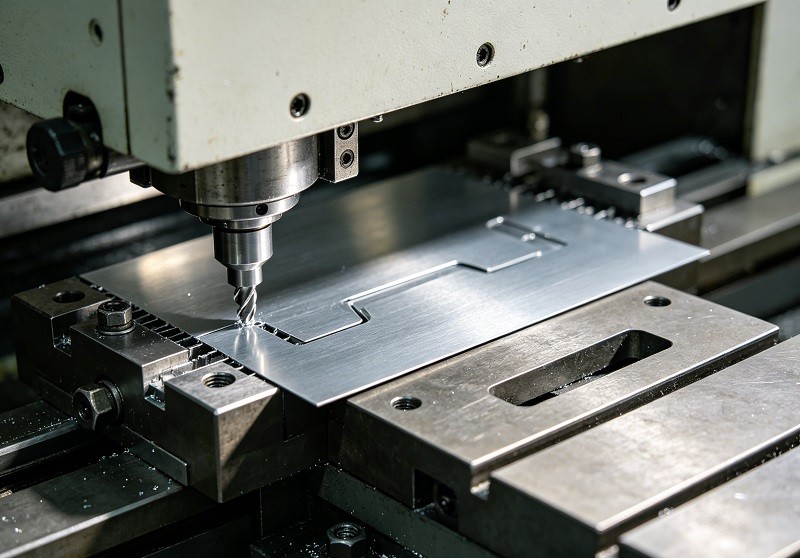
Key characteristics: Minimal edge break, smooth edges, flat surfaces, and capabilities for thicker metals.
Unlike conventional stamping, which creates a part with a distinct rollover, burnish zone, and fracture zone (break), fine blanking produces a clean, square edge with almost no die break. This is achieved by clamping the material tightly with a guide plate and a V-ring that presses into the material, preventing the metal from fracturing and instead causing it to flow. The result is unparalleled flatness and smooth, perpendicular edges that are crucial for many high-performance applications. This process excels with materials up to 19 mm (0.75 inches) in thickness, maintaining tight dimensional tolerances throughout.
Ideal applications: Precision components like gears and levers that demand superior edge quality.
The superior edge quality and dimensional accuracy of fine blanking make it the ideal choice for critical components where performance cannot be compromised. This includes parts like automotive transmission gears, clutch plates, braking system components, and medical devices. For items such as levers, cams, and other mechanisms requiring direct-use, load-bearing surfaces without further machining, fine blanking provides a cost-effective and reliable manufacturing solution.
Progressive Stamping: Efficiency for High Volume
Progressive stamping is a cornerstone of modern high-volume manufacturing, celebrated for its speed, efficiency, and ability to produce complex parts at a low per-unit cost.
How it works: Performing multiple operations within a single die, using a strip carrier.
In progressive die stamping, a coil or strip of metal is fed through a multi-station die within a single press. As the strip "progresses" through the die, each station performs one or more distinct operations, such as punching, bending, coining, and forming. The material strip itself acts as the carrier, accurately positioning the part from one station to the next. At the final station, the completed part is cut from the carrier strip. This continuous and automated process allows for the production of thousands of parts per hour.
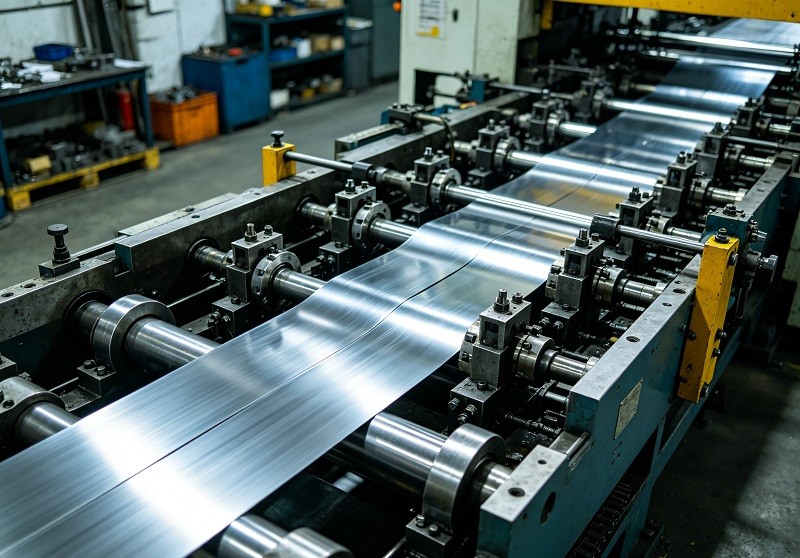
Benefits: High yield rates, potential for lower costs (if the design allows for conversion from other methods), and integration of secondary operations like forming, punching, and riveting.
The primary advantage of progressive stamping is its efficiency in mass production. While the initial tooling investment can be substantial, the high speed of operation leads to a very low cost per part, making it highly economical for large production runs. The process minimizes scrap by optimizing the layout of parts on the metal strip. Furthermore, it allows for the integration of various secondary operations directly into the die, such as the insertion of fasteners, tapping of threads, or even in-die assembly, which drastically reduces post-production handling, labor costs, and lead times.
Deep Drawn Stamping: Crafting Complex Hollow Forms
Deep drawn stamping is a unique metal forming process used to transform a flat sheet of metal into a three-dimensional, hollow shape without a seam.
Unique capabilities: Producing seamless, hollow, or cup-shaped parts, accommodating complex geometries, varying material thicknesses, and reducing material waste.
The deep drawing process works by placing a metal blank over a die and punching it into the die cavity, causing the material to flow and form into the desired shape. This technique excels at producing parts where the depth is equal to or greater than its diameter, such as cylinders, cans, and enclosures. Deep drawing can create complex, asymmetrical geometries and maintain different material thicknesses within a single part. Because it forms the part from a single piece of sheet metal, it produces a seamless, structurally robust final product and is a highly material-efficient process.
Advantages: Excellent strength-to-weight ratios, high precision, and reliability for consistent quality across large batches.
The cold working of the metal during the drawing process strain-hardens the material, resulting in a finished part with an excellent strength-to-weight ratio. Deep drawn parts are known for their high precision and seamless construction, which is critical for applications requiring containment or pressure resistance, such as fuel filter housings, medical device enclosures, and fire extinguisher canisters. The process is highly repeatable, ensuring consistent quality and dimensional accuracy across production batches numbering in the millions.
General Metal Stamping: Versatility and Economy
General, or conventional, metal stamping is the most common and versatile form of metal forming, encompassing a wide range of techniques suitable for countless applications.
Basic principles: Shaping or cutting flat metal sheets using dies and presses.
At its core, general metal stamping involves using a machine press and a custom die to cut or form a flat metal sheet into a specific shape. This can be a single-hit process using a simple die to produce features like holes or simple bends, or it can involve a series of separate press operations to create a more complex part. The principles cover a broad category of operations, including piercing, blanking, bending, and forming.
Common applications and limitations: Suitable for simpler parts and short production cycles, but may result in tool marks and challenges with very long components.
This method is well-suited for producing simpler components like brackets, washers, and housings, particularly for short to medium production runs where the cost of complex progressive tooling is not justified. However, conventional stamping typically results in a die break edge, and the part may require secondary deburring or finishing. The process can also leave tool marks on the part surface. It may present challenges for producing very long parts that can be difficult to handle and maintain straightness through multiple, separate operations.
Key Factors Influencing Process Selection for Metal Stamping Parts Manufacturers
Making the right choice among these processes is a strategic decision that directly impacts profitability and product success. A careful evaluation of part design, material properties, production volume, and quality requirements is essential to align the manufacturing method with the project's goals.
Part Design and Specifications
The geometry and functional requirements of the component are the primary drivers in process selection. A detailed analysis of the part's design specifications will often narrow the viable options significantly.
Considering geometric complexity, overall size, and tight dimensional tolerances.
The complexity of a part is a major determining factor. For instance, a simple, flat bracket can be economically produced with general stamping. However, a small, intricate component with multiple bends and features produced in high volumes is a perfect candidate for progressive stamping. A deep, seamless cylindrical housing can only be achieved through deep drawn stamping. The overall size of the part also matters; very large parts may not be suitable for progressive dies due to material handling constraints, while very small, high-precision parts might require fine blanking. When tight dimensional tolerances are critical, processes like fine blanking and deep drawing offer superior precision compared to conventional methods.
Evaluating critical edge conditions and desired surface finish requirements.
The requirements for a part's edges and surfaces are crucial. Applications in safety or high-wear areas often cannot tolerate the burrs and sharp fracture zones typical of conventional stamping. In these cases, fine blanking is the superior choice, delivering clean, square edges ready for assembly. If a part will be visible in the final product, the surface finish is important, and the manufacturer must choose a process and material that minimizes scratches and tool marks.
Material Considerations
The type, thickness, and properties of the metal being formed are intrinsically linked to the stamping process. Certain materials behave differently under pressure and require specific techniques for successful forming.
The impact of material type (e.g., steel, aluminum, copper, brass, stainless steel) on processing capabilities.
Different materials have unique characteristics regarding formability, hardness, and elasticity. For example, softer materials like aluminum and copper are generally easier to draw and form than high-strength steels or stainless steel, which require higher press tonnage and more robust tooling. The choice of material affects die design, lubrication requirements, and press speed. A deep draw, for instance, requires a material with good ductility to prevent tearing or cracking.
Common Stamping Materials and Considerations:
| Material | Key Characteristics | Best Suited Processes |
|---|---|---|
| Carbon Steel | Strong, versatile, and cost-effective. | General Stamping, Progressive Stamping, Deep Drawing |
| Stainless Steel | High corrosion resistance, strong, prone to work hardening. | Progressive Stamping, Deep Drawing (requires more tonnage) |
| Aluminum | Lightweight, high conductivity, good corrosion resistance. | Deep Drawing, Progressive Stamping |
| Copper & Brass | Excellent electrical conductivity, high formability. | Progressive Stamping, Fine Blanking (for contacts) |
Understanding how material thickness and mechanical properties affect process choice.
Material thickness is a critical factor. Thicker and harder materials require significantly more force to cut and form, dictating the required press tonnage. Fine blanking, for example, is capable of handling thicker materials than many other precision stamping processes. Mechanical properties like tensile strength and yield strength determine how the material will stretch, bend, and react to the forming process, influencing the risk of springback (where the material partially returns to its original shape after forming) or fracture. A knowledgeable manufacturing partner can help select a material and process that work in harmony.
Production Volume and Cost Efficiency
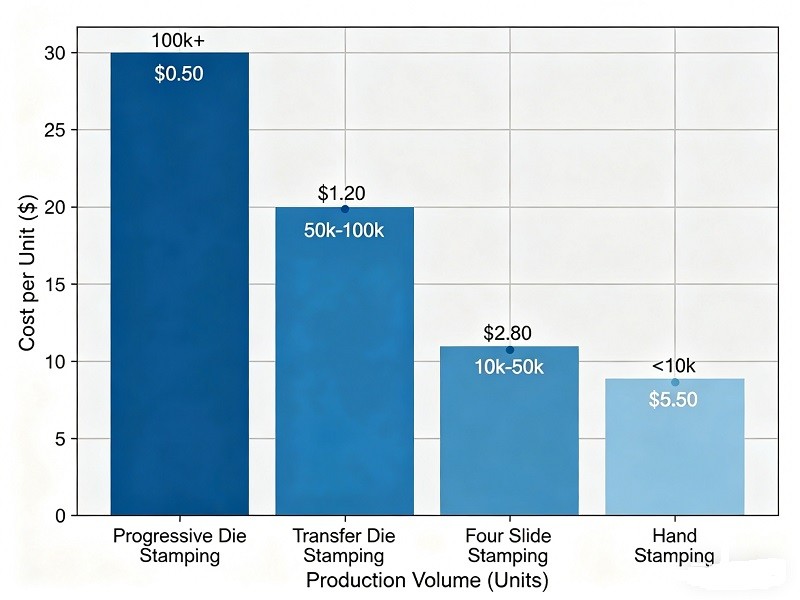
The economic viability of a stamping project is a balance between tooling costs and the per-part price, heavily influenced by the expected production volume.
Balancing initial tooling investments with the unit cost for different production volumes, from prototyping to mass production.
There is a fundamental trade-off in metal stamping:
- Low Volume (Prototyping, Short Runs): Single-hit or general stamping is often most cost-effective. The tooling is simpler and cheaper to create, but the per-part cost is higher due to increased labor and handling.
- High Volume (Mass Production): Progressive stamping is the ideal choice. The initial investment in complex tooling is high, but the automated process results in a very low unit cost, making it extremely efficient for runs of tens of thousands to millions of parts.
- Specialized Needs: Fine blanking and deep drawing have tooling costs that vary with complexity but are often justified by the unique part features and the elimination of secondary operations.
Assessing the influence of integrating or performing secondary operations on overall cost and lead times.
A significant portion of a part's final cost can come from secondary operations performed after stamping, such as deburring, tapping, machining, or assembly. A process like progressive stamping that integrates these operations into the die itself offers enormous cost and time savings. It eliminates the need to move parts between different work centers, reduces labor, and shortens the overall production lead time, which can be a major competitive advantage.
Comparing the total cost implications of processes like fine blanking versus progressive stamping.
A direct comparison requires looking at the total cost of ownership. For a specific part, progressive stamping might offer a lower initial unit cost. However, if that part then requires a secondary machining operation to achieve a critical flat surface or a clean edge, the total cost could exceed that of using fine blanking from the start. Fine blanking often produces a net-shape part that is ready for immediate assembly, providing a hidden cost saving.
Precision and Quality Requirements
Maintaining consistent quality is paramount, and the chosen process must be capable of achieving the specified precision levels throughout the entire production run.
Achieving tight tolerances and maintaining consistent quality throughout production batches.
Processes are distinguished by their ability to hold tight tolerances. Fine blanking is at the top for dimensional accuracy and edge quality. Progressive stamping is known for its high repeatability over millions of cycles, ensuring that the last part is identical to the first. Deep drawing also provides excellent consistency for complex forms. The key is to match the part's tolerance requirements with the inherent capability of the process to avoid costly over-engineering or, conversely, non-conforming parts.
The crucial role of Geometric Dimensioning and Tolerancing (GD&T) in defining critical part features.
Geometric Dimensioning and Tolerancing (GD&T) is the symbolic language used on engineering drawings to communicate the precise geometric requirements for a part. It goes beyond simple dimensions to define the allowable variation in form, orientation, and location of features. For a metal stamper, GD&T is essential for understanding which features are most critical to the part's function. A clear GD&T strategy ensures that the manufacturer focuses quality control efforts where they matter most and selects a process capable of meeting those specific geometric controls.
Partnering with the Right Metal Stamping Parts Manufacturer: What to Look For
Selecting the right process is only half the battle. The success of a project relies heavily on the capabilities, expertise, and collaborative spirit of your manufacturing partner. A good partner doesn't just make parts; they provide engineering support and act as an extension of your own team.
Manufacturer Capabilities and Expertise
Not all stamping companies are created equal. Look for a partner whose experience and equipment align with your specific industry and project needs.
Seeking experience within our specific industry and the ability to process diverse materials.
A manufacturer with deep experience in your industry—be it automotive, aerospace, medical, or electronics—will already understand the unique challenges, quality standards, and material requirements common to your field. They can provide valuable Design for Manufacturability (DFM) feedback that is relevant and practical. Ask for case studies or examples of similar parts they have produced. Their ability to work with a wide range of materials is also a sign of technical depth and flexibility.
Ensuring the manufacturer has the right facility size, equipment range, and workforce to meet our production demands efficiently.
Verify that the potential partner has the necessary infrastructure. This includes:
- Press Capacity: Do they have a range of presses (tonnage and bed size) to accommodate your part's size and material?
- In-House Tooling: A manufacturer with an in-house tool and die shop can build, maintain, and repair tooling faster, minimizing downtime.
- Technical Workforce: Is their team comprised of experienced engineers, toolmakers, and quality technicians who can support your project from concept to completion?
Quality Assurance and Certifications
Robust quality systems are non-negotiable. Look for objective proof of a manufacturer's commitment to quality through internationally recognized certifications and transparent processes.
The importance of certifications like ISO 9001:2015 and other relevant industry standards.
Certifications are a third-party validation of a company's quality management system. ISO 9001:2015 is the foundational standard, indicating that the manufacturer has well-defined and consistently followed processes for production, inspection, and continuous improvement. For automotive projects, IATF 16949 is the required standard, which builds upon ISO 9001 with more stringent requirements. These certifications provide confidence that the supplier is committed to delivering consistent quality.
Verifying robust quality control measures are in place throughout their manufacturing processes.
A quality-focused manufacturer should be able to demonstrate their quality control measures. This includes everything from initial raw material inspection to in-process checks using statistical process control (SPC) and final inspection with advanced metrology equipment like Coordinate Measuring Machines (CMMs) and vision systems. Ask to see their quality lab and review their quality documentation.
Transparency and Communication
A successful partnership is built on trust, which is fostered through clear, consistent, and proactive communication.
Prioritizing clear communication, regular project updates, and a customer-centric approach.
The ideal manufacturing partner will provide a dedicated point of contact for your projects and establish a clear communication rhythm. They should be transparent about production status, forthcoming with any potential issues, and collaborative in finding solutions. A customer-centric manufacturer views your success as their own and is invested in building a long-term relationship.
A good partner should be able to offer expert guidance and suggest cost-saving alternatives that don't compromise quality.
A true partner does more than simply take orders. They should act as a consultant, leveraging their manufacturing expertise to improve your product. This includes offering DFM feedback to optimize a part for a more efficient process, suggesting alternative materials that could improve performance or reduce cost, and proactively looking for opportunities for value engineering without ever compromising the quality or integrity of the final component.
For metal stamping parts manufacturers, the optimal choice of metal stamping process is a strategic balancing act of precision, production volume, cost-efficiency, and specific design requirements. Each method, from the unparalleled precision of fine blanking to the high-speed efficiency of progressive stamping and the unique formability of deep drawing, offers distinct advantages. Understanding the capabilities and limitations of each is the cornerstone of successful and profitable manufacturing.
By carefully evaluating project needs against these process characteristics and collaborating with an experienced and transparent metal stamping parts manufacturer, we can navigate these complexities effectively. This partnership-driven approach not only ensures the selection of the most appropriate and cost-effective manufacturing path but also fosters innovation, guarantees long-term product quality, and builds a foundation for future success. We encourage you to share this guide with your teams and start a conversation about how you can optimize your process selection for your next project.