Introduction: Precision Machining at 30,000 Feet
The aerospace industry demands a level of precision, reliability, and traceability that surpasses virtually every other manufacturing sector. Every component aboard an aircraft or spacecraft must function flawlessly under extreme conditions — from the cryogenic vacuum of space to the searing heat of a jet engine turbine section. CNC machining has become the backbone of aerospace manufacturing, delivering the tight tolerances, complex geometries, and material integrity that flight safety demands.
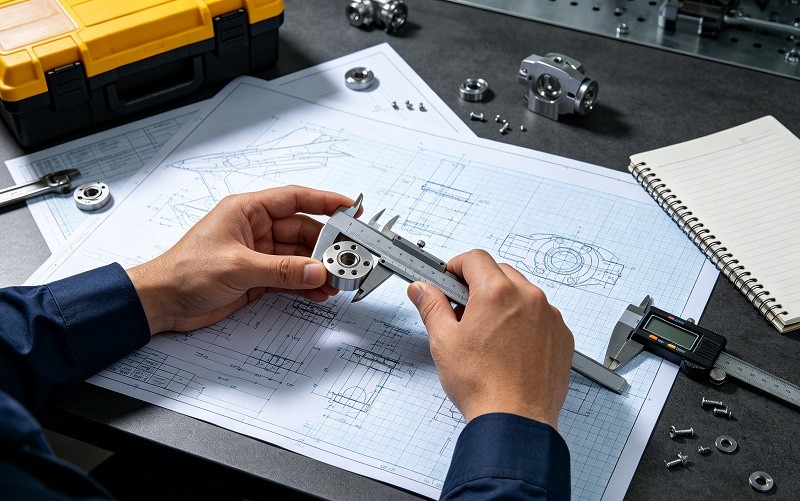
At SOMI Custom Parts, we combine decades of precision manufacturing experience with state-of-the-art multi-axis CNC machining centers to serve the aerospace supply chain. From structural brackets for commercial aircraft to critical engine components for next-generation propulsion systems, our facility is equipped and certified to meet the most stringent aerospace requirements.
What Is Aerospace CNC Machining?
Aerospace CNC machining refers to the computer-controlled subtractive manufacturing of components for aircraft, spacecraft, satellites, propulsion systems, and avionics. What distinguishes it from standard CNC machining is the comprehensive framework of certification, traceability, and quality assurance that governs every step of production.
Key Distinction: While a general CNC shop may hold tolerances of ±0.005 in and operate under ISO 9001, an aerospace CNC shop must hold ±0.001 in or tighter, maintain AS9100D certification, provide full material traceability, and deliver complete First Article Inspection (FAI) reports per AS9102 for every new part.
Aerospace components must withstand extreme operating conditions including vibration loads up to 20g, pressure differentials across flight envelopes, rapid thermal cycling from -55°C to over 1,000°C in engine sections, and continuous fatigue loading over decades of service. These requirements translate directly into manufacturing specifications that are far more demanding than commercial or industrial standards.
Key Benefits of CNC Machining for Aerospace Applications
Micron-Level Precision
Aerospace CNC machining routinely achieves tolerances of ±0.001 in for structural parts and ±0.0002 in for critical engine components, with surface finishes as low as Ra 0.2 µm.
Complex Geometry Capability
5-axis CNC machines produce turbine blades, impellers, and structural ribs with compound-curved surfaces and internal cooling channels in a single setup.
Full Material Traceability
Every part is traceable from mill heat-lot certificate to finished component, meeting AS9100 and OEM requirements for complete documented genealogy.
Repeatable Quality
CNC automation combined with Statistical Process Control (SPC) and 100% CMM inspection ensures every part in a production run meets the same tight specifications.
Aerospace Materials: Selection and Machining Considerations
Material selection is one of the most critical decisions in aerospace manufacturing. The choice directly affects component weight, strength, corrosion resistance, thermal stability, and fatigue life. Each material family presents unique machining challenges that require specialized expertise.
Aluminum Alloys — 7075-T6 and 6061-T6
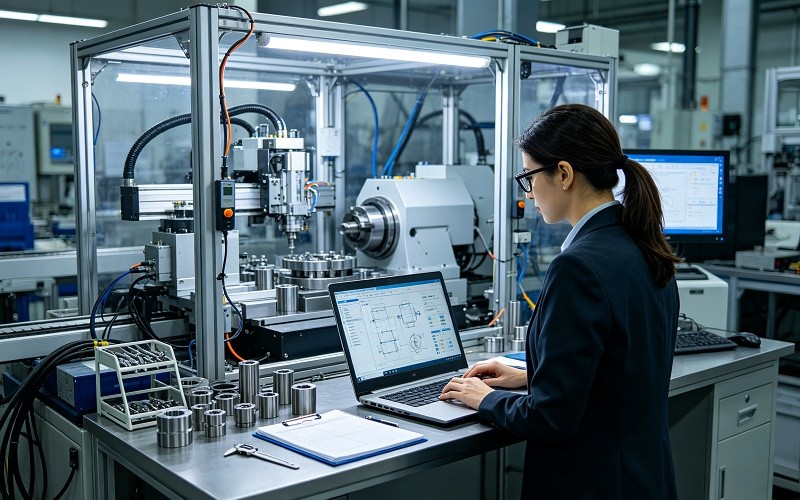
Aluminum accounts for the majority of aerospace machined parts by volume. 7075-T6 is the workhorse structural alloy with a yield strength around 500 MPa (83 ksi) and a density of just 0.101 lb/in³. It is the standard choice for wing ribs, fuselage frames, and structural brackets where weight is the primary constraint. 6061-T6 is used for less demanding structural and non-structural applications where cost efficiency matters more than peak strength. These alloys are relatively machinable, but managing thin-wall deflection — often as thin as 0.040 in (1.0 mm) — requires careful fixturing and tool path strategies.
Titanium Alloys — Ti-6Al-4V (Grade 5)
Titanium Ti-6Al-4V is the second most important aerospace structural material, combining high strength (up to 930 MPa tensile), low density (4.43 g/cm³), excellent corrosion resistance, and high-temperature capability up to 550°C. It is indispensable for engine mounts, landing gear components, fasteners, and structural fittings. However, titanium is notoriously difficult to machine: it generates significant cutting heat, has poor thermal conductivity (only 7 W/m·K), work-hardens rapidly, and can chemically react with tooling at high temperatures. Effective titanium machining requires rigid setups, sharp carbide or ceramic tooling, high-pressure coolant systems, and reduced cutting speeds — typically 30-60 SFM compared to 800+ SFM for aluminum.
Nickel-Based Superalloys — Inconel 718 and 625
Engine-adjacent components that experience sustained high temperatures — turbine casings, combustion chamber components, exhaust structures — use nickel-based superalloys such as Inconel 718 (tensile strength up to 1,240 MPa, operating temperature up to 650°C+). These materials are among the most difficult to machine in existence: they work-harden aggressively, retain heat at the cutting zone, and wear tools rapidly. Machining superalloys demands specialized tooling strategies, low cutting speeds (20-40 SFM), and experienced programmers who understand chip thinning, tool engagement angles, and thermal management.
| Material |
Tensile Strength |
Max Temp |
Machinability |
Relative Cost |
| Aluminum 7075-T6 |
570 MPa |
~120°C |
Excellent |
Reference |
| Titanium Ti-6Al-4V |
930 MPa |
~550°C |
Difficult |
5-10× aluminum |
| Inconel 718 |
1,240 MPa |
~650°C+ |
Very Difficult |
15-30× aluminum |
Aerospace Quality Standards and Certifications
Quality assurance in aerospace manufacturing is governed by a multi-layered framework of international standards. These certifications are not optional differentiators — they are contractual requirements from OEMs and prime contractors.
AS9100D
Aerospace quality management system built on ISO 9001 with additions for risk management, configuration management, product safety, and counterfeit part prevention. Baseline requirement for any aerospace CNC machining supplier.
AS9102
First Article Inspection (FAI) standard requiring complete dimensional verification of every drawing requirement on the first production part. A typical FAI package for a moderately complex aerospace part runs 20-50 pages.
NADCAP
National Aerospace and Defense Contractors Accreditation Program for special processes: heat treatment, non-destructive testing (NDT), chemical processing, welding, and coatings.
ASME Y14.5
GD&T (Geometric Dimensioning and Tolerancing) standard defining how dimensional tolerances, true position, flatness, concentricity, and profile are specified and interpreted on aerospace drawings.
Precision Tolerances in Aerospace Components
Aerospace tolerances are significantly tighter than general industrial machining — typically 2-5× stricter. Even a 0.01 mm dimensional deviation can cause mechanical imbalance in a high-speed turbine assembly operating at 15,000+ RPM.
| Component Type |
Typical Tolerance |
Surface Finish |
| Structural components (ribs, brackets, frames) |
±0.001 in (25 µm) |
Ra 1.6-3.2 µm |
| Engine components (housings, mounts) |
±0.0002-0.0005 in (5-13 µm) |
Ra 0.8 µm |
| Hydraulic and fuel system parts |
±0.0001-0.0003 in (2.5-7.6 µm) |
Ra 0.2-0.4 µm |
5-Axis CNC Machining for Complex Aerospace Parts
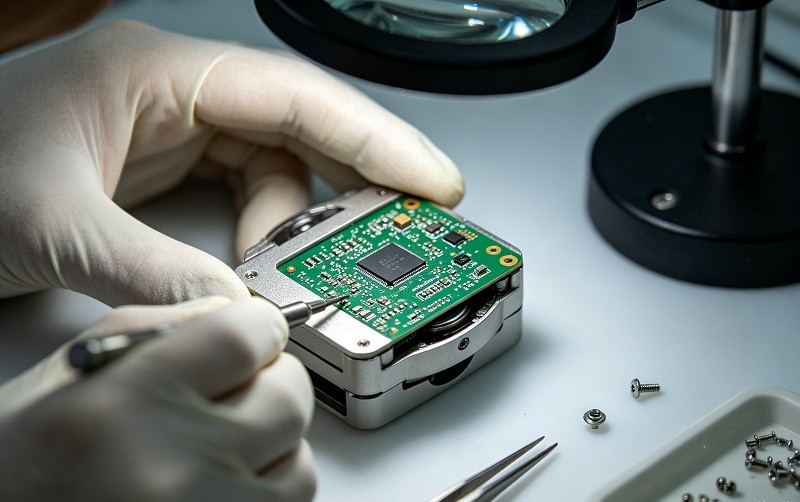
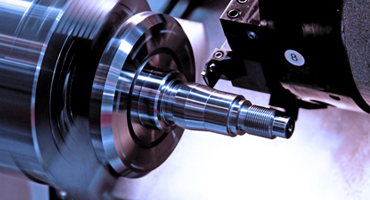
Aerospace components frequently feature complex geometries that cannot be efficiently produced on conventional 3-axis machines. Curved aerodynamic surfaces, internal cooling channels, thin-wall structures, and compound-angle features demand multi-axis capability. 5-axis CNC machining allows cutting tools to move along five independent axes simultaneously, enabling single-setup production of parts that would otherwise require multiple fixtures and repositioning steps.
The benefits are substantial: single-setup machining eliminates cumulative positional errors from re-fixturing, shorter and more rigid tool assemblies improve surface finish, and continuous tool engagement reduces cycle times by 30-50% compared to 3-axis approaches on complex parts. Typical aerospace parts produced with 5-axis machining include turbine blades, impellers, satellite brackets, aircraft structural ribs, and engine diffusers.
How SOMI Custom Parts Supports Aerospace Manufacturing
At SOMI Custom Parts, we bring extensive experience in precision CNC machining across the full spectrum of aerospace materials — from aluminum and titanium to Inconel and engineering plastics. Our manufacturing facility is equipped with advanced 3/4/5-axis CNC machining centers capable of holding tolerances down to ±0.005 mm, with CMM inspection capability and comprehensive quality documentation.
We understand that aerospace buyers need more than competitive pricing. They need a partner who can deliver full material traceability, dimensional inspection reports, and consistent quality across both prototype and production quantities. Our engineering team works closely with clients to review CNC machining designs for manufacturability, suggest tolerance rationalization where appropriate, and ensure that every part meets the specified requirements. Learn more about our manufacturing capabilities and how we support aerospace supply chains with precision-machined components.
Frequently Asked Questions
What certifications should an aerospace CNC machining supplier hold?
AS9100D is the absolute minimum certification for aerospace flight hardware production. NADCAP accreditation is required for special processes such as heat treatment, NDT, and coatings. OEM-specific approvals (Boeing BAC, Airbus AIPS) may be required for direct supply to prime contractors. ITAR registration is necessary for defense-related aerospace components.
What tolerance can CNC machining achieve for aerospace parts?
Standard aerospace CNC machining holds ±0.001 in (25 µm) on linear dimensions and bore diameters. Precision operations achieve ±0.0005 in (12.7 µm) or tighter. Engine components and hydraulic systems may require ±0.0002 in (5 µm) or better, with surface finishes down to Ra 0.2 µm for sealing surfaces.
Which aerospace materials are most challenging to machine?
Nickel-based superalloys like Inconel 718 are the most challenging due to aggressive work-hardening and extreme heat generation during cutting. Titanium Ti-6Al-4V is also difficult because of its poor thermal conductivity and chemical reactivity with tooling. Both require specialized cutting parameters, high-pressure coolant, and experienced programmers to achieve aerospace tolerances.
How does aerospace CNC machining differ from standard commercial machining?
Aerospace machining operates under a fundamentally different quality framework. The key differences are: tolerances 2-5× tighter, mandatory AS9100 quality management system, full material traceability from mill cert to finished part, 100% CMM inspection on critical features, FAI per AS9102 for every new part, and significantly higher documentation requirements. As a result, aerospace parts typically cost 3-10× more than visually similar commercial parts.
What is the typical lead time for aerospace CNC machined parts?
Prototype quantities can be produced in 3-15 days depending on complexity and material availability. Production runs typically require 2-6 weeks. Lead times are influenced by material sourcing (aerospace-certified materials with mill certs), CAM programming for complex 5-axis parts, and FAI documentation requirements. Contact our team with your specific requirements for an accurate timeline.
Conclusion: Building the Future of Flight, One Part at a Time
Aerospace CNC machining represents the pinnacle of precision manufacturing — where microns matter, materials are pushed to their limits, and quality is not negotiable. As the aerospace industry continues to evolve with commercial space flight, next-generation aircraft programs, and increasing defense requirements, the demand for qualified CNC machining partners has never been greater.
Whether you need structural brackets, engine components, avionics housings, or custom prototypes, SOMI Custom Parts has the equipment, expertise, and quality systems to deliver. Browse our manufacturing capabilities or reach out to our engineering team to discuss your aerospace project requirements. Let us show you what true precision machining looks like.