A Guide to Wholesale 3D Printed Parts for Industrial Applications
As we navigate the evolving landscape of modern manufacturing, it's evident that emerging technologies are unlocking remarkable possibilities for businesses, particularly in the realm of bulk part production. In this comprehensive guide, we will explore how wholesale 3D printed parts are revolutionizing industrial applications, presenting solutions that were once considered impossible or prohibitively expensive. We'll delve into the significant advantages and crucial considerations involved when leveraging 3D printing for large-scale industrial projects.
Why Wholesale 3D Printed Parts Are a Game Changer for Industry
The industrial world is undergoing a significant transformation, and at the heart of this change is additive manufacturing, or 3D printing. For businesses that rely on producing parts in large quantities, wholesale 3D printing services are not just a novelty; they are a strategic advantage. This technology dismantles many of the traditional barriers to production, paving the way for unprecedented efficiency and innovation.
Unlocking Design Freedom and Faster Innovation
One of the most celebrated benefits of 3D printing is the immense design freedom it offers. It empowers engineers and designers to move beyond the limitations of conventional manufacturing, where the complexity of a part often dictates its feasibility and cost. This newfound liberty, combined with an accelerated development process, is a powerful catalyst for innovation.
Creating Complex Shapes and Custom Designs with Ease
Traditional manufacturing methods, such as subtractive machining or injection molding, often struggle with intricate details, internal channels, or organic shapes. Additive manufacturing, however, excels in this area. It builds objects layer by layer directly from a digital file, making the production of complex geometries no more difficult than simple ones. This capability is revolutionary, allowing for the creation of parts with labyrinthine internal structures, lightweight lattice infills, and shapes optimized for performance rather than manufacturability. As a result, industries like aerospace, automotive, and healthcare can produce highly specialized, performance-driven components that were previously impossible to make in one piece.
Speeding Up Product Development and Time-to-Market
In today's competitive landscape, speed is paramount. The time it takes to move a product from concept to market can be the difference between success and failure. 3D printing drastically shortens this timeline by enabling rapid prototyping. Where traditional prototyping could take weeks or even months due to tooling and setup, 3D printers can produce a physical, testable model in mere hours or days. This allows design teams to quickly iterate, test for form and function, and identify potential flaws early in the process, mitigating risks and reducing development costs. By accelerating the design, testing, and validation cycle, companies can significantly reduce their overall time-to-market and respond more quickly to market demands.
Smart Cost-Savings and Less Waste in Wholesale Production
Beyond the exciting possibilities in design and speed, wholesale 3D printing offers compelling financial and environmental arguments. By fundamentally changing how parts are made, it introduces efficiencies that challenge the economic models of traditional manufacturing, particularly when it comes to tooling and material consumption.
Saving Money by Avoiding Expensive Molds and Tooling
One of the most significant barriers to entry for many manufacturing projects is the high upfront cost of tooling. Processes like injection molding require the creation of complex and expensive molds, an investment that can run into tens of thousands of dollars and take weeks or months to produce. This cost is only justifiable for mass production where it can be amortized over hundreds of thousands of parts.
Additive manufacturing completely sidesteps this hurdle. Since parts are built directly from a digital file, there is no need for molds, dies, or other custom tooling. This dramatically reduces initial setup costs and makes 3D printing an exceptionally cost-effective solution for small to medium-volume production runs. It allows businesses to move from design to production without the substantial capital outlay and time delay associated with traditional tool-based methods.
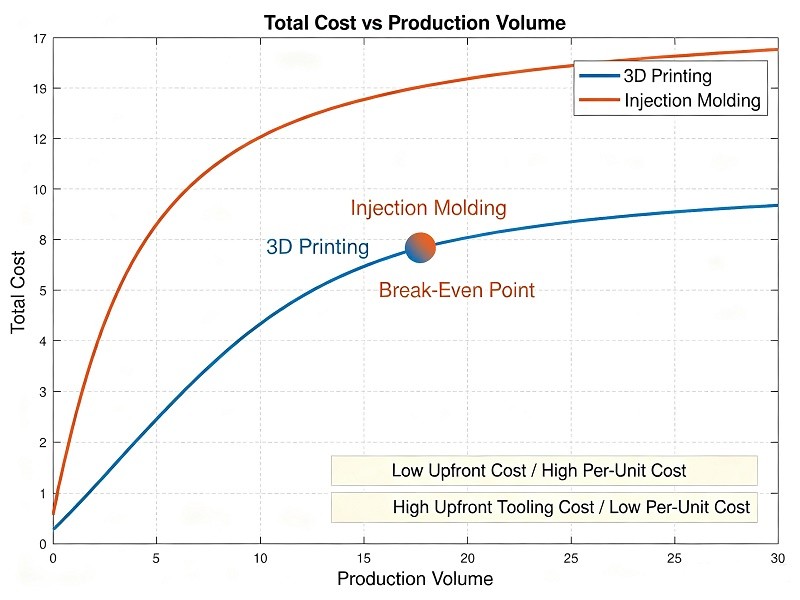
A comparison showing how 3D printing avoids the high initial tooling costs inherent in traditional manufacturing methods like injection molding.
Using Only What's Needed: A Win for Your Budget and the Planet
Traditional manufacturing is often a subtractive process, meaning you start with a larger block or sheet of material and cut, drill, or carve away until you have your final part. This method, by its very nature, generates a significant amount of waste material in the form of chips and offcuts—sometimes as much as 90% of the original material. This waste not only has an environmental cost but also a financial one, as you are paying for material that is ultimately discarded.
Additive manufacturing, as the name implies, is the opposite. It is an additive process that builds a part layer by layer, depositing material only where it is needed. This approach is incredibly efficient, reducing material waste by up to 90% compared to subtractive methods. Using less material translates directly into lower part costs, especially when working with high-value materials like aerospace-grade metals or specialized polymers. This inherent efficiency makes 3D printing a more sustainable manufacturing choice, minimizing environmental impact while simultaneously improving your bottom line.
Building Stronger Supply Chains with On-Demand Wholesale 3D Printed Parts
The agility of 3D printing extends far beyond the design phase and into the very structure of our supply chains. Recent global disruptions have highlighted the fragility of long, complex supply chains that span continents. Additive manufacturing offers a powerful alternative: a decentralized, on-demand production model that builds resilience, reduces logistical burdens, and brings manufacturing closer to the point of need.
Producing Parts Locally and Reducing Shipping Hassles
Traditional supply chains often rely on centralized factories, frequently located overseas, to achieve economies of scale. Finished parts must then be shipped across the globe, a process that is time-consuming, expensive, and vulnerable to delays from port congestion, tariffs, and geopolitical instability.
3D printing facilitates a shift toward decentralized or distributed manufacturing. Instead of a single massive factory, production can occur in multiple, smaller facilities located closer to the end user. This localized approach dramatically reduces lead times, transportation costs, and the carbon footprint associated with long-distance shipping. For businesses, this means faster delivery to customers, greater supply chain agility, and insulation from the risks of global logistics.
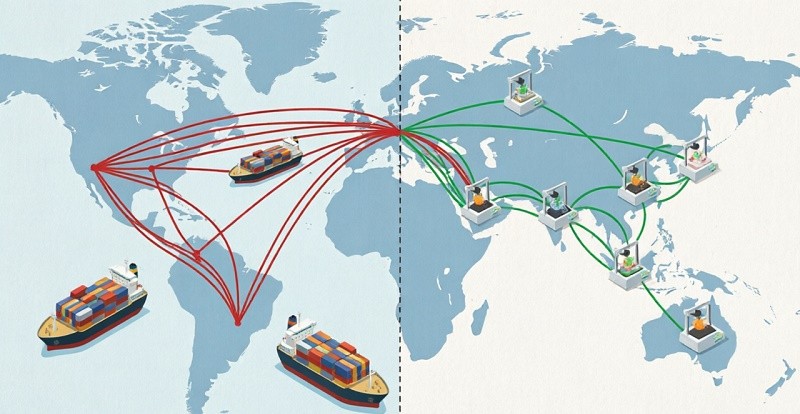
Additive manufacturing enables a shift from complex global supply chains to efficient, localized production hubs.
Eliminating Storage Needs by Printing Parts Only When They're Required
Conventional manufacturing often operates on a "just-in-case" model, where large batches of parts are produced and stored in warehouses to anticipate future demand. This practice ties up capital, incurs significant storage and inventory management costs, and carries the risk of parts becoming obsolete.
3D printing enables a true "just-in-time" (JIT) manufacturing strategy. Instead of a physical inventory, companies can maintain a digital inventory—a library of part files stored in the cloud. Parts are then printed on-demand, precisely when and where they are needed, in the exact quantity required. This revolutionary approach all but eliminates the need for physical warehousing, freeing up capital, reducing storage costs, and ensuring that inventory never becomes obsolete. It supports a lean, agile operation that can respond instantly to customer orders or internal needs, such as producing spare parts on the spot to minimize equipment downtime.
Key Considerations When Getting Started with Wholesale 3D Printed Parts
Successfully integrating wholesale 3D printed parts into an industrial workflow requires careful planning and strategic decision-making. It's not a one-size-fits-all solution, and understanding its ideal applications, materials, and partnership requirements is crucial for maximizing its benefits. By thoughtfully navigating these key considerations, businesses can unlock the full potential of this transformative technology.
Matching the Right Technology to Your Production Needs
3D printing is a powerful tool, but it's not always the right tool for every job. Knowing when to use additive manufacturing versus traditional methods like CNC machining or injection molding is essential for a cost-effective and efficient production strategy. The key is to identify the unique strengths of 3D printing and apply them where they provide the most value.
Understanding When 3D Printing Shines Compared to Traditional Manufacturing
3D printing and traditional manufacturing are not mutually exclusive; in fact, they are often complementary. The choice between them depends on several factors, including design complexity, production volume, material requirements, and lead time.
Here's a comparison to guide your decision:
| Factor | 3D Printing (Additive) | Traditional Manufacturing (Subtractive/Formative) |
|---|---|---|
| Design Complexity | Excels. Ideal for intricate geometries, internal channels, and organic shapes with no added cost for complexity. | Limited. Complex designs can be difficult, expensive, or impossible to produce. |
| Production Volume | Cost-effective for low- to mid-volume (typically 1 to ~1,000 parts) and one-off custom pieces. | Cost-effective for high-volume production (thousands to millions of parts) where tooling costs are justified. |
| Lead Time | Fast. Prototypes and parts can be produced in hours or days, as no tooling is required. | Slow to start. Can take weeks or months for mold/tool creation before production begins. |
| Material Waste | Minimal. Builds parts layer by layer, using only the necessary material. | Significant. Subtractive methods like CNC machining can generate substantial material scrap. |
| Cost Structure | Low upfront costs (no tooling). Per-part cost is relatively consistent regardless of volume. | High upfront costs for tooling. Per-part cost decreases significantly as volume increases. |
| Precision | Good to high, but may require post-processing for very tight tolerances. | Very high. CNC machining, in particular, offers exceptional precision and surface finishes. |
3D printing truly shines in applications requiring rapid prototyping, design flexibility, and low-volume production of highly complex parts.
Finding the 'Sweet Spot' for Cost-Effective Batch Sizes and Complexity
The "sweet spot" for wholesale 3D printing is where the benefits of tooling-free production and design complexity outweigh the higher per-part cost compared to mass production methods. This is typically in low- to medium-volume batches, often ranging from a single prototype up to several hundred or even a few thousand units.
One of the most critical calculations is the break-even point. This is the production volume at which the total cost of injection molding (including the expensive mold) becomes equal to the total cost of 3D printing. Below this point, 3D printing is more economical. Above it, injection molding's low per-part cost wins out. This break-even point can vary dramatically—from under 1,000 to over 10,000 parts—depending on factors like part size and complexity. For a simple, small part, the crossover might happen at a higher volume, whereas a highly complex part requiring an expensive mold may favor 3D printing for much larger quantities.
Therefore, the ideal batch size for 3D printing is one that:
- Is not large enough to justify the high tooling investment of injection molding.
- Involves parts with a high degree of complexity that would be costly or impossible to machine.
- Requires a fast turnaround time that traditional methods cannot meet.
- May be subject to future design changes, which are easy and cheap to implement with 3D printing.
Choosing the Best Materials for Your Industrial Wholesale 3D Printed Parts
The success of any industrial application hinges on the performance and reliability of the materials used. Additive manufacturing offers a diverse and expanding palette of materials, each with unique properties. Selecting the right one—and ensuring it meets rigorous quality standards—is a non-negotiable step for producing robust, functional parts.
From Plastics to Metals: A Growing Range of Options
The range of materials available for industrial 3D printing is vast and continually growing, moving far beyond simple plastics to include high-performance polymers, composites, and a wide array of metals. Each category offers distinct advantages for specific applications.
Plastics and Polymers: This is the most common category of 3D printing materials, encompassing a broad spectrum of options.
- Thermoplastics like PLA, ABS, and PETG are workhorses for prototyping and some functional parts due to their ease of use and affordability.
- Engineering-grade plastics such as Nylon, Polycarbonate (PC), and ASA offer enhanced strength, durability, and temperature resistance, making them suitable for more demanding applications like jigs, fixtures, and end-use components.
- High-performance polymers like PEEK and ULTEM provide exceptional thermal and chemical resistance and are often used as a lightweight alternative to metal in aerospace and automotive industries.
- Resins (Photopolymers) used in technologies like SLA and DLP allow for extremely high-detail parts with smooth surface finishes, ideal for medical models, jewelry casting, and intricate prototypes.
Composites: These materials are created by reinforcing a base plastic (often Nylon) with fibers like carbon fiber, fiberglass, or Kevlar. The resulting parts are exceptionally strong, stiff, and lightweight, making them ideal for replacing machined aluminum in applications like robotic end-effectors, custom tooling, and high-performance automotive components.
Metals: Metal additive manufacturing has unlocked the ability to print high-strength, complex parts directly from metal powders. This is a game-changer for producing functional, end-use parts that would be difficult or impossible to manufacture otherwise. Common options include:
- Stainless Steel: Valued for its excellent strength and corrosion resistance, used across many industries.
- Aluminum: A lightweight yet strong material with good thermal properties.
- Titanium: Known for its exceptional strength-to-weight ratio and biocompatibility, making it a top choice for aerospace and medical implants.
- Tool Steels: Extremely hard and wear-resistant, used to print custom molds, dies, and other tooling components.
- Superalloys like Inconel are used for high-temperature and high-stress environments, such as in jet engine and gas turbine components.
Making Sure Your Materials Meet High Industry Standards
For industrial applications, especially in highly regulated sectors like aerospace, automotive, and medical, simply choosing a material type is not enough. The parts must be reliable, repeatable, and meet stringent quality benchmarks. This requires a strong focus on material qualification and process control.
Global standards bodies like ASTM International and the International Organization for Standardization (ISO) have developed a framework of standards for additive manufacturing. These standards address everything from terminology (ISO/ASTM 52900) to material properties and testing methodologies (ISO/ASTM 52927). Adherence to these standards is critical for a few key reasons:
- Consistency and Repeatability: Standards ensure that a part printed today will have the same properties as a part printed a year from now, regardless of the machine or location.
- Traceability: It provides a clear record of the material batch, machine parameters, and post-processing steps, which is crucial for quality assurance and regulatory compliance.
- Performance Guarantee: Following established testing procedures validates that a material's mechanical properties (like tensile strength, impact resistance, and hardness) meet the specifications required for the application.
When working with a wholesale 3D printing partner, it's essential to verify their commitment to quality management systems, such as ISO 9001 certification, which demonstrates a systematic approach to ensuring consistent quality and continuous improvement. This ensures that the materials used are of high quality and that the entire manufacturing process is controlled and documented to produce parts you can trust.
Working with the Right Partner for Your Wholesale 3D Printed Parts
Transitioning to additive manufacturing is not just about buying a new piece of equipment; it's about adopting a new production philosophy. The success of this transition often depends on the expertise and capabilities of the partners you choose to work with. A great partner brings more than just printing capacity—they bring deep knowledge, a commitment to quality, and the ability to grow with you.
The Importance of Design Experts for Additive Manufacturing (DfAM)
To truly unlock the power of 3D printing, you can't simply send a design meant for CNC machining or injection molding to a printer. You must design specifically for the additive process, a methodology known as Design for Additive Manufacturing (DfAM). DfAM is a specialized skill set that reimagines parts from the ground up to leverage the unique strengths of 3D printing.
A partner with DfAM expertise can help you:
- Consolidate Parts: One of the most powerful DfAM techniques is part consolidation, where a complex assembly of multiple components is redesigned into a single, unified part. This significantly reduces assembly time, labor costs, and potential points of failure.
- Optimize for Performance: Using tools like topology optimization and generative design, experts can create parts that have been algorithmically engineered for maximum strength and minimum weight. These processes remove material from non-critical areas, resulting in organic, lightweight structures that maintain or even exceed the performance of their solid counterparts.
- Improve Printability: DfAM experts understand the nuances of the printing process. They can orient parts to maximize strength, minimize the need for support structures (which saves time and material), and ensure features are designed within the printer's resolution capabilities.
Without DfAM, you might be able to print a part, but you won't be harnessing the full economic and performance benefits of the technology.
Ensuring High Quality and the Ability to Scale Up Production
Choosing a wholesale partner is a long-term strategic decision. You need a provider that not only meets your immediate needs for prototypes or small batches but can also support you as your demand grows.
Key factors to evaluate in a potential partner include:
- Robust Quality Management Systems: Quality control is paramount in industrial production to ensure consistency, reliability, and safety. Look for partners with formal quality management systems and certifications, such as ISO 9001. This certification indicates a commitment to documented procedures, process control, and continuous improvement, which is essential for delivering repeatable, high-quality parts.
- Scalable Production Capacity: Can the provider handle your production needs as they grow from tens to hundreds or even thousands of parts? A reliable partner should have a significant and flexible production capacity, often leveraging a network of machines to handle fluctuating demand and urgent orders without compromising lead times.
- Technological and Material Expertise: A good partner will have a deep understanding of a wide range of technologies and materials. They should be able to advise you on the best choices for your specific application and have experience with projects similar to yours.
- Comprehensive Services: Beyond just printing, look for partners who offer end-to-end services. This includes DfAM consultation, engineering support, and various post-processing options like dyeing, vapor smoothing, and precision machining to achieve the required finish and tolerances.
Comparing partners solely on the initial quote can be misleading. A low price may hide compromises in build orientation, material quality, or process controls that result in inferior parts. A true partner invests in your success by prioritizing quality and providing the expertise needed to manufacture your parts correctly the first time.
The Future Is Now: Blending Traditional and Wholesale 3D Printed Parts for Success
The future of industrial production isn't about choosing one manufacturing method over another; it's about intelligently combining them to create the most efficient, resilient, and innovative workflow possible. Additive manufacturing is not here to replace traditional techniques entirely but to augment them. By blending the strengths of wholesale 3D printing with established processes, businesses can achieve a new level of operational excellence and prepare for the next generation of manufacturing challenges.
Combining the Best of Both Worlds for Optimal Manufacturing
The most forward-thinking companies are adopting a hybrid approach, using 3D printing and traditional manufacturing in tandem. This strategy leverages the speed and flexibility of additive for certain tasks while relying on the scalability and precision of conventional methods for others, creating a powerful synergy.
Using 3D Printing for Tools, Fixtures, and Prototypes
One of the most immediate and impactful ways to blend these technologies is by using 3D printing to support traditional manufacturing lines. Instead of being used for the final parts, 3D printing can create the tools that help make them. This includes:
- Jigs and Fixtures: These custom tools are used to hold workpieces in place during assembly, machining, or inspection. Traditionally, they are machined from metal, a process that is slow and expensive. 3D printing can produce lightweight, ergonomic, and custom jigs and fixtures in-house in a matter of hours and at a fraction of the cost. This allows for rapid iteration and optimization of production lines.
- Rapid Tooling and Molds: For low-volume injection molding, 3D printing can be used to create custom molds quickly and cheaply. This is ideal for testing a design with the final production material before committing to expensive and time-consuming steel tooling.
- Prototypes: As discussed earlier, 3D printing is unparalleled for creating fast, low-cost prototypes to test form, fit, and function before scaling up to mass production with traditional methods.
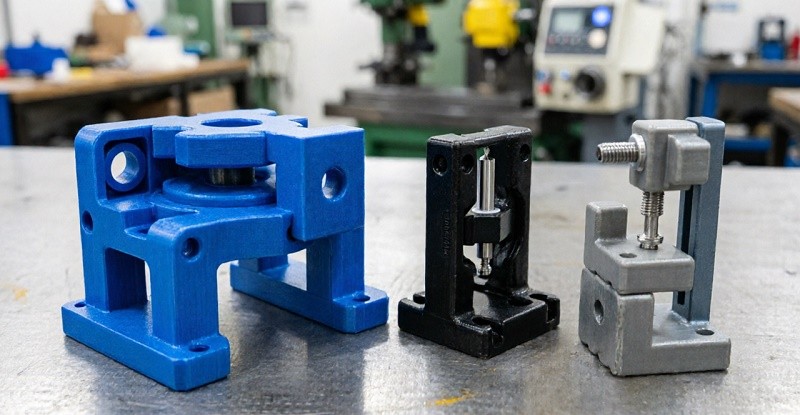
3D printed jigs, fixtures, and other manufacturing aids can dramatically reduce costs and lead times compared to traditional tooling methods.
Creating Hybrid Products by Mixing Different Manufacturing Techniques
Hybrid manufacturing represents a more advanced integration, where both additive and subtractive processes are used to create a single, optimized part. This approach harnesses the unique capabilities of each method to achieve results that neither could accomplish alone. A common workflow involves:
- Adding Material: A part is first 3D printed to its "near-net shape," efficiently creating complex internal features like cooling channels or lightweight lattice structures that are impossible to machine.
- Removing Material: The part is then moved to a CNC machine for finishing. The subtractive process is used to machine critical surfaces, threads, and holes to achieve the tight tolerances and smooth surface finishes required for high-performance applications.
This hybrid process combines the geometric freedom of 3D printing with the precision of CNC machining, creating components that are both highly complex and exceptionally accurate. Some advanced systems even integrate both additive (e.g., Directed Energy Deposition) and subtractive capabilities into a single machine, streamlining the process even further.
Driving Sustainability and Constant Innovation with Wholesale 3D Printed Parts
Beyond immediate production benefits, integrating 3D printing is a strategic move towards a more sustainable and adaptable manufacturing future. It encourages a circular economy through material innovation and enables a culture of continuous improvement through the power of digital design.
Exploring Eco-Friendly Materials and Recycling Methods for 3D Printing
Sustainability is no longer an afterthought in manufacturing; it is a core business imperative. Additive manufacturing contributes to a more eco-friendly production model in several ways:
- Material Efficiency: As an additive process, 3D printing inherently produces far less waste than subtractive methods.
- Biodegradable Polymers: The development of biodegradable materials, such as Polylactic Acid (PLA) derived from renewable resources like corn starch, offers a more environmentally friendly option for certain applications. Research is also expanding into other bio-based polymers like PHA (Polyhydroxyalkanoates), which can biodegrade more rapidly.
- Recycling and Reuse: In industrial processes, recycling is key. For metal powder bed fusion, unused powder in a build can be sieved and reused for subsequent prints. For plastics, efforts are growing to create filaments and powders from recycled sources, such as PET bottles or other industrial plastic waste, supporting a more circular economy.
While challenges in material degradation and process complexity remain, the push toward sustainable materials and robust recycling workflows is a significant and growing trend in the industry.
Embracing Digital Design for Continuous Improvements and Adaptability
At its core, 3D printing is a digitally native technology. This fundamental characteristic is what drives its power for continuous innovation and adaptability.
- Generative Design and AI: AI-driven tools like generative design and topology optimization are revolutionizing the engineering process. Instead of manually designing a part, engineers can input performance criteria (like loads, constraints, and weight targets) and allow AI algorithms to generate hundreds or even thousands of optimized design options. This accelerates innovation by exploring solutions that a human designer might never conceive.
- The Digital Twin: A part's digital file can evolve into a "digital twin"—a virtual replica of the physical object that is updated throughout its lifecycle. This digital record can be used to simulate performance, predict maintenance needs, and inform the design of future iterations. By connecting the digital model to real-world performance data, companies can create a closed-loop feedback system for continuous product improvement.
This digital workflow means that design improvements can be implemented instantly, without the need for costly and time-consuming re-tooling. By simply updating a CAD file, a better, more efficient version of a part can be produced on-demand, fostering a culture of constant, agile improvement.
Conclusion
In closing, wholesale 3D printed parts represent not just a fleeting trend but a fundamental and enduring shift in how industries can approach production. This technology offers a powerful toolkit for overcoming traditional manufacturing barriers, enabling unparalleled design freedom, significant cost and waste reduction, and the creation of more resilient, localized supply chains.
By thoroughly understanding the unique advantages of additive manufacturing and carefully planning its implementation—from material selection and DfAM to choosing the right a partner—businesses can unlock new, transformative levels of efficiency, flexibility, and sustainability. The journey into wholesale 3D printing is more than a process change; it's about fostering a mindset of continuous improvement and digital adaptability.
Embracing this technology today means positioning your business for a more agile, innovative, and competitive future in manufacturing. We encourage you to explore how these principles can be applied to your own operations. Share this guide with your team, start a conversation, and take the first step towards reinventing your production workflow. The future of manufacturing is here, and it's being built one layer at a time.