A Beginner's Guide to CNC Machining Services for Precision Parts
I'm here to guide you through the exciting world of CNC machining services, especially how they create precision parts. In today's manufacturing landscape, the demand for components with exacting specifications is paramount, and this is precisely where CNC machining excels. It is a sophisticated manufacturing process that employs computer-controlled machines to cut, shape, and create parts from raw materials with astounding accuracy. This technology transforms simple blocks of metal or plastic into complex, functional components that power our world.
This guide will serve as your introduction to the fundamentals of CNC machining. We will explore its core processes, such as milling and turning, and uncover why it has become a transformative force in industries ranging from aerospace and automotive to medicine and electronics. Furthermore, we'll delve into the significant benefits, the wide array of materials that can be used, and the essential criteria to consider when selecting a top-tier CNC Milling Parts Manufacturer. By the end, you'll have a clear understanding of how this technology brings precision-engineered designs to life.
What Exactly Is CNC Machining and Why It Matters to a CNC Milling Parts Manufacturer
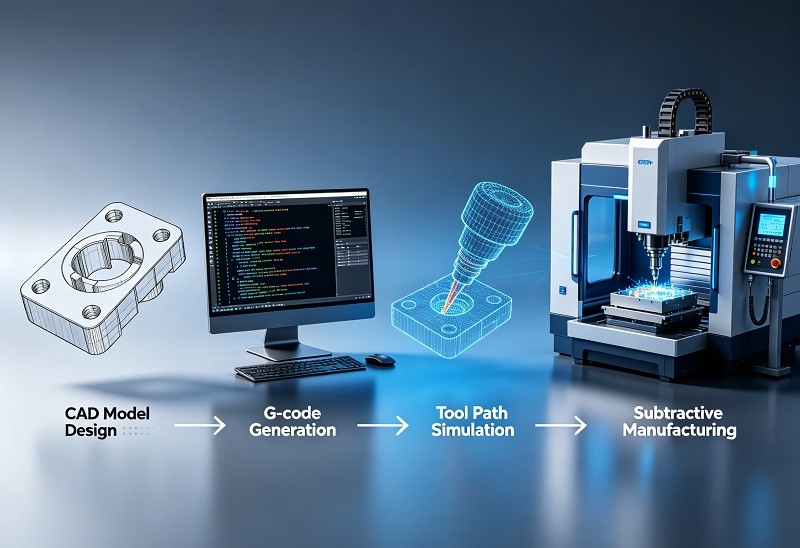
CNC (Computer Numerical Control) machining is a cornerstone of modern manufacturing, representing a significant leap from traditional, manual methods. It is a subtractive manufacturing process, which means it selectively removes material from a solid block (the workpiece) to achieve a final, desired shape. The entire operation is directed by a pre-programmed computer script, which allows for a level of precision, complexity, and repeatability that is simply unattainable by human hands alone. For any company identifying as an expert CNC Milling Parts Manufacturer, a deep understanding and mastery of this technology are non-negotiable, as it forms the very foundation of their ability to deliver high-quality, consistent components.
Understanding the Basics of Computer Numerical Control (CNC)
At its heart, CNC technology is the automation of machine tools through computer programming. Instead of an operator manually turning cranks, pushing levers, and making precise measurements on the fly, a computer program dictates every movement and action of the machine. This foundational shift from manual to automated control is what unlocks the immense capabilities of CNC machining, making it an indispensable tool for producing everything from simple brackets to highly complex turbine blades.
How CNC Machines Work: The Role of Computerized Control
The operation of a CNC machine begins with a digital design, typically a 2D or 3D Computer-Aided Design (CAD) file. This digital blueprint is then converted into a specific set of instructions for the machine through Computer-Aided Manufacturing (CAM) software. These instructions are written in a programming language called G-code, which directs the machine's movements, and M-code, which controls auxiliary functions like coolant flow and tool changes.
The G-code tells the cutting tool exactly where to move along the X, Y, and Z axes, its speed, and its feed rate. The machine's controller reads this code and translates it into electrical signals that power motors and drive components, moving the cutting tool or the workpiece with microscopic precision. This closed-loop system continuously monitors the machine's position and speed, making real-time adjustments to ensure the final part perfectly matches the original CAD model. This level of automation and precision control is what allows for the creation of intricate and identical parts, a critical function for any serious manufacturer.
Comparing CNC with Traditional Machining Methods
The evolution from traditional, or conventional, machining to CNC represents a paradigm shift in manufacturing. Traditional methods rely entirely on the skill and constant attention of a human operator who manually controls the machine tools. While this approach can produce high-quality parts, it has several inherent limitations when compared to its computerized counterpart.
| Feature | Traditional Machining | CNC Machining |
|---|---|---|
| Control | Fully manual; relies on operator skill and experience. | Automated; controlled by a computer program (G-code). |
| Precision | Dependent on the operator; prone to human error. | Extremely high and consistent; can achieve very tight tolerances. |
| Repeatability | Low; each part is unique and may have slight variations. | High; can produce thousands of identical parts with minimal deviation. |
| Complexity | Limited; difficult to create complex geometries and intricate shapes. | High; excels at producing complex and organic shapes from a digital file. |
| Labor | Labor-intensive; requires constant operator supervision for each machine. | Less labor-intensive; one operator can often oversee multiple machines. |
| Speed | Slower, especially for complex parts, due to manual adjustments. | Much faster, as machines can run continuously and at optimized speeds. |
| Setup Time | Shorter for a single, simple part. | Longer initial setup for programming, but much faster for production runs. |
While traditional machining still has its place for one-off custom jobs or simple repairs, CNC machining is the undisputed leader for production environments where precision, consistency, and efficiency are critical. The automation provided by CNC reduces the chance of human error, increases production speed, and allows for the creation of parts with a level of complexity that would be impractical or impossible to achieve manually.
The Pillars of Precision: Accuracy and Repeatability
In the world of precision manufacturing, two concepts are paramount: accuracy and repeatability. Accuracy refers to how closely a machined part conforms to the dimensions specified in its design blueprint. Repeatability, on the other hand, is the ability of a machine to consistently produce parts with the same dimensions over and over again, across an entire production run. CNC machining excels at both, which is why it has become the standard for industries where even the slightest deviation can have significant consequences.
Achieving Micro-level Tolerances with CNC
A "tolerance" is the acceptable range of variation in a part's dimension. For example, a shaft designed to be 10mm in diameter might have a tolerance of ±0.01mm, meaning any shaft between 9.99mm and 10.01mm is acceptable. CNC machines are renowned for their ability to achieve incredibly tight tolerances, often measured in microns (one-thousandth of a millimeter).
This capability is a direct result of the computerized control system. Factors that can affect tolerance, such as tool wear, temperature variations, and material inconsistencies, are meticulously managed. Advanced CNC systems use probes and sensors to measure the part in-process and automatically adjust the cutting path to compensate for any deviations. This ensures that every feature is machined with exceptional accuracy, meeting the stringent requirements of medical implants, aerospace components, and high-performance engine parts.
Ensuring Consistent Quality Across Batches for Any CNC Milling Parts Manufacturer
For a CNC Milling Parts Manufacturer, producing a single perfect part is not enough; they must be able to deliver hundreds or thousands of identical parts, all meeting the same high-quality standards. This is where the repeatability of CNC machining truly shines. Once a program is created and verified, the CNC machine can execute it endlessly with virtually no deviation.
Unlike manual machining, where operator fatigue or slight differences in technique can lead to variations between parts, automation eliminates this inconsistency. The machine performs the exact same sequence of movements for every single workpiece. This process is further supported by robust quality control systems that use automated inspection tools like Coordinate Measuring Machines (CMMs) to verify the dimensions of parts from a production run. This combination of automated production and rigorous inspection guarantees a consistent level of quality across entire batches, providing customers with the confidence that every part they receive is a perfect match to the approved design.
The Core Advantages of Partnering with an Expert CNC Milling Parts Manufacturer
Choosing to work with an expert CNC milling parts manufacturer offers a multitude of strategic advantages that go far beyond simply acquiring a finished component. It unlocks new potentials in design, streamlines production workflows, and ultimately provides a competitive edge in the market. The benefits are seen in enhanced product performance, reduced time to market, and improved cost-effectiveness, making it a critical partnership for innovative companies across all sectors.
Unlocking Design Freedom and Complexity
One of the most transformative benefits of CNC machining is the incredible level of design freedom it offers. Engineers and designers are no longer constrained by the limitations of traditional manufacturing methods, which often struggled with complex curves, intricate internal features, and unconventional geometries. CNC technology turns these complex digital designs into tangible, functional parts with precision and ease.
Crafting Intricate Geometries and Designs
CNC machines, particularly advanced 5-axis systems, can manipulate a cutting tool or workpiece along multiple axes simultaneously. This capability allows them to create complex contours, undercuts, and multifaceted surfaces in a single setup. What might have required multiple machines and complex fixturing with traditional methods can be accomplished efficiently on one machine. This opens the door to designing parts that are optimized for performance, weight, and aesthetics, rather than being compromised by manufacturing limitations. Industries like aerospace rely on this to create lightweight yet strong components with complex aerodynamic shapes.
Flexibility for Customization and Prototyping
The digital nature of CNC machining makes it exceptionally well-suited for both rapid prototyping and custom manufacturing. A design can be modified in CAD software, and a new G-code program can be generated in a matter of hours. This agility allows companies to quickly produce physical prototypes to test form, fit, and function before committing to a full production run, a process known as rapid prototyping. It significantly accelerates the development cycle and reduces the risk of costly design flaws. Furthermore, this same flexibility makes it economically viable to produce small batches of custom parts or even one-off components, catering to specialized applications and personalized products.
Efficiency, Speed, and Cost-Effectiveness
In today's fast-paced market, efficiency is key to staying competitive. CNC machining introduces a level of automation that streamlines production, reduces lead times, and can lead to significant cost savings, especially for medium to high-volume production runs.
Reduced Production Times and Waste
CNC machines are designed for continuous, high-speed operation. They can run 24/7 with minimal human oversight, drastically increasing output compared to manual methods. The subtractive process is also highly optimized by CAM software to create the most efficient toolpaths, minimizing cutting time and motion. This optimization also extends to material usage. By nesting parts tightly on a sheet of raw material or using advanced toolpaths, CNC machining can significantly reduce the amount of scrap material produced, leading to both cost savings and more sustainable manufacturing practices.
Labor Savings Through Automation
The automation inherent in CNC machining directly translates to reduced labor costs. In a traditional machine shop, one skilled operator is typically dedicated to one machine. In a CNC environment, a single operator can often set up and supervise multiple machines simultaneously. Their role shifts from manual operation to process monitoring, quality control, and programming. This not only makes the manufacturing process more cost-effective but also reduces the potential for human error, further enhancing consistency and quality.
Material Versatility and Structural Integrity
The physical properties of a part are just as important as its dimensions. CNC machining is compatible with a vast array of materials and, because it is a subtractive process that works from a solid block, it maintains the material's inherent strength and structural integrity.
Working with a Wide Range of Materials
CNC machines can be equipped with different cutting tools, speeds, and feeds to effectively shape a huge spectrum of materials. This versatility allows manufacturers to select the perfect material for any given application based on its required properties, such as strength, weight, hardness, chemical resistance, or electrical conductivity. Common materials include:
- Metals: Aluminum alloys, various steels (stainless, carbon, alloy), titanium, brass, copper, and exotic alloys.
- Plastics: ABS, Polycarbonate, Nylon, Acrylic (PMMA), PEEK, and Delrin.
- Composites: Carbon fiber, fiberglass, and other reinforced polymers.
- Wood and Foam: For modeling, prototyping, and specific design applications.
Ensuring High Strength and Durability
Unlike additive manufacturing (3D printing), which builds parts layer by layer and can sometimes create weak points between layers, CNC machining starts with a solid, forged, or extruded block of material. The process of carving away material does not introduce internal stresses or alter the material's grain structure in a negative way. As a result, CNC machined parts retain the full strength, hardness, and durability of the raw material from which they were made. This makes CNC machining the preferred method for producing critical, load-bearing components where structural integrity and reliability are absolutely essential.
Exploring Key CNC Machining Processes Offered by a Comprehensive CNC Milling Parts Manufacturer
Within the broad category of CNC machining, there are several distinct processes, each suited to creating different types of geometries. A truly comprehensive CNC Milling Parts Manufacturer will have expertise and equipment for multiple processes, allowing them to produce a wide variety of components. The most common of these are CNC milling and CNC turning, often complemented by other specialized processes like drilling and grinding.
CNC Milling: The Workhorse of Complex Shapes
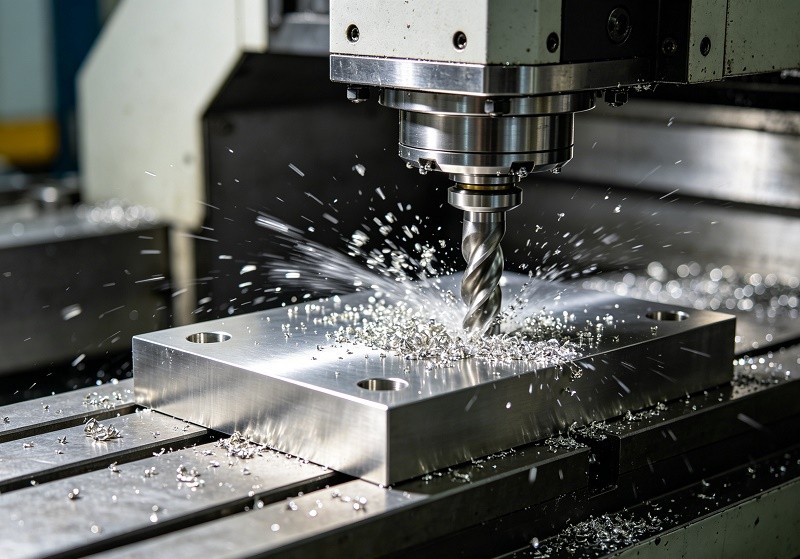
CNC milling is arguably the most common and versatile CNC machining process. It is used to create flat and contoured surfaces, slots, pockets, and complex 3D shapes. In this process, the workpiece is typically held stationary on a machine bed while a rotating multi-point cutting tool moves around it to remove material.
How CNC Milling Shapes Materials
In a CNC milling machine, the cutting tool, which looks similar to a drill bit but is designed to cut along its sides as well as its tip, spins at high speed. A computer program directs either the tool or the workpiece (or both) to move along multiple axes, typically X, Y, and Z. As the rotating tool comes into contact with the workpiece, its sharp flutes chip away material to create the desired shape. Advanced multi-axis machines, such as 5-axis mills, can move the tool and the workpiece in five different directions simultaneously. This allows them to create extremely complex geometries, such as turbine blades or orthopedic implants, in a single operation.
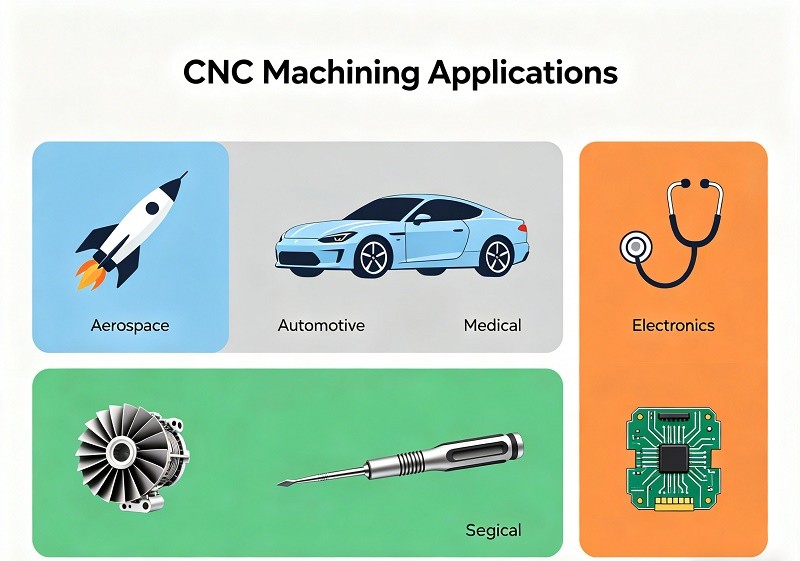
Applications of CNC Milling, from Automotive to Aerospace
The versatility of CNC milling makes it indispensable across nearly every manufacturing sector. Its ability to produce both simple and highly complex parts with precision makes it suitable for a vast range of applications.
- Aerospace: Manufacturing of structural components, engine parts, and complex brackets from high-strength aluminum and titanium alloys.
- Automotive: Production of engine blocks, transmission components, suspension parts, and molds for casting other parts.
- Medical: Creation of custom surgical instruments, orthopedic implants (like knee and hip joints), and components for medical devices.
- Electronics: Machining of enclosures, heat sinks, and custom connectors that require precision and a good surface finish.
- Prototyping: Rapidly creating functional prototypes for design validation across all industries.
CNC Turning: Perfecting Cylindrical Components
While milling excels at complex shapes, CNC turning is the go-to process for creating parts with cylindrical or conical features. In turning, the workpiece rotates at high speed while a stationary single-point cutting tool moves along its surface to remove material.
The Mechanics of CNC Turning
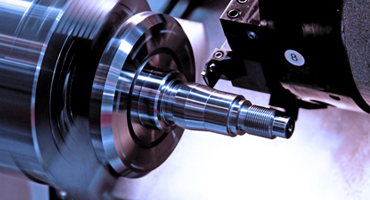
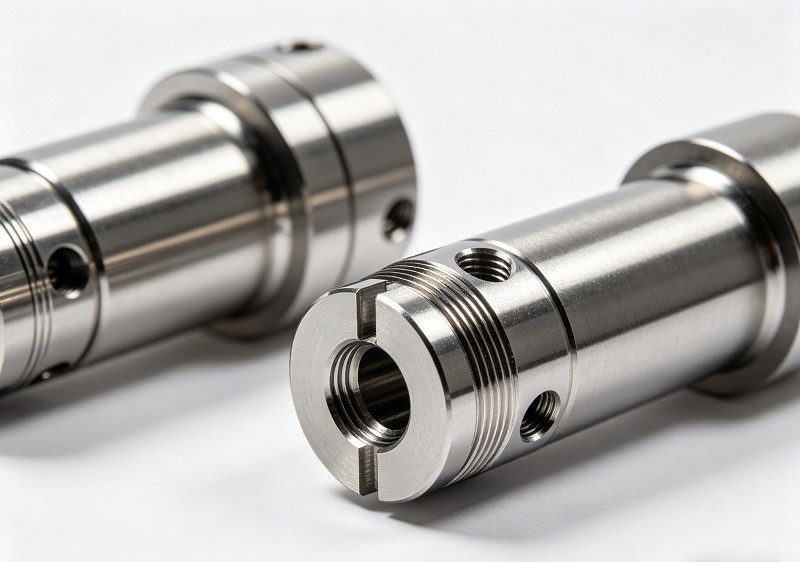
In a CNC lathe, the modern machine used for turning, a block of raw material (the "blank") is clamped in a chuck and rotated rapidly. A computer-controlled cutting tool is then fed into the rotating workpiece. By moving the tool along the length of the workpiece (the Z-axis) and in and out (the X-axis), the machine can create a variety of features, including cylindrical steps, tapers, contours, threads, and grooves. Live-tooling lathes can even incorporate secondary milling or drilling operations, allowing for the creation of more complex rotational parts in a single setup.
Producing Precision Shafts, Pins, and Bushings
CNC turning is ideal for producing any component that is symmetrical around a central axis. This makes it the perfect method for manufacturing parts that are essential in virtually all types of machinery and mechanical assemblies. Common examples include:
- Shafts: For transmitting power in motors and gearboxes.
- Pins and Dowels: Used for alignment and fastening components together.
- Bushings and Bearings: To reduce friction and support rotating shafts.
- Screws, Bolts, and Nozzles: Any part that requires precise external or internal threads.
- Flanges and Fittings: Used in piping and fluid systems.
The high precision and excellent surface finishes achievable with CNC turning make it essential for creating these components, which often require tight tolerances to ensure proper fit and function.
Other Important CNC Processes: Drilling and Hybrid Machining
Beyond milling and turning, several other CNC processes are crucial for a full-service manufacturing partner.
CNC Drilling: While basic drilling can be done on mills and lathes, dedicated CNC drilling machines are used to create, size, and finish holes with high accuracy. It's a fundamental process for creating mounting points, fluid passages, and clearance holes. The CNC control ensures holes are placed with perfect accuracy and drilled to a precise depth.
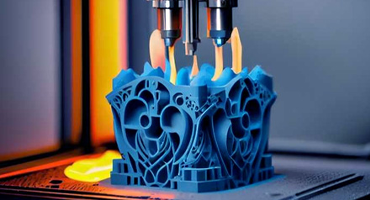
Hybrid Machining: This represents the cutting edge of manufacturing, combining CNC subtractive processes with additive manufacturing (3D printing) in a single machine. For example, a machine might 3D print a metal feature and then use a milling tool to machine its critical surfaces to a tight tolerance, all in one setup. This allows for the creation of parts with complex internal structures (from additive) and high-precision external surfaces (from subtractive), opening up entirely new design possibilities.
Common Materials and Finishes Utilized by an Advanced CNC Milling Parts Manufacturer
The final performance, appearance, and longevity of a machined part depend heavily on two factors: the raw material it is made from and the surface finish applied to it. An experienced CNC Milling Parts Manufacturer will offer a wide selection of both, along with the expertise to help you choose the best combination for your specific application. This allows for a high degree of customization to meet functional requirements like strength, corrosion resistance, and aesthetics.
A Spectrum of Materials for Diverse Applications
The choice of material is a critical design decision driven by factors such as mechanical stress, operating environment, weight requirements, and cost. CNC machining's versatility allows it to work with a vast range of metals, plastics, and composites, each offering a unique set of properties.
Metals: Aluminum, Steel, Titanium, and More
Metals are by far the most common materials used in CNC machining due to their strength, durability, and thermal stability. Different metals and their alloys are chosen for specific benefits:
- Aluminum Alloys (e.g., 6061, 7075): Prized for their excellent strength-to-weight ratio, corrosion resistance, and machinability. 6061 is a versatile general-purpose alloy, while 7075 offers much higher strength, making it ideal for aerospace and high-stress applications.
- Stainless Steel (e.g., 303, 304, 316): Known for high strength, hardness, and exceptional corrosion resistance. 304 is a common choice for food and medical equipment, while 316 offers superior resistance to chlorides, making it suitable for marine environments.
- Carbon and Alloy Steels: Offer a wide range of hardness and strength properties that can be further enhanced through heat treatment. They are used for tools, gears, and structural components.
- Titanium: Offers a strength-to-weight ratio superior to both aluminum and steel, along with extreme temperature and corrosion resistance. These properties make it essential for aerospace, military, and medical implant applications, despite its higher cost and difficulty to machine.
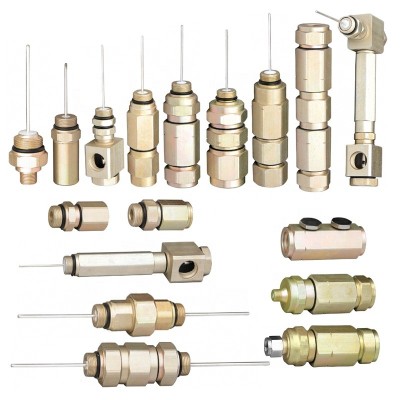
- Brass and Copper: Chosen for their excellent electrical conductivity and corrosion resistance. Brass is often used for fittings and connectors, while copper is used for electrical components and heat exchangers.
Plastics and Composites: Expanding Possibilities
Plastics offer a lightweight, corrosion-resistant, and often more cost-effective alternative to metals for certain applications. They are valued for their electrical insulating properties and chemical resistance.
- ABS (Acrylonitrile Butadiene Styrene): A common, tough, and impact-resistant thermoplastic used for enclosures, prototypes, and consumer products.
- Nylon: Offers excellent wear resistance and a low coefficient of friction, making it ideal for gears, bearings, and wear pads.
- Polycarbonate: A transparent plastic with outstanding impact strength, used for protective guards, lenses, and durable housings.
- PEEK (Polyether Ether Ketone): A high-performance thermoplastic with exceptional mechanical strength, chemical resistance, and stability at high temperatures. It is often used as a metal replacement in demanding medical, aerospace, and chemical processing applications.
- Composites (e.g., Carbon Fiber): Machined for applications requiring the absolute highest strength-to-weight ratio, such as in high-performance motorsports and aerospace structures.
Surface Finishes: Enhancing Performance and Aesthetics
A surface finish is a secondary process applied after machining to alter the part's surface. This can be done to improve its appearance, increase its hardness, enhance its corrosion resistance, or change its texture.
Anodizing, Powder Coating, and Electroplating
These finishes add a protective and often decorative layer to the surface of the part.
- Anodizing: An electrochemical process primarily used for aluminum that creates a hard, durable, and corrosion-resistant oxide layer on the surface. This layer can be dyed in various colors, making it popular for both protective and aesthetic purposes.
- Powder Coating: A dry powder is applied to the part and then cured with heat to form a hard, durable finish that is tougher than conventional paint. It provides excellent protection against scratches, chemicals, and weathering.
- Electroplating: A process that uses an electric current to deposit a thin layer of one metal onto another. This is done for decorative purposes (e.g., chrome plating), to improve corrosion resistance (e.g., zinc or nickel plating), or to enhance conductivity (e.g., gold or silver plating).
Polishing, Sandblasting, and Chemical Treatments
These finishes modify the existing surface of the part rather than adding a new layer.
- Polishing: A mechanical process that smooths the surface to create a mirror-like, reflective finish. This is often done for aesthetic reasons or to create a smooth, easily cleanable surface for food or medical applications.
- Sandblasting (Bead Blasting): Involves propelling a stream of abrasive media (like glass beads or sand) against the surface. It creates a uniform matte or satin finish, removes tool marks, and can prepare the surface for painting or coating.
- Chemical Treatments (e.g., Passivation): Passivation is a chemical process used on stainless steel to remove free iron from the surface and form a passive oxide layer that enhances its natural corrosion resistance. Alodine or chem-film is a similar conversion coating used on aluminum to provide corrosion resistance and act as a primer for paint.
Choosing the Right CNC Milling Parts Manufacturer: What to Look For
Selecting the right manufacturing partner is one of the most critical decisions you will make in bringing a product to market. The quality of your parts, the reliability of your supply chain, and even the success of your project can depend on this choice. A top-tier CNC Milling Parts Manufacturer is more than just a vendor; they are a partner who provides technical expertise, ensures quality, and communicates effectively. Here are the key factors to evaluate.
Technical Capabilities and Equipment
The manufacturer's equipment and technical expertise directly determine the complexity, precision, and quality of the parts they can produce. Look for a partner who has invested in modern, high-performance technology and has the experience to leverage it effectively.
Advanced Multi-Axis Machines and Tooling
The type of CNC machines a shop possesses is a primary indicator of its capabilities.
- 3-Axis vs. 5-Axis: While 3-axis machines are suitable for simpler parts, 5-axis machines can create highly complex geometries in a single setup. This reduces setup time, increases accuracy, and allows for the production of parts that would otherwise be impossible. A manufacturer with 5-axis capabilities is better equipped for intricate aerospace, medical, or automotive components.
- Tooling and Automation: An advanced shop will have a large library of high-quality cutting tools for various materials and operations. Look for evidence of automation, such as robotic loaders or pallet changers, which indicate a focus on efficiency and consistency for higher volume production.
Experience with Challenging Materials
Machining standard aluminum is one thing; machining hardened tool steel, titanium, or high-performance plastics like PEEK is another. Each material has unique properties and requires specific knowledge regarding cutting speeds, feeds, tools, and coolants. Inquire about the manufacturer's experience with the specific material you plan to use. A partner who has a proven track record with challenging materials is far more likely to produce your parts successfully and efficiently.
Quality Control and Certifications
A commitment to quality should be evident in every aspect of a manufacturer's operations. This is verified through robust processes and adherence to internationally recognized standards.
Adherence to Industry Standards (e.g., ISO, AS9100)
Certifications are a formal, third-party validation of a company's quality management system.
- ISO 9001: This is the international standard for a quality management system. It ensures the company has documented processes for everything from quoting to shipping, with a focus on continual improvement and customer satisfaction. It is the baseline certification for any reputable manufacturer.
- AS9100: This standard includes all the requirements of ISO 9001 but adds more stringent requirements specific to the aerospace industry, focusing on safety, reliability, and risk management. If you are in the aerospace, defense, or other high-stakes industries, an AS9100-certified partner is essential.
Robust Inspection and Verification Processes
A great manufacturer doesn't just make parts; they verify them. Look for a dedicated, climate-controlled quality lab with advanced inspection equipment. Key tools include:
- Coordinate Measuring Machines (CMMs): These machines use a probe to take highly accurate 3D measurements of a part, comparing them directly to the CAD model to ensure all dimensions are within tolerance.
- Optical Comparators and Vision Systems: Used for quick and accurate 2D measurements of profiles and features.
- Material and Finish Verification: Processes for verifying material composition (e.g., XRF analyzers) and finish thickness.
Ask about their standard inspection reports (e.g., First Article Inspection Reports or FAI) and their process for handling non-conforming parts.
Engineering Support and Communication
An ideal partner acts as an extension of your own engineering team, providing valuable feedback and maintaining clear communication throughout the project lifecycle.
Design for Manufacturability (DFM) Feedback
An experienced manufacturer can often spot ways to improve a design to make it easier, faster, and more cost-effective to machine, without compromising its function. This is known as Design for Manufacturability (DFM) feedback. A good partner will proactively suggest minor changes—like adjusting a fillet radius to match a standard tool size or modifying a deep pocket to improve tool access—that can result in significant cost and time savings.
Transparent Communication and Project Management
Clear, consistent communication is the bedrock of a successful partnership. Look for a manufacturer with a dedicated point of contact for your project, whether it's an engineer or a project manager. They should provide proactive updates on progress, immediately flag any potential issues, and be readily available to answer your questions. A transparent project management process, from initial quote to final delivery, builds trust and ensures there are no surprises.
Cost Considerations and Supply Chain Reliability
While price is always a factor, the lowest quote is not always the best value. True cost should be evaluated in the context of quality, reliability, and total cost of ownership. A cheap part that fails in the field or arrives late can cost far more in the long run. Look for a manufacturer who provides clear, detailed quotes that break down costs. Furthermore, assess their supply chain stability. Do they have reliable sources for raw materials? What are their typical lead times? A partner with a resilient supply chain and a proven record of on-time delivery is invaluable for keeping your own production lines running smoothly and meeting your market deadlines.
As we've seen, CNC machining is a powerful and versatile manufacturing method that delivers unparalleled precision, efficiency, and design flexibility. From the intricate components that power aerospace technology to the custom implants used in life-saving surgeries, its impact is undeniable. When you are in the market for a partner, it is crucial to look beyond the basics. Remember to consider their deep technical capabilities, their investment in advanced machinery, their unwavering commitment to quality control as proven by certifications like ISO 9001, and their dedication to proactive customer service and engineering support.
By choosing the right partner, you do more than just buy a part; you form a strategic alliance that empowers your entire project. A top-tier manufacturer will ensure your components benefit from the highest possible quality, optimized and efficient production processes, and dependable, on-time delivery. Ultimately, this partnership is what allows you to bring your most innovative and ambitious designs to life with the utmost confidence, turning digital concepts into tangible, high-performance realities. We encourage you to share this guide with colleagues and stakeholders to foster a deeper understanding of this critical manufacturing technology.