A Beginner's Guide to 3D Printing SLM Parts: Insights from Your Supplier
Welcome to our beginner's guide on 3D printing SLM parts! We are Somi Custom Parts, your trusted OEM supplier, and we're here to shed some light on Selective Laser Melting (SLM) technology. If you're curious about how precise metal parts are made for demanding applications like aerospace or medical devices, you're in the right place.
SLM 3D printing is a cutting-edge additive manufacturing method that allows us to create intricate metal components layer by layer, and it's transforming industries worldwide. Join us as we explore the fundamentals of SLM and how our expertise as a supplier of 3D Pringting SLM Parts can benefit you. We'll walk you through the process and highlight what makes SLM an exceptional manufacturing solution.
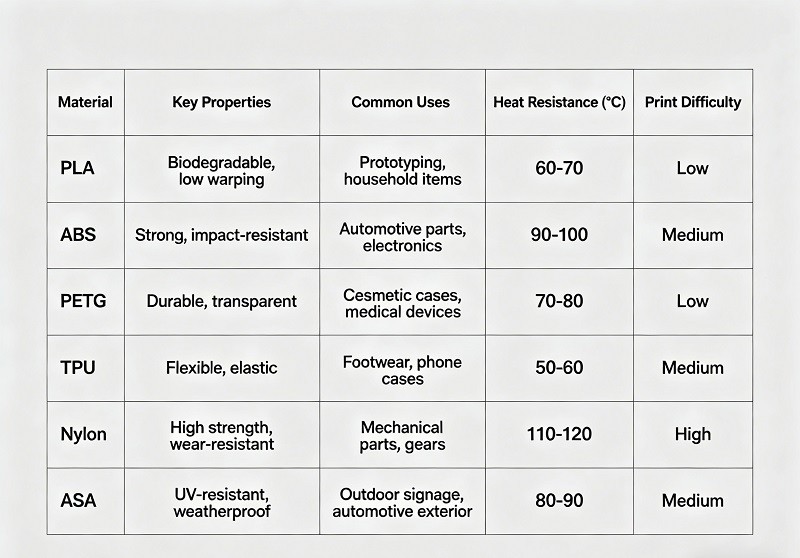
Understanding Selective Laser Melting (SLM) as a 3D Printing SLM Parts Supplier
Selective Laser Melting, a technology first developed in Germany in the mid-1990s, has rapidly become the most widely adopted method for metal additive manufacturing, accounting for about 80% of all metal 3D printers in use today. As your dedicated OEM partner, Somi Custom Parts harnesses this technology to deliver parts that meet the highest standards of quality and complexity. SLM is known by several names, including Direct Metal Laser Sintering (DMLS) or Laser Powder Bed Fusion (LPBF), but the core principle remains the same: building fully dense metal parts from fine powder. This process is renowned for its ability to produce components with mechanical properties that are often comparable or even superior to those made with traditional manufacturing.
What is SLM 3D Printing?
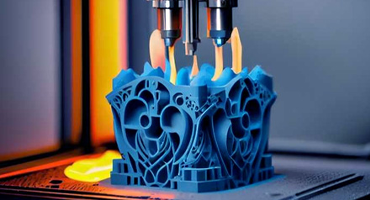
At its heart, SLM is a metal additive manufacturing process that uses a high-powered laser to build solid objects from a bed of metallic powder. Unlike processes that merely sinter particles together, SLM fully melts the metal powder, creating a strong, homogenous part with a density often exceeding 99.7%. This makes it the preferred technology for creating robust, functional parts for critical applications.
A Powder Bed Fusion Technology
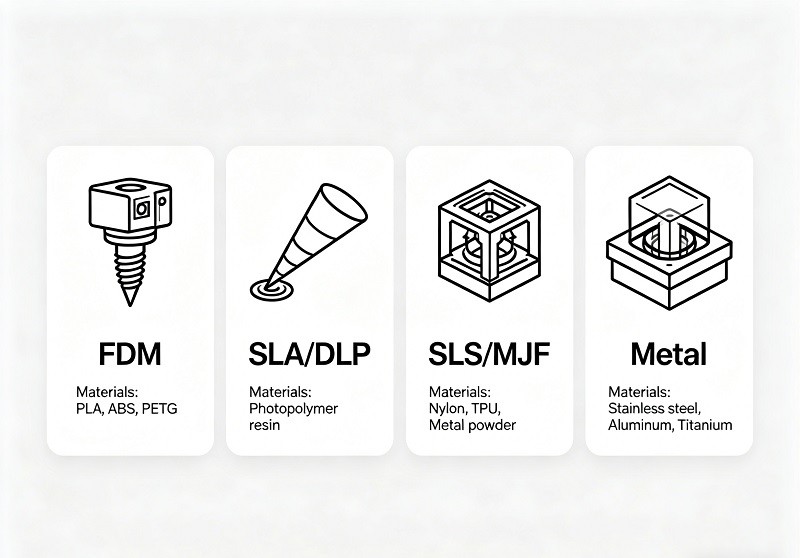
SLM belongs to the Laser Powder Bed Fusion (LPBF) family of AM technologies. The process takes place in a highly controlled environment, inside a build chamber filled with an inert gas like argon or nitrogen. This inert atmosphere is crucial as it prevents the hot metal from oxidizing, which would otherwise compromise the part's structural integrity and mechanical properties. The technology is distinct from Selective Laser Sintering (SLS), which is primarily used for polymers and sinters powder without full melting, whereas SLM is exclusively for metals and achieves a complete melt.
How the SLM Process Works
The journey from a digital file to a physical metal part is a meticulously controlled sequence. At Somi Custom Parts, we follow a rigorous process to ensure every component meets your specifications.
Here’s a step-by-step breakdown:
- Digital Model Preparation: The process begins with a 3D computer-aided design (CAD) model. This digital blueprint is then "sliced" into hundreds or thousands of ultra-thin layers, typically between 20 and 100 microns thick. This file dictates the precise path the laser will follow for each layer.
- Powder Bed Preparation: A recoating mechanism spreads a thin, uniform layer of fine metal powder across a build platform. The quality and consistency of this powder layer are critical for the final part's quality.
- Selective Melting: A high-power ytterbium fiber laser, guided by the sliced CAD data, scans the surface of the powder bed. The laser selectively melts and fuses the powder particles in the desired pattern for that specific layer.
- Layer-by-Layer Construction: After a layer is fused, the build platform lowers by the thickness of one layer, and the recoater applies a fresh layer of powder. The laser then melts the next cross-section, fusing it to the layer below.
- Part Completion and Cooling: This cycle repeats layer by layer until the entire part is formed. Once printing is complete, the finished part is encased in the surrounding un-melted powder and is left to cool within the machine.
- Post-Processing: The build chamber is opened, and the excess powder is carefully removed for reuse. The part, which is often attached to the build plate via support structures, then proceeds to post-processing. This can include stress relief, removal of supports, and surface finishing to achieve the final desired properties and tolerances.
Key Advantages of SLM for Your Projects, from Your 3D Printing SLM Parts Supplier
SLM isn't just another manufacturing method; it's a transformative technology that unlocks new possibilities for design and performance. It enables the production of parts that would be impossible or prohibitively expensive to create using traditional methods like CNC machining or casting.
Unmatched Design Freedom and Complexity
The most significant advantage of SLM is the immense design freedom it offers. Since parts are built layer by layer, designers can create incredibly complex geometries, including:
- Internal Channels and Conformal Cooling: Intricate internal channels can be designed directly into a part for optimized fluid flow or thermal management, a feat impossible with subtractive methods. This is revolutionary for applications like creating molds with conformal cooling channels or high-performance heat exchangers.
- Lattice Structures: SLM can produce parts with internal lattice structures, which dramatically reduce weight while maintaining structural integrity. This is a key reason for its adoption in the aerospace and medical implant industries, where high strength-to-weight ratios are critical.
- Part Consolidation: Multiple components of an assembly can be redesigned and printed as a single, complex part. This reduces assembly time, eliminates weak points like joints or welds, and often results in a lighter, stronger final product.
Creating High-Strength, Durable Metal Parts
SLM produces parts that are not just prototypes but fully functional, end-use components with excellent mechanical properties. The process of fully melting the metal powder results in parts with near-zero porosity, giving them strength, durability, and fatigue resistance that often meets or exceeds that of parts made by forging or casting.
The rapid heating and cooling cycles inherent to the SLM process create a very fine-grained microstructure within the material. This unique microstructure often results in superior mechanical properties. For example, stainless steel parts produced by SLM can exhibit higher ultimate tensile strength than their conventionally manufactured counterparts. Aluminum alloys, while challenging to process, can achieve high density and ultimate tensile strengths of around 400 MPa when manufactured with optimized SLM parameters. This makes SLM an ideal choice for high-performance applications where reliability under extreme conditions is paramount.
Factors Ensuring Accuracy in SLM 3D Printed Parts: Insights from Your 3D Printing SLM Parts Supplier
While SLM technology offers incredible design freedom, achieving high dimensional accuracy is a complex process. It requires a deep understanding of the interplay between machine, material, and design. At Somi Custom Parts, our expertise as an experienced supplier ensures that we manage these variables to deliver parts that meet your tightest tolerances. The general accuracy of SLM is notable, with standard tolerances often falling within ±0.1 mm to ±0.2% of the part dimension, but this is highly dependent on a range of factors.
Crucial Elements for Precision in SLM
Achieving a precise part is not as simple as pressing "print." It involves the careful calibration and control of numerous interconnected parameters throughout the manufacturing workflow.
The Role of Machine Precision and Advanced Laser Systems
The quality of the SLM machine itself is the foundation of accuracy. High-end industrial printers are equipped with advanced systems that are critical for precision:
- Laser System Quality: The laser's spot size (typically 70-100 µm), power stability, and beam quality directly impact the size of the melt pool and the fineness of the details that can be created. High-precision galvanometers—tiny, fast-moving mirrors—steer the laser beam with extreme accuracy, ensuring it melts the powder at the exact intended coordinates.
- Motion Control and Layer Thickness: The mechanical precision of the build platform's z-axis movement and the recoater mechanism determines the consistency of each powder layer. Layer thicknesses typically range from 20 to 60 micrometers, and maintaining this consistency is vital for vertical accuracy. Any deviation can compound over hundreds or thousands of layers, leading to significant error.
Impact of Material Properties and Design Complexity
The material used and the part's geometry introduce another layer of complexity.
- Material Properties: Different metal powders have unique thermal properties, such as thermal conductivity and shrinkage rates upon cooling. For instance, titanium's low thermal conductivity allows for sharp details, but it can also lead to high residual stress. The powder's particle size, shape, and flowability also affect how uniformly the powder bed is spread, influencing the final part's density and surface quality.
- Design Complexity: Intricate designs with features like thin walls, overhangs, and internal channels are more challenging to print accurately. Overhanging features inclined at angles less than 45 degrees typically require support structures to anchor them to the build plate and dissipate heat, preventing distortion and collapse. The design and placement of these supports are critical, as their removal can impact the final surface finish and accuracy.
The Influence of Post-Processing Techniques
A part that comes out of an SLM printer is rarely ready for use. Post-processing is a mandatory and critical stage that significantly influences the final dimensions and properties of the component.
- Heat Treatment (Stress Relief): The rapid heating and cooling during the SLM process create significant internal stresses within the part. If these stresses are not relieved through a controlled heat treatment process (like annealing), the part can warp or crack, especially after being removed from the build plate. This thermal treatment is arguably the most crucial post-processing step for ensuring dimensional stability.
- Support Removal: Supports must be carefully removed, often using manual or mechanical methods like cutting, grinding, or wire EDM. This process must be done carefully to avoid damaging the part's surface.
- Surface Finishing: The "as-built" surface of an SLM part has a characteristic roughness due to the layered nature of its creation. Techniques like sandblasting, tumbling, polishing, or even CNC machining can be used to achieve the required surface smoothness (Ra) for a specific application. For example, post-machining can improve a rough as-built finish to a very smooth one, suitable for high-performance interfaces.
Measuring and Achieving Dimensional Accuracy
As a quality-focused 3D Pringting SLM Parts supplier, Somi Custom Parts employs a rigorous quality control framework to verify and guarantee the precision of every component we produce.
Understanding Dimensional Tolerance and Surface Roughness
Two key metrics define the accuracy of an SLM part:
- Dimensional Tolerance: This measures how closely the final part's dimensions match the original CAD model. While a well-calibrated SLM machine can achieve tolerances of ±0.05 mm on small features, a more common industry standard is around ±0.1 mm or ±0.2% for larger dimensions. It’s important to recognize that SLM is a "near-net-shape" process, meaning that for features requiring exceptionally high precision (like bearing fits), post-machining is often necessary.
- Surface Roughness (Ra): This quantifies the fine-scale texture of a part's surface. The as-printed surface roughness of SLM parts can be relatively high but can be significantly improved through post-processing. For example, grinding and polishing can achieve a very smooth finish required for seals or low-friction surfaces.
| Parameter | Typical As-Printed Value | Post-Processed Potential | Importance |
|---|---|---|---|
| Dimensional Tolerance | ±0.1 mm to ±0.2% | Down to ±0.01 - 0.02 mm (with machining) | Crucial for fit, form, and function of assemblies. |
| Surface Roughness (Ra) | 6-15 µm | < 1 µm | Affects friction, wear, fatigue life, and fluid dynamics. |
| Minimum Wall Thickness | ~0.5 mm | N/A | Defines the limit for creating thin, delicate features. |
| Minimum Hole Diameter | ~0.5 mm | N/A | Small holes may fuse shut during printing due to heat bleed. |
Our Quality Control and Expertise as a 3D Printing SLM Parts Supplier
At Somi Custom Parts, ensuring accuracy is not an afterthought; it is integrated into every step of our OEM service.
- Design for Additive Manufacturing (DfAM) Review: Our engineers work with you to optimize your design for the SLM process, identifying potential issues with overhangs, wall thicknesses, and internal stresses before printing begins.
- Process Parameter Optimization: We have developed optimized parameter sets for a wide range of materials, controlling factors like laser power, scan speed, and layer thickness to maximize accuracy and part quality.
- In-Process Monitoring: Our advanced SLM machines are equipped with real-time monitoring systems that track the melt pool and thermal conditions during the build, allowing for immediate adjustments to prevent defects.
- Comprehensive Inspection: After post-processing, every part undergoes a rigorous quality inspection using high-precision tools, including CMMs (Coordinate Measuring Machines) and 3D scanners, to verify that all dimensions are within the specified tolerances. For critical components, we can also perform non-destructive testing (NDT) to ensure internal integrity.
Real-World Applications and How Your 3D Printing SLM Parts Supplier Delivers
The unique advantages of Selective Laser Melting—namely the ability to create complex, strong, and lightweight metal parts—have made it an indispensable technology in many of the world's most demanding industries. As your OEM partner, Somi Custom Parts is proud to supply high-precision components that drive innovation in these critical sectors.
SLM in Demanding Industries
From the skies to the operating room, SLM is enabling the creation of parts that were previously impossible to manufacture.
Aerospace: Lightweight and High-Performance Components
The aerospace industry was an early adopter of SLM, driven by the constant need to reduce weight and improve performance. Lighter aircraft are more fuel-efficient, have a longer range, and can carry a greater payload. SLM contributes to this by:
- Producing Lightweight Brackets and Structures: By using topology optimization and lattice structures, engineers can design structural components that are significantly lighter than their traditionally machined counterparts without sacrificing strength.
- Manufacturing Complex Engine Parts: SLM is used to create components like turbine blades and fuel nozzles with intricate internal cooling channels. These optimized designs improve thermal efficiency, leading to better engine performance and durability under extreme temperatures. Materials like Titanium alloys (e.g., Ti-6Al-4V) and Nickel-based superalloys (e.g., Inconel) are commonly used for their high strength-to-weight ratio and temperature resistance.
Automotive: From Prototypes to Production
In the automotive sector, SLM is accelerating innovation from the design studio to the production line. It allows for rapid iteration and the creation of high-performance parts.
- Rapid Prototyping and Tooling: SLM enables the quick production of functional metal prototypes for testing, drastically shortening development cycles. It is also used to create custom jigs, fixtures, and even molds with conformal cooling channels, which can improve the efficiency and quality of other manufacturing processes like injection molding.
- High-Performance and Custom Components: In motorsports and high-end automotive, SLM is used to produce lightweight components for chassis, suspension, and powertrains. It also opens the door for on-demand production of customized parts, from unique exhaust components to personalized interior trim, meeting the growing demand for vehicle personalization.
Medical: Patient-Specific Implants and Tools
SLM has revolutionized the medical field by enabling a new era of personalized medicine. Its ability to create biocompatible parts tailored to an individual's anatomy has led to better patient outcomes and faster recovery times.
- Custom Orthopedic Implants: Using data from a patient's CT or MRI scan, surgeons can design and print patient-specific implants for knees, hips, and spinal applications. SLM can create porous lattice structures on the surface of titanium implants that mimic natural bone, promoting osseointegration—where the patient's bone grows into the implant, creating a stronger, more lasting bond.
- Surgical Tools and Guides: The technology is also used to produce complex, highly precise surgical instruments and patient-specific surgical guides. These guides help surgeons perform procedures with greater accuracy, reducing surgery time and improving results. Biocompatible materials like titanium alloys and stainless steel are standard for these applications.
How We Ensure High Accuracy as Your Preferred 3D Printing SLM Parts Supplier
At Somi Custom Parts, our commitment to quality and precision is unwavering. We have built our OEM services around a foundation of cutting-edge technology and deep expertise to ensure we deliver superior parts every time.
Cutting-Edge SLM Machines and Experienced Engineers
Our factory is equipped with the latest generation of SLM machines featuring multi-laser systems and advanced process controls, enabling higher productivity and precision. However, the best equipment is only as effective as the team operating it. Our engineers are experts in Design for Additive Manufacturing (DfAM), material science, and post-processing. They work closely with you to translate your designs into high-quality, functional metal parts, ensuring that every aspect of the process is optimized for success.
Comprehensive Quality Control and Real-time Monitoring
Our quality assurance process is rigorous and multi-faceted. It begins with stringent inspection of incoming metal powders and extends through every stage of production.
- Real-Time Process Monitoring: Advanced sensors within our SLM systems monitor the build process in real time, tracking variables like melt pool temperature and layer uniformity. This allows for live feedback and adjustments to prevent defects before they occur.
- Meticulous Post-Processing: We follow a strict, documented workflow for post-processing, including scientifically developed heat treatment cycles to relieve residual stress and ensure dimensional stability.
- Final Inspection and Validation: Before shipping, every part is subjected to a final quality inspection using state-of-the-art metrology equipment. We verify all critical dimensions against your CAD model and provide detailed inspection reports, giving you complete confidence in the parts you receive. This ensures we consistently deliver the accuracy and reliability required for the most critical applications.
Conclusion: Partnering with Somi Custom Parts for Your SLM Needs
In summary, Selective Laser Melting offers incredible possibilities for creating complex, strong, and precise metal parts. It has moved far beyond a prototyping technology to become a mainstream solution for producing end-use components in the most demanding industries. As your dedicated OEM supplier, Somi Custom Parts combines advanced technology with deep engineering expertise to meet your most challenging project requirements.
We hope this guide has given you a clearer understanding of SLM technology, from its core process and key advantages to the critical factors that ensure accuracy. We are committed to providing high-quality, accurate SLM 3D printed parts and invite you to connect with us to discuss how we can bring your designs to life. Our goal is to leverage our capabilities to help you innovate and succeed.
Ready to explore the benefits of SLM for your next project? Reach out to us, your trusted supplier of 3D Pringting SLM Parts, and let's build the future together. Share this article with your colleagues and let's start a conversation about what's possible with additive manufacturing.